
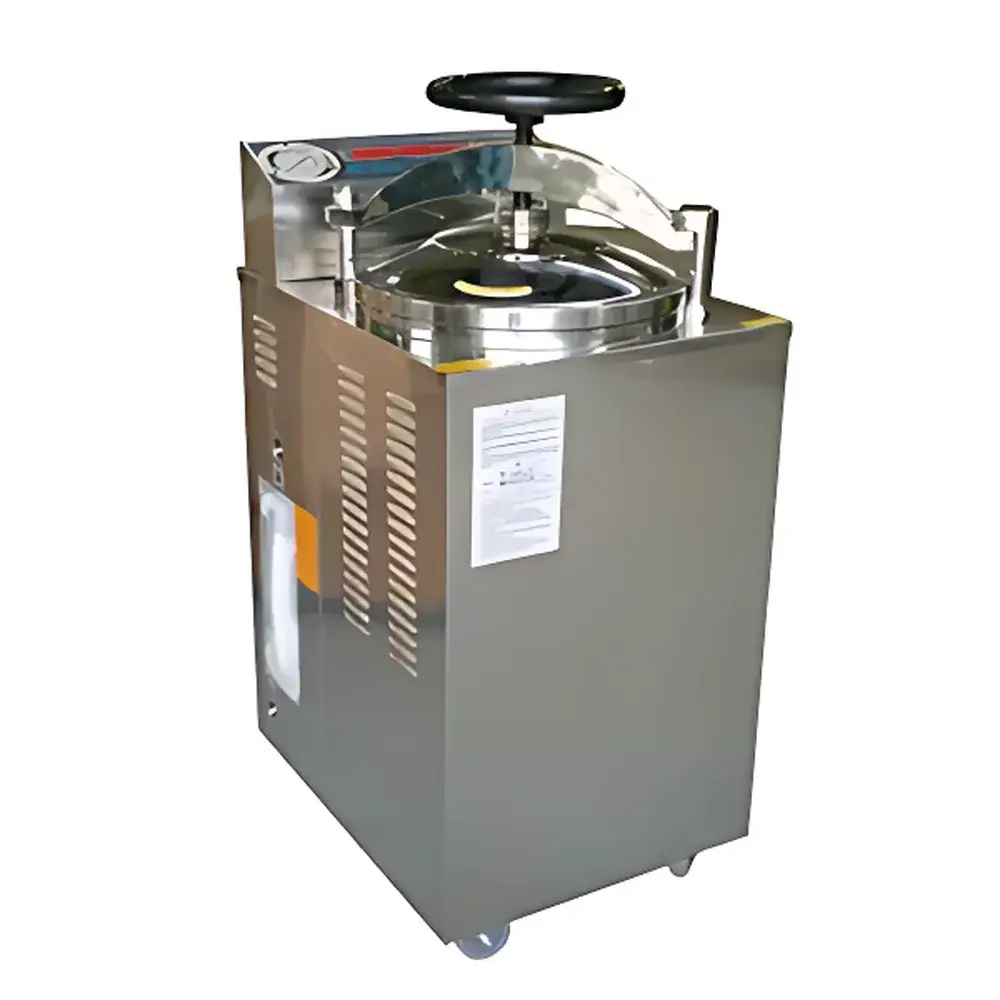
BOXUN YXQ-75G Vertical Steam Sterilizer
| Brand | BOXUN |
|---|---|
| Origin | Shanghai, China |
| Model | YXQ-75G |
| Instrument Type | Vertical |
| Max Temperature | 135 °C |
| Max Pressure | 0.22 MPa |
| Chamber Dimensions | Ø400 mm × 720 mm |
| Chamber Volume | 75 L |
| External Dimensions | 485 mm × 605 mm × 1190 mm |
| Sterilization Power | 3.5 kW |
| Drying Power | 0.8 kW |
| Voltage/Frequency | 220 V ±10%, 50 Hz ±2% |
| Design Temp/Pressure | 138 °C / 0.25 MPa |
| Sterilization Timer | 4–120 min |
| Drying Timer | 30–240 min |
| Basket Size | Ø360 mm × 280 mm × 2 units |
| Safety Features | Automatic cold-air purge, self-sealing gasket, overpressure relief, low-water alarm, dry-run protection, dual-limit temperature cutoff, interlocked handwheel door |
Overview
The BOXUN YXQ-75G Vertical Steam Sterilizer is a fully automated, gravity-displacement-type autoclave engineered for reliable saturated steam sterilization in laboratory, clinical, and research environments. Operating on the principle of moist heat sterilization—where microbial inactivation is achieved through irreversible denaturation of proteins and nucleic acids—the unit delivers validated lethality (F0) across defined load configurations at temperatures up to 135 °C and pressures up to 0.22 MPa. Its 75-liter stainless steel chamber (SUS304) supports routine sterilization of wrapped instruments, unwrapped tools, glassware, textile packs, culture media, and aqueous solutions. Designed to meet fundamental requirements of ISO 17665-1 (Sterilization of health care products — Moist heat — Part 1: Requirements for the development, validation and routine control of a sterilization process for medical devices), the YXQ-75G incorporates fail-safe mechanical and electronic safeguards to ensure operator safety and process integrity during every cycle.
Key Features
- Vertical orientation with space-efficient footprint (485 mm × 605 mm base) optimized for benchtop or floor-mounted installation in constrained lab spaces
- Microprocessor-based control system with real-time monitoring of chamber temperature, pressure, and elapsed time; intuitive LED interface with cycle status feedback
- Interlocked handwheel door mechanism featuring automatic pressure-release before unlocking—compliant with ASME PVHO-1 and EN 285 safety principles
- Self-expanding silicone gasket ensuring hermetic seal integrity across repeated thermal cycles without manual torque adjustment
- Dual-stage safety architecture: primary overtemperature cutoff at 138 °C (design limit), secondary thermal fuse at 150 °C; mechanical pressure relief valve set at 0.25 MPa
- Integrated cold-air purge function to evacuate non-condensable gases prior to sterilization phase—critical for achieving uniform steam penetration
- Three-phase programmable cycle logic: (a) sterilize-only; (b) sterilize + exhaust; (c) sterilize + exhaust + drain + drying—enabling flexible workflow integration
- Automatic water replenishment and heating sequence with low-water level detection and dry-run shutdown to prevent heater damage
Sample Compatibility & Compliance
The YXQ-75G accommodates a broad range of sterilizable loads, including but not limited to surgical instruments, Petri dishes, pipette tips, cotton gauze, saline solutions, agar media, and buffered reagents. Load configuration must adhere to ISO 11140-1 guidelines for pack density and air removal efficiency. The chamber’s cylindrical geometry (Ø400 mm × 720 mm) and dual-tier stainless steel baskets (Ø360 mm × 280 mm each) support vertical stacking while maintaining adequate steam circulation. All wetted components—including inner chamber, door liner, and basket—utilize AISI 304 stainless steel, certified per ASTM A240 for corrosion resistance in chloride-rich or alkaline cleaning environments. The sterilizer complies with GB 8599–2008 (Chinese national standard for large steam sterilizers) and incorporates design elements aligned with EN 61010-1 (safety requirements for electrical equipment) and EN 61326-1 (EMC for laboratory instrumentation).
Software & Data Management
While the YXQ-75G operates via embedded firmware without cloud connectivity, its control module logs critical cycle parameters—including start time, peak temperature, holding time, final pressure, and completion status—in non-volatile memory (retention ≥10 years). Optional RS232 or USB interfaces enable direct data export to external PCs for audit trail generation. When paired with optional thermal printer (sold separately), the unit produces hard-copy records compliant with GLP documentation requirements, including date/time stamps, operator ID fields, and cycle deviation flags. All sterilization cycles satisfy basic traceability prerequisites under FDA 21 CFR Part 11 when used with controlled access protocols and handwritten logbook supplementation.
Applications
- Routine decontamination of reusable surgical and dental instruments in university teaching hospitals and outpatient clinics
- Preparation of sterile culture media and buffers in microbiology, molecular biology, and cell culture laboratories
- Validation of sterilization efficacy for quality control labs performing bioburden reduction studies per ISO 11737-1
- Processing of animal husbandry equipment and veterinary supplies requiring terminal sterilization
- Supporting Good Manufacturing Practice (GMP) workflows where documented thermal lethality is required for raw material preparation
- Education and training platforms for sterilization science in biomedical engineering and pharmaceutical technology curricula
FAQ
What sterilization standards does the YXQ-75G conform to?
It meets GB 8599–2008 and incorporates functional safety features consistent with ISO 17665-1 and EN 285 principles for steam sterilization process validation.
Can the unit sterilize liquids in sealed containers?
No—this model is not designed for liquid-cycle sterilization with slow-cool ramping; use only for solid or porous loads and open-top liquid vessels with appropriate venting.
Is validation support documentation provided?
Factory-supplied IQ/OQ templates are available upon request; PQ execution requires user-defined biological indicators (e.g., Geobacillus stearothermophilus spores) and calibrated thermocouples.
What maintenance intervals are recommended?
Daily: chamber wipe-down and gasket inspection; quarterly: safety valve testing and pressure transducer calibration; annually: full performance verification per manufacturer’s service protocol.
Does the unit support remote monitoring?
Not natively—however, analog output signals (0–5 V or 4–20 mA) for temperature and pressure can be interfaced with third-party SCADA systems using optional signal converters.



