
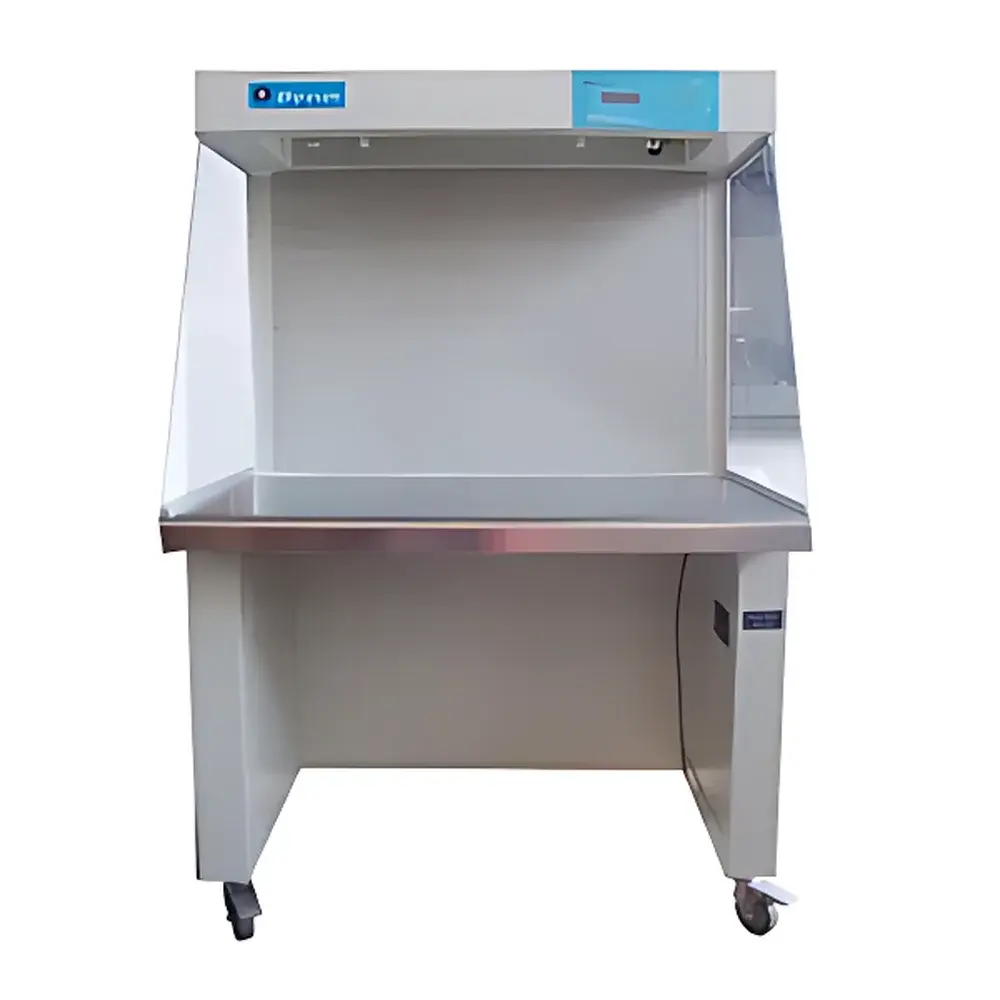
BOXUN SW-CJ-1BU Horizontal Laminar Flow Clean Bench
| Brand | BOXUN |
|---|---|
| Origin | Shanghai, China |
| Manufacturer Type | Authorized Distributor |
| Product Category | Domestic |
| Model | SW-CJ-1BU |
| Instrument Type | Horizontal Laminar Flow Clean Bench |
| Cleanliness Class | ISO Class 5 (100-level, ≥99.99% filtration efficiency for particles ≥0.5 µm) |
| Noise Level | ≤67 dB(A) |
| User Capacity | Single-user, single-face configuration |
| Airflow Pattern | Horizontal unidirectional laminar flow |
| Working Surface Air Velocity Range | 0.3–0.6 m/s (adjustable in six discrete steps) |
| Vibration Peak-to-Peak Amplitude | ≤5 µm (X/Y/Z axes) |
| Illumination | ≥300 lux |
| Work Area Dimensions (W×D×H) | 910 × 480 × 570 mm |
| Overall Dimensions (W×D×H) | 910 × 790 × 1380 mm |
| HEPA Filter Specification | 815 × 575 × 50 mm (single unit) |
| Pre-filter | Medium-efficiency panel filter |
| Lighting | 20 W fluorescent lamp (1 unit) |
| UV Germicidal Lamp | 20 W (1 unit, timer-controlled: 0–999 min) |
| Construction Materials | Cold-rolled steel housing with epoxy powder coating |
| Power Supply | AC 220 V ±10%, 50/60 Hz |
| Rated Power | 0.15 kW |
| Net Weight | 110 kg |
Overview
The BOXUN SW-CJ-1BU Horizontal Laminar Flow Clean Bench is an ISO Class 5-certified local containment system engineered to deliver a continuous, particle-free working environment for non-hazardous applications requiring microbiological or particulate control. Unlike vertical flow hoods that direct air downward toward the operator, this unit employs a horizontal laminar airflow principle—air is drawn through a pre-filter and then forced uniformly across the work surface via a centrifugal blower, passing through a certified HEPA filter (≥99.99% efficiency at 0.5 µm) before exiting parallel to the work plane. This configuration minimizes turbulence and cross-contamination risk within the sterile field, making it ideal for aseptic handling of cell cultures, media preparation, semiconductor component assembly, and precision optical alignment where operator-generated particles must be excluded from the critical zone.
Key Features
- Robust structural architecture: Cold-rolled steel enclosure with electrostatic epoxy powder coating ensures long-term corrosion resistance and mechanical stability; SUS304 brushed stainless steel work surface provides chemical inertness, ease of decontamination, and compliance with GLP cleaning validation protocols.
- Optimized airflow management: Six-step microswitch-controlled fan speed regulation enables precise adjustment of face velocity (0.3–0.6 m/s), supporting method-specific requirements such as low-velocity handling of sensitive biological specimens or higher-velocity operation for rapid particle clearance.
- Dual independent lighting system: A 20 W fluorescent lamp delivers ≥300 lux illumination across the full work area, meeting ISO 14644-1 ambient lighting recommendations; a separate 20 W UV-C germicidal lamp (254 nm) features programmable timing (0–999 minutes) for validated surface decontamination cycles prior to operation.
- Human-centered ergonomics: Full-width horizontal sliding sash offers unobstructed access while maintaining laminar integrity; tempered organic glass side panels provide optical clarity, impact resistance, and structural rigidity without compromising light transmission or introducing static charge.
- Integrated vibration mitigation: Mechanical isolation design limits transmitted vibration to ≤5 µm peak-to-peak amplitude across all three orthogonal axes—critical for micro-manipulation tasks and optical instrumentation integration.
Sample Compatibility & Compliance
The SW-CJ-1BU is intended for use with non-volatile, non-toxic, and non-aerosol-generating materials. It is not suitable for handling biohazards (BSL-2+ agents), volatile organic compounds, or radioactive isotopes. Its design conforms to ISO 14644-1:2015 (Cleanrooms and associated controlled environments) for airborne particulate cleanliness classification and supports adherence to USP environmental monitoring expectations for non-sterile compounding and aseptic processing support zones. The HEPA filter complies with EN 1822-1:2019 (H14 grade) and undergoes DOP/PAO challenge testing during factory certification. All electrical components meet IEC 61010-1 safety standards for laboratory equipment.
Software & Data Management
This clean bench operates via a dedicated embedded LCD controller with tactile membrane switches—no external software or PC interface is required. All operational parameters (fan speed, UV timer, lighting status) are locally monitored and logged in non-volatile memory for audit trail purposes. While the unit does not feature network connectivity or electronic data export, its timer-based UV sterilization cycle supports documented GxP practices when integrated into lab SOPs. Routine maintenance records—including HEPA filter replacement dates, pre-filter cleaning logs, and annual airflow verification reports—can be maintained manually per ISO 14644-3:2019 recommendations.
Applications
- Aseptic preparation of microbial culture media, plant tissue culture substrates, and cell line passaging in academic and industrial life science laboratories.
- Assembly and inspection of microelectronic components, MEMS devices, and photonic modules where sub-micron particulate exclusion is essential.
- Environmental sample preparation for PCR, ELISA, and chromatographic analysis to prevent false positives from ambient contamination.
- Calibration and alignment of high-resolution optical instruments including interferometers, confocal microscopes, and laser spectroscopy platforms.
- Quality control staging for pharmaceutical excipient handling and non-sterile dosage form development under ISO Class 5 background conditions.
FAQ
What ISO cleanliness class does the SW-CJ-1BU achieve?
It meets ISO Class 5 (formerly Federal Standard 209E Class 100), verified by particle counting per ISO 14644-1 using ≥0.5 µm probe sensitivity.
Can this unit be used for handling pathogenic microorganisms?
No. As a non-recirculating horizontal flow bench with no negative pressure containment or exhaust ducting, it provides personnel protection only—not product or environmental protection against biohazards.
How often should the HEPA filter be replaced?
Under typical usage (8 hrs/day, moderate ambient dust load), replacement is recommended every 18–24 months, contingent upon differential pressure monitoring and upstream pre-filter maintenance.
Is the UV lamp intensity validated?
Yes—each unit ships with a factory-issued UV irradiance certificate (measured at 1 m distance, 254 nm wavelength) traceable to NIM (National Institute of Metrology, China).
Does the unit comply with FDA 21 CFR Part 11 requirements?
No—this is a standalone electromechanical device without electronic record generation, user authentication, or audit trail functionality. It may be operated within Part 11-compliant workflows when paired with external documentation systems.



