
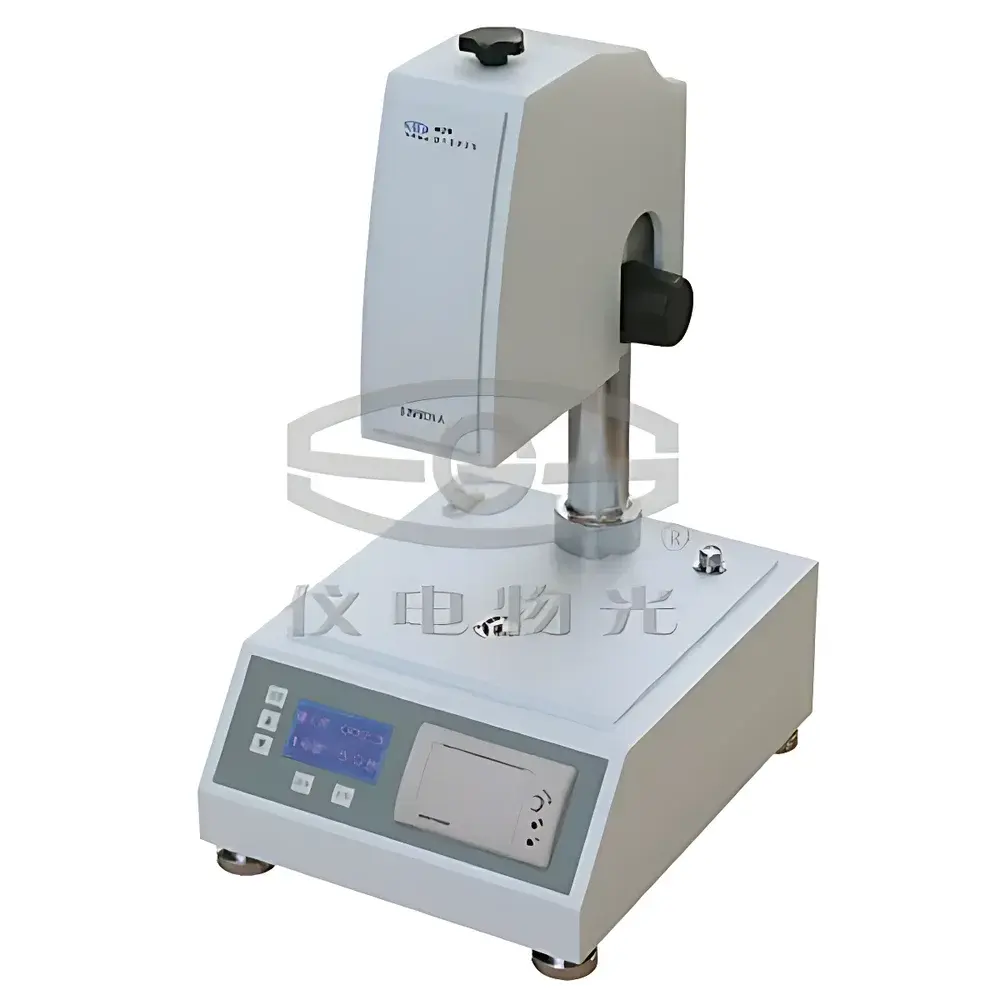
YDWG WZR Penetrometer
| Brand | YDWG |
|---|---|
| Origin | Shanghai, China |
| Manufacturer Type | Authorized Distributor |
| Country of Origin | China |
| Model | WZR |
| Pricing | Upon Request |
| Measurement Range | 0–50 mm (0–500 penetration units) |
| Minimum Resolution | 0.01 mm (equivalent to 0.1 penetration unit) |
| Displacement Sensor Resolution | 0.01 mm |
| Standard Cone Assembly Mass | 150.0 g ± 0.1 g (cone body: 114.44 g ± 0.07 g) |
| Timing Range | 1.0–9.9 s (adjustable in 0.1 s increments) |
| Interface | RS-232 serial port |
| Printer | Built-in RMD III 32PHR-410 thermal microprinter |
| Display | LCD panel |
| Power Supply | 220 V ± 22 V, 50 Hz ± 1 Hz, 30 W |
| Dimensions (W × D × H) | 340 × 280 × 600 mm |
| Net Weight | 16 kg |
| Compliance | GB/T 269–1991, Chinese Pharmacopoeia (ChP) General Chapter 0902 |
Overview
The YDWG WZR Penetrometer is a precision mechanical instrument engineered for the standardized measurement of consistency in semi-solid materials—primarily lubricating greases, petroleum jellies, pharmaceutical ointments, and topical formulations. It operates on the fundamental principle of static cone penetration: a standardized conical probe (150 g total mass, 30° apex angle, 1.0 mm tip diameter) is allowed to descend under gravity into a conditioned sample for a defined time interval (typically 5.0 s, per GB/T 269–1991 and ChP 0902). The depth of penetration—measured in tenths of a millimeter (0.1 mm = 1 penetration unit)—serves as a direct, reproducible index of material resistance to deformation. This method is rooted in empirical rheology and remains the globally accepted benchmark for quality control and batch release in industries where consistency directly correlates with performance, stability, and patient safety.
Key Features
- High-resolution linear displacement sensor (0.01 mm resolution) ensures traceable, repeatable depth measurements across the full 0–50 mm range (0–500 penetration units).
- Calibrated cone assembly with certified mass: total 150.0 g ± 0.1 g (cone body 114.44 g ± 0.07 g), compliant with ISO 2137 and ASTM D217 dimensional and mass tolerances.
- Programmable timing module with 0.1 s resolution (1.0–9.9 s), enabling method flexibility for non-standard protocols or research applications.
- Integrated LCD interface with real-time display of penetration depth, elapsed time, and test count—no external software required for basic operation.
- Built-in thermal microprinter (RMD III 32PHR-410) provides immediate hard-copy reporting with date/time stamp, sample ID field, and statistical summary (mean, SD, CV%) for up to 99 tests.
- RS-232 serial interface supports bidirectional communication with laboratory PCs for automated data logging, LIMS integration, and long-term trending analysis.
- Robust cast-aluminum base and vertical column architecture minimizes vibration-induced error and ensures long-term mechanical stability under routine QC use.
Sample Compatibility & Compliance
The WZR Penetrometer accommodates standard 115 mm × 65 mm cylindrical metal or glass sample cups (as specified in GB/T 269–1991 and ASTM D217). Sample temperature control is performed externally using calibrated water baths or environmental chambers (25 °C ± 0.5 °C standard). The instrument meets the geometric and metrological requirements of national and international standards including GB/T 269–1991, ASTM D217, ISO 2137, and Chinese Pharmacopoeia General Chapter 0902. Its design supports GLP-compliant workflows: all test parameters (time, temperature, cone mass verification records) are manually documented or electronically captured via PC interface, enabling full audit trails when paired with validated data acquisition software.
Software & Data Management
While fully functional as a standalone instrument, the WZR supports optional Windows-based data management software via RS-232. This application enables automated test sequencing, customizable report templates (PDF/CSV export), statistical process control (SPC) charting, and user-access-level controls (operator, supervisor, administrator). Data files include embedded metadata: operator ID, sample lot number, ambient temperature/humidity, calibration certificate IDs, and timestamped raw penetration values. When deployed in regulated environments (e.g., pharmaceutical manufacturing), the software can be configured to meet FDA 21 CFR Part 11 requirements—including electronic signatures, audit trail logging, and data integrity safeguards—subject to site-specific validation protocols.
Applications
- Quality assurance of lithium-based, calcium-sulfonate, and polyurea greases during production and incoming inspection.
- Batch-to-batch consistency testing of petrolatum, white ointment USP, and hydrophilic ointment NF formulations.
- R&D evaluation of thickener concentration effects on semi-solid rheology in cosmetic and dermal delivery systems.
- Stability studies tracking consistency drift over accelerated aging (e.g., 40 °C/75% RH for 3 months).
- Supplier qualification and technical specification verification against contractual penetration limits (e.g., NLGI grade classification).
- Regulatory submission support for topical drug products requiring ChP or ICH Q5C rheological characterization.
FAQ
What is the difference between penetration depth (mm) and penetration number (units)?
Penetration depth is measured in millimeters (mm); the penetration number (or “penetration unit”) is defined as 10 × depth in mm—thus 25.3 mm = 253 penetration units. This scaling convention simplifies reporting and aligns with historical industry practice.
Can the WZR be used for non-lubricant materials such as food gels or adhesives?
Yes—provided the material exhibits sufficient structural integrity to support the cone without extrusion or wall effects, and its yield behavior falls within the 0–500 unit range. Validation per ASTM D1091 or internal method suitability protocols is recommended.
Is periodic calibration of the displacement sensor required?
Yes. YDWG recommends annual traceable calibration using NIST-traceable gauge blocks or certified depth standards, documented per ISO/IEC 17025 requirements for accredited labs.
Does the instrument comply with ISO/IEC 17025 documentation requirements?
The hardware and firmware support essential elements—unique test ID generation, parameter logging, and uneditable raw data export—enabling compliance when integrated into a validated laboratory quality system.
How is cone mass verified during routine operation?
A certified analytical balance (±0.01 g readability) must be used to verify total cone assembly mass before each shift or daily, per GB/T 269–1991 Section 5.2. Records must be retained for audit purposes.





