
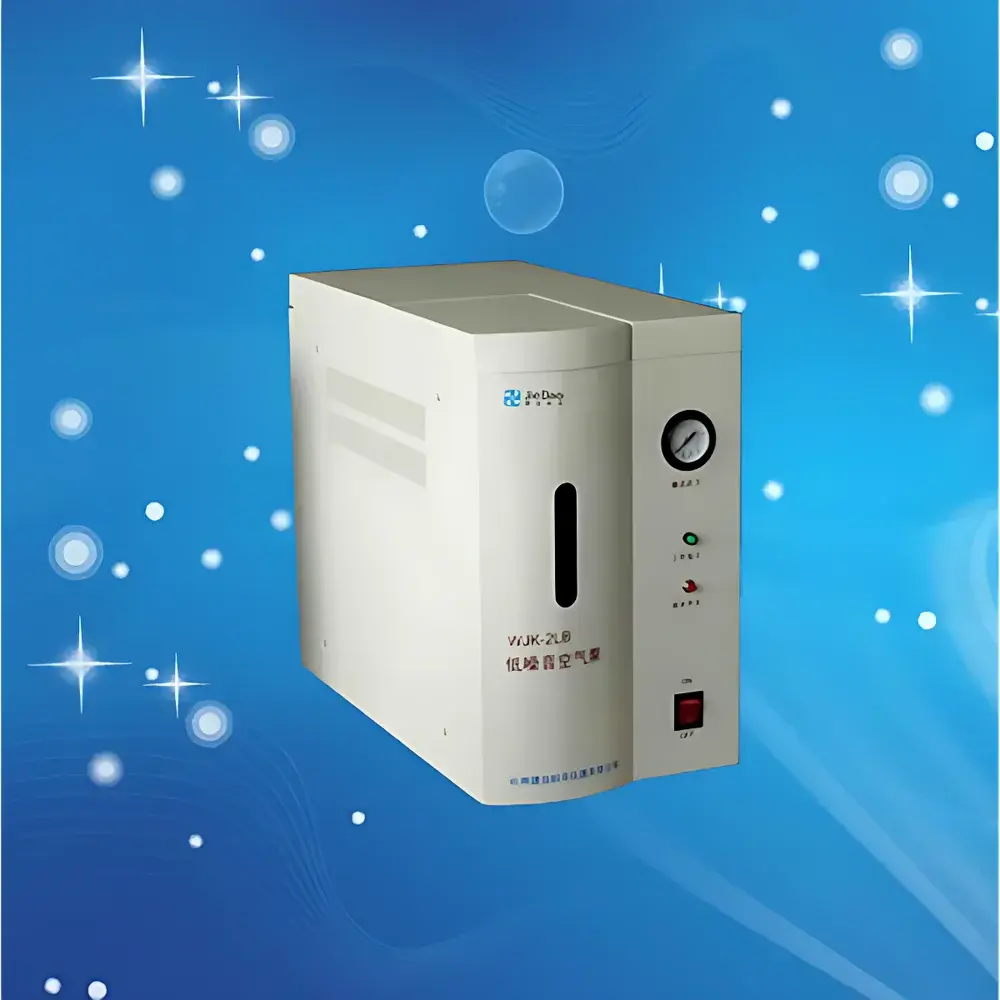
Jiedao/Kexiao WJK-2LB & WJK-5LB High-Purity Air Generators for GC Applications
| Brand | Jiedao/Kexiao |
|---|---|
| Model | WJK-2LB, WJK-5LB |
| Output Flow | 0–2000 mL/min (WJK-2LB), 0–5000 mL/min (WJK-5LB) |
| Output Pressure | 0–0.4 MPa |
| Noise Level | ≤42 dB(A) |
| Power Consumption | ≤150 W |
| Dimensions (L×W×H) | 390 × 210 × 340 mm |
| Weight | 25 kg |
| Operating Temperature | 5–40 °C |
| Relative Humidity | <85% RH |
| Power Supply | AC 220 V ±10%, 50 Hz |
Overview
The Jiedao/Kexiao WJK-2LB and WJK-5LB High-Purity Air Generators are engineered for continuous, reliable supply of instrument-grade compressed air in analytical laboratories—specifically optimized as dedicated air sources for gas chromatography (GC) systems, including flame ionization detectors (FID), nitrogen-phosphorus detectors (NPD), and thermal conductivity detectors (TCD). These generators operate on a closed-loop, oil-free compression principle using high-efficiency rocking-piston compressors, eliminating contamination risks associated with lubricated alternatives. Ambient air is drawn through multi-stage particulate and coalescing pre-filters, compressed to ~0.7 MPa, stored in an integrated pressure vessel, and subsequently conditioned via precision pressure regulation, catalytic hydrocarbon removal, desiccant-based drying, and final sub-micron filtration. The resulting output meets stringent GC air specifications: hydrocarbon content <0.1 ppm (as methane equivalent), dew point ≤−40 °C at operating pressure, and particulate load <0.01 µm. Unlike cylinder-based supply, these units eliminate logistical overhead, pressure fluctuations, and safety hazards related to high-pressure gas storage.
Key Features
- Oil-free rocking-piston compressor technology ensures zero hydrocarbon carryover and long-term reliability without scheduled oil changes
- Dual-stage purification architecture: catalytic oxidation of residual hydrocarbons followed by regenerative desiccant drying for consistent dew point control
- Integrated pressure stabilization system maintains output pressure within ±0.01 MPa across full flow range, critical for detector stability
- Intelligent microprocessor controller with real-time monitoring of inlet pressure, outlet pressure, temperature, and system status
- Automatic start/stop logic triggered by downstream pressure demand; built-in thermal overload and low-oil-level (if applicable) protection circuits
- Ultra-low acoustic signature (≤42 dB[A]) enables benchtop deployment in noise-sensitive environments including open-plan labs and QC suites
- Compact footprint (390 × 210 × 340 mm) and lightweight design (25 kg) facilitate integration beneath fume hoods or adjacent to GC workstations
Sample Compatibility & Compliance
These air generators are validated for compatibility with all major GC platforms—including Agilent, Thermo Fisher Scientific, Shimadzu, and PerkinElmer—and support both single- and multi-detector configurations requiring parallel air streams. The purified air stream complies with ASTM D6299 (standard practice for laboratory quality control) and ISO 8573-1:2010 Class 2:2:2 for particulates, water, and oil content. While not certified to ISO/IEC 17025, the unit’s stable output performance supports GLP-compliant method validation when paired with documented calibration and maintenance logs. No regulatory submission (e.g., FDA 21 CFR Part 11) is required for air generators per se; however, audit-ready operation is supported via timestamped event logging (power cycles, fault alerts, runtime hours) accessible through the front-panel interface.
Software & Data Management
The WJK series operates autonomously without PC dependency. All operational parameters—including cumulative runtime, number of auto-cycles, and fault history—are retained in non-volatile memory and viewable via the LCD display. No proprietary software, drivers, or network connectivity are provided; configuration is limited to manual setpoint adjustment (e.g., target output pressure) via membrane keypad. For laboratories implementing electronic lab notebooks (ELN) or LIMS, users may manually record generator serial number, service dates, and filter replacement intervals as part of instrument qualification documentation. Optional external analog output (0–5 V or 4–20 mA) for pressure or flow monitoring is not standard but can be added upon request for OEM integration.
Applications
- Primary air supply for FID and NPD in environmental testing (EPA Method 8021B, 8260), petrochemical analysis (ASTM D3606), and food safety screening (AOAC 2012.01)
- Balanced air source in GC–MS systems where auxiliary air is required for interface cooling or jet separator operation
- Carrier gas makeup air in split/splitless injectors and pneumatic actuators for autosampler valves
- General-purpose clean, dry air for particle counters, FTIR purge lines, and optical bench enclosures requiring inert atmosphere
- Replacement for high-pressure air cylinders in routine QC labs performing >20 injections/day, reducing cylinder change frequency by >95%
FAQ
What is the expected service life of the catalytic hydrocarbon scrubber?
Under typical GC usage (8 h/day, 5 days/week), the catalyst cartridge maintains specification compliance for ≥12 months; replacement is recommended annually or after 3000 hours of operation.
Can the WJK-5LB supply two GCs simultaneously?
Yes—provided total combined air demand remains within 5000 mL/min and pressure drop across distribution tubing is compensated via inline regulators.
Is the output air suitable for use with electron capture detectors (ECD)?
No. ECD requires ultra-high-purity nitrogen or argon/methane; this generator is not designed for trace electronegative impurity control below ppq levels.
Do I need to install an external particulate filter upstream?
No—the integrated 5 µm pre-filter handles ambient dust; however, in high-particulate environments (e.g., near milling equipment), a dedicated HVAC-grade intake filter is advised.
How often must the desiccant be regenerated or replaced?
The dual-bed desiccant system is self-regenerating during normal pressure cycling; no user intervention is required for ≥2 years under specified humidity conditions.



