
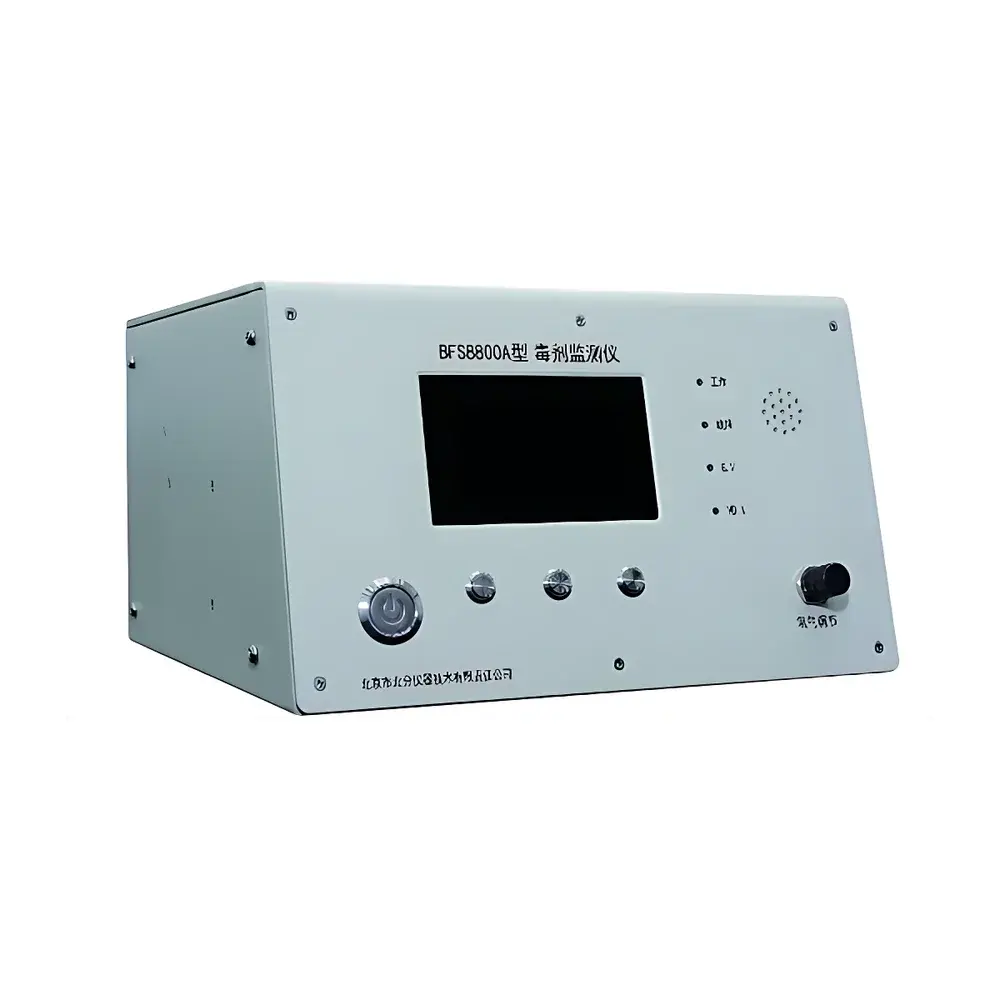
BFIT BFS8800A Chemical Warfare Agent Monitor
| Brand | BFIT |
|---|---|
| Origin | Beijing, China |
| Manufacturer Type | Authorized Distributor |
| Country of Origin | China |
| Model | BFS8800A |
| Pricing | Available Upon Request |
Overview
The BFIT BFS8800A Chemical Warfare Agent Monitor is a fixed-installation, continuous-emission monitoring system engineered for the real-time detection of organophosphorus and organosulfur chemical warfare agents (CWAs) and related toxic industrial compounds. It operates on the principle of flame photometric detection (FPD), a well-established analytical technique that leverages the characteristic atomic emission spectra of phosphorus (at 526 nm) and sulfur (at 394 nm) when combusted in a hydrogen–air flame. This selective optical detection mechanism provides inherent elemental specificity—distinguishing phosphorus- and sulfur-containing analytes from common interferents such as hydrocarbons or nitrogen oxides—without requiring chromatographic separation. Designed for deployment in high-integrity safety-critical environments, the BFS8800A delivers reliable, low-maintenance operation under ambient indoor conditions typical of laboratories, storage facilities, and protective ventilation enclosures.
Key Features
- Continuous 7×24 online monitoring with automatic baseline stabilization and self-diagnostic routines
- Dual-channel FPD architecture enabling simultaneous, independent quantification of P- and S-based compounds
- Sub-ppb (parts-per-quadrillion) detection capability for key nerve agents (e.g., sarin, VX analogs) and blister agents (e.g., mustard gas derivatives)
- Response time (T90) ≤ 15 seconds; recovery-to-baseline time < 60 seconds—enabling rapid successive event resolution
- Integrated auto-ignition sequence with flame status monitoring and fail-safe shutdown logic
- Modbus RTU/ASCII and 4–20 mA analog output interfaces for seamless integration with building management systems (BMS) and filter-ventilation control units
- Embedded fault logging with timestamped event records compliant with GLP audit trail requirements
Sample Compatibility & Compliance
The BFS8800A is optimized for gaseous-phase sampling of ambient air in enclosed or semi-enclosed spaces. It accepts sample streams via heated stainless-steel inlet lines (standard 6 mm OD), supporting flow rates of 0.5–2.0 L/min. The instrument does not require carrier gases beyond the onboard H2/air supply and is compatible with standard particulate pre-filters (≤ 0.3 µm) and moisture traps to prevent condensate ingress. It meets IEC 61000-6-2 (immunity) and IEC 61000-6-4 (emissions) standards for industrial environments. While not certified to MIL-STD-810G or NATO AEP-55, its detection performance aligns with reference methods cited in ASTM E2919 (Standard Guide for Detection of Chemical Warfare Agents) and supports verification protocols outlined in ISO 17025-accredited laboratories conducting CWA exposure assessments.
Software & Data Management
The BFS8800A includes embedded firmware with local data buffering (72-hour rolling storage at 1-minute intervals) and configurable alarm thresholds (user-definable P/S concentration setpoints, hysteresis, and delay timers). Remote configuration and real-time data viewing are supported via optional Ethernet-enabled gateway modules running secure HTTPS/TLS v1.2. All calibration events, alarm triggers, and system errors are logged with ISO 8601 timestamps and stored in CSV-compatible format. Audit trail functionality satisfies FDA 21 CFR Part 11 requirements for electronic records when deployed in regulated pharmaceutical or defense R&D settings—provided external authentication and role-based access controls are implemented at the network level.
Applications
- Continuous surveillance of air intake zones in chemical defense laboratories and NBC (nuclear, biological, chemical) research facilities
- Integration with collective protection systems—including filtered ventilation units, overpressure shelters, and airlock transition chambers—to trigger automatic filter bypass or shutdown upon CWA breakthrough
- Performance validation of adsorptive media (e.g., activated carbon, metal-organic frameworks) in respirators and HVAC filtration banks
- Baseline monitoring during decontamination operations and post-event environmental clearance verification
- Supporting emergency response coordination by providing trace-level concentration trends to incident command systems
FAQ
Does the BFS8800A require routine calibration with certified CWA simulants?
Yes—bi-weekly verification using EPA-certified phosphorus/sulfur standard gases (e.g., triethyl phosphate, methyl sulfide) is recommended. Full calibration is required after sensor replacement or major maintenance.
Can it detect non-volatile or aerosolized CWAs?
No—the BFS8800A is designed exclusively for vapor-phase detection. Aerosols or particulates must be thermally desorbed or volatilized upstream using an approved thermal desorption module (sold separately).
Is the instrument suitable for outdoor deployment?
It is rated for indoor use only (IP20 enclosure). Outdoor installation requires climate-controlled housing with temperature stabilization (15–30 °C) and inlet air conditioning to prevent dew point-related condensation.
What communication protocols does it support natively?
RS-485 Modbus RTU/ASCII and isolated 4–20 mA current loop outputs are standard. Optional WiFi/Ethernet modules enable MQTT and OPC UA integration.
How is cybersecurity addressed in firmware updates?
Firmware updates are delivered as signed binary packages validated via SHA-256 hash and RSA-2048 signature verification prior to installation. No remote update capability is enabled by default.
Related Products




