
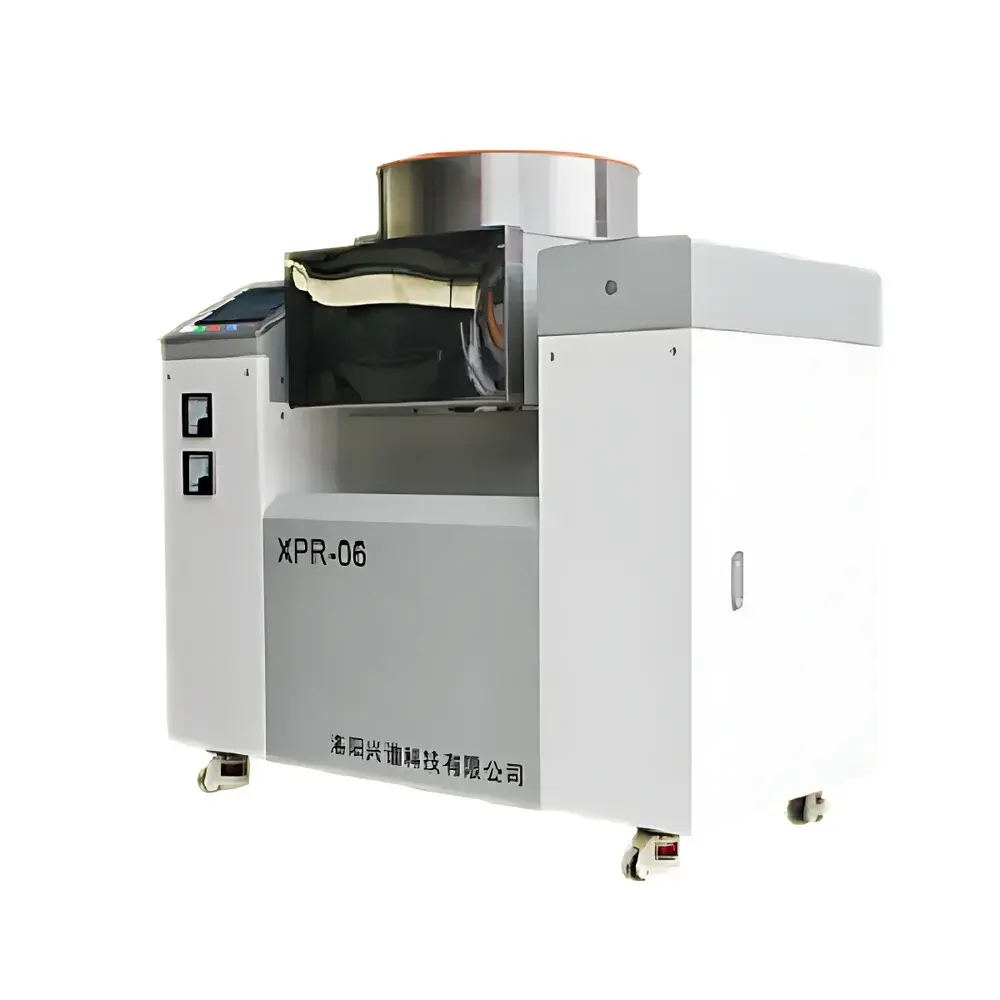
Xingpu XPR-06 Fusion Machine
| Brand | Xingpu |
|---|---|
| Origin | Henan, China |
| Manufacturer Type | Authorized Distributor |
| Country of Origin | China |
| Model | XPR-06 |
| Price Range | USD 14,000–28,000 |
| Sample Capacity | 1–6 positions |
| Operating Temperature Range | 0–1200 °C |
| Temperature Control Accuracy | ±1 °C |
| Dimensions (L×W×H) | 1200 mm × 650 mm × 1150 mm |
| Heating Element | Silicon Carbide Rods |
| Thermocouple Type | S-type Platinum-Rhodium |
| Max. Ramp Rate | ≥45 °C/min |
| Rated Power | 12 kW |
| Oscillation Amplitude | 0–40° (adjustable) |
| Casting Mode | Automated Tilt Pouring |
| Crucible Capacity | 85 g per crucible (single-use preformed crucibles) |
Overview
The Xingpu XPR-06 Fusion Machine is a programmable high-temperature sample preparation system engineered for the precise and reproducible fusion of inorganic powders—primarily geological, metallurgical, ceramic, and environmental samples—into homogeneous, glassy discs or beads suitable for quantitative X-ray fluorescence (XRF) and inductively coupled plasma (ICP) analysis. It operates on the principle of flux-assisted fusion: powdered samples are mixed with lithium tetraborate (Li₂B₄O₇), lithium metaborate (LiBO₂), or other alkaline fluxes, then heated under controlled thermal profiles to form low-viscosity melts. The molten mixture is uniformly distributed via mechanical oscillation and solidified by controlled cooling, yielding flat, bubble-free, chemically stable beads with minimal segregation. Unlike static furnace-based fusion, the XPR-06 integrates a six-position rotating crucible carousel with synchronized tilt-pour casting, ensuring consistent exposure of each sample to the uniform thermal gradient across the furnace zone—a design feature critical for inter-run repeatability and long-term calibration stability in regulated analytical workflows.
Key Features
- Six-position motorized crucible carousel with independent positional indexing and synchronized rotation during heating—enabling uniform thermal history for all samples within a single run.
- High-stability temperature control system utilizing S-type platinum-rhodium thermocouples and digital PID regulation, delivering ±1 °C accuracy across the full 0–1200 °C operating range.
- Robust silicon carbide (SiC) heating elements housed in a double-layered, fiber-insulated refractory chamber—optimized for thermal uniformity, rapid ramp rates (≥45 °C/min), and extended service life at sustained high temperatures.
- Programmable oscillation mechanism with adjustable amplitude (0–40°) and frequency—ensuring thorough melt homogenization and effective degassing prior to casting.
- Automated tilt-pour casting module with precision angle control and timed release, eliminating manual handling and minimizing operator-induced variability in bead geometry and surface finish.
- Integrated safety architecture including over-temperature cut-off, door interlock, cooling fan monitoring, and real-time fault logging compliant with IEC 61000-6-2/6-4 electromagnetic compatibility standards.
Sample Compatibility & Compliance
The XPR-06 accommodates standard 30–35 mm diameter platinum-gold (Pt/Au) or platinum-rhodium (Pt/Rh) crucibles, supporting typical fusion loads of 0.1–0.7 g sample + 3–6 g flux (e.g., Li₂B₄O₇, LiBO₂, Na₂CO₃). It is validated for use with ASTM D5630 (ash content in plastics), ISO 9556 (iron and steel—determination of manganese), ISO 8289 (water quality—determination of silica), and USP <731> (loss on drying—applicable to fused bead validation). All thermal profiles and operational parameters are fully configurable and auditable, supporting GLP/GMP documentation requirements. Data integrity features—including user access levels, electronic signatures, and time-stamped event logs—are designed to align with FDA 21 CFR Part 11 expectations when integrated into validated laboratory information management systems (LIMS).
Software & Data Management
The machine is operated via an embedded 7-inch industrial touchscreen HMI running a deterministic real-time control kernel. Up to 99 customizable fusion protocols can be stored locally, each defining ramp/soak segments, oscillation timing, pour angle, and cooling profile. USB export enables transfer of run logs (CSV format) containing timestamped temperature, position, power draw, and error codes. Optional RS-485 Modbus RTU or Ethernet TCP/IP interface allows bidirectional integration with LIMS or SCADA platforms for automated job dispatch and result traceability. Firmware updates are performed via secure authenticated firmware packages; configuration backups support rapid recovery during instrument requalification.
Applications
- Preparation of fused beads for major and trace element quantification in XRF spectrometry (e.g., ores, slags, soils, fly ash).
- Routine calibration standard production for ICP-OES and ICP-MS—particularly where matrix-matched calibration is required.
- Homogenization and vitrification of heterogeneous environmental solids (sediments, dusts, filters) prior to total digestion or leach testing.
- Production of certified reference material (CRM) batches under ISO/IEC 17025-accredited conditions.
- Research-scale development of novel flux formulations and thermal protocols for challenging matrices (e.g., high-alumina clays, refractory oxides, sulfide concentrates).
FAQ
What crucible materials are compatible with the XPR-06?
Platinum-gold (95% Pt / 5% Au), platinum-rhodium (90% Pt / 10% Rh), and high-purity graphite crucibles are supported; maximum recommended operating temperature varies by material—consult crucible manufacturer specifications.
Is the XPR-06 suitable for fluoride-based fluxes such as LiF or NaF?
Yes, but extended use with fluorides requires enhanced ventilation and periodic inspection of furnace insulation integrity due to potential corrosion at elevated temperatures.
Can the oscillation amplitude and timing be modified per step in a multi-segment thermal program?
Yes—each soak segment supports independent oscillation enable/disable, amplitude (0–40°), and dwell duration settings.
Does the system include validation documentation for IQ/OQ/PQ?
A comprehensive factory-verified OQ protocol (including temperature mapping, oscillation repeatability, and pour consistency tests) is supplied; IQ and PQ templates are provided for site-specific execution.
What maintenance intervals are recommended for the heating elements and thermocouples?
Silicon carbide rods should be inspected visually every 200 operating hours; S-type thermocouples require annual calibration verification using a traceable dry-block calibrator.



