
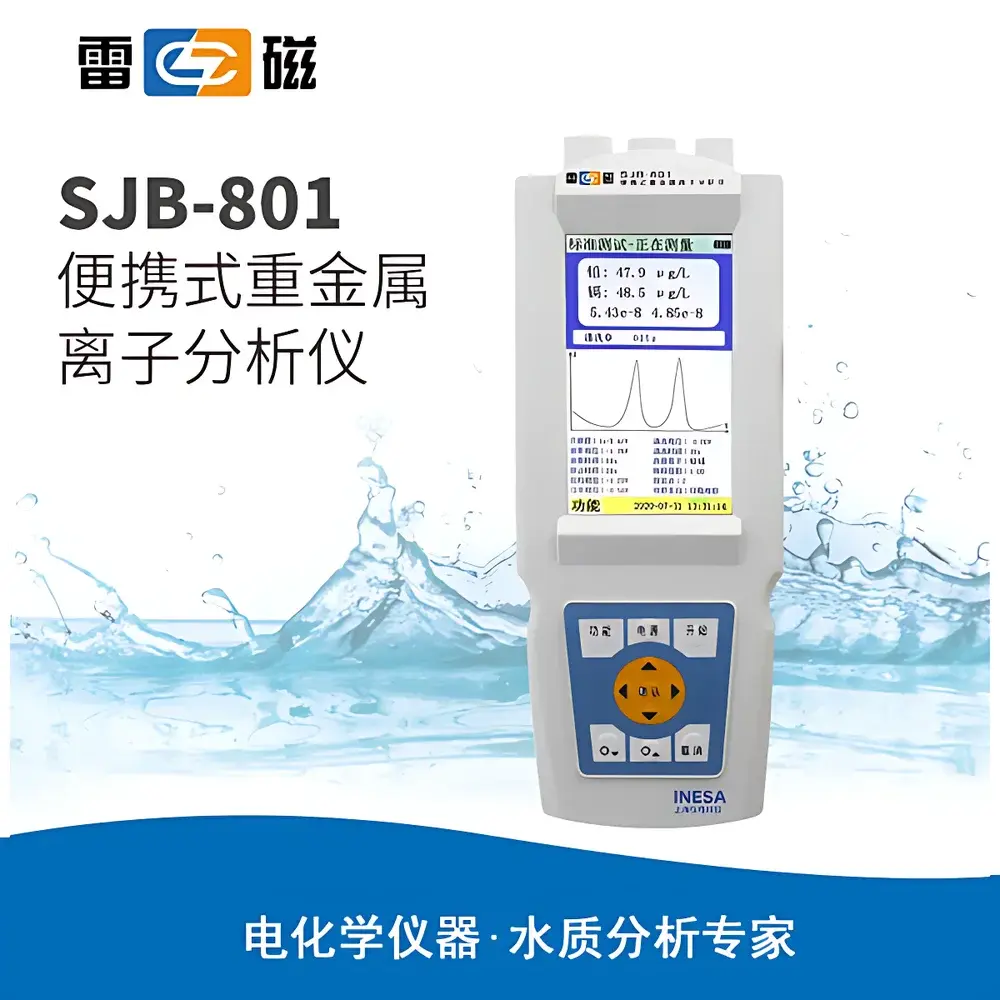
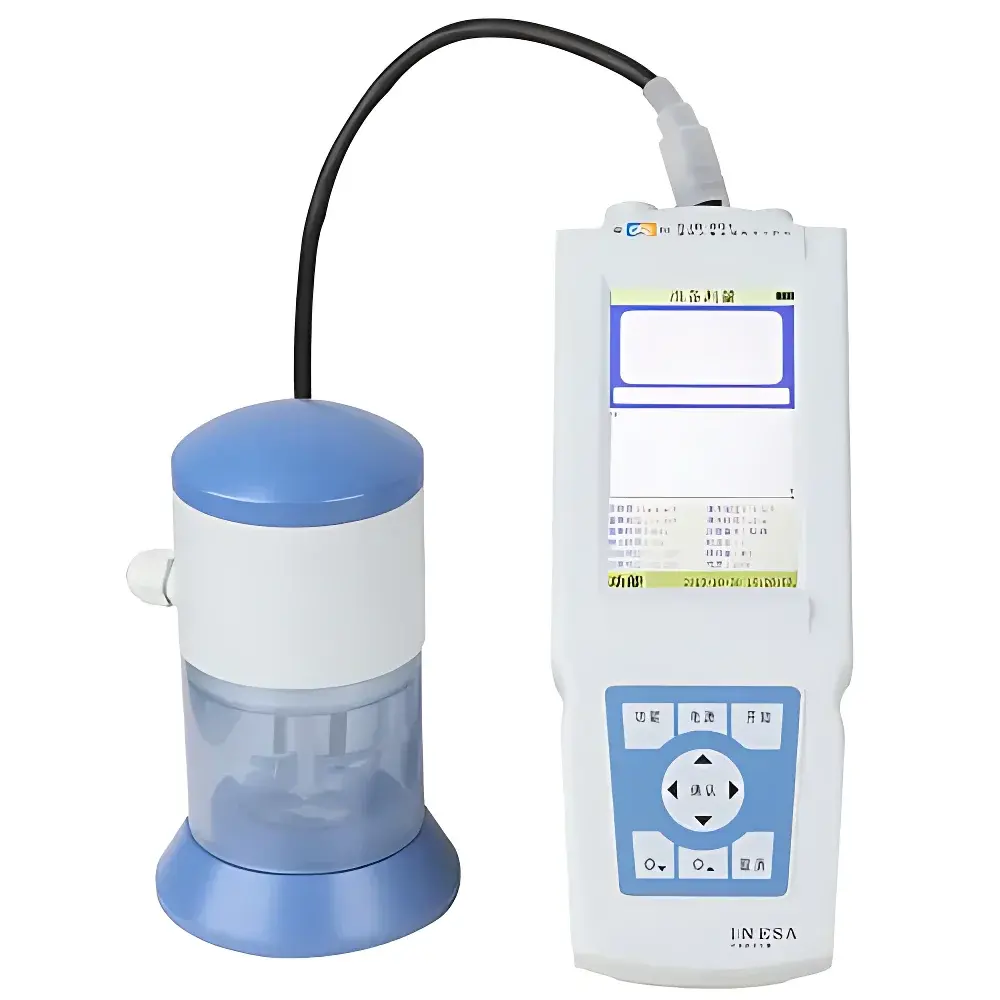
Leici SJB-801 Portable Heavy Metals Analyzer
| Brand | Leici |
|---|---|
| Origin | Shanghai, China |
| Model | SJB-801 |
| Instrument Type | Portable |
| Detection Principle | Anodic Stripping Voltammetry (ASV) |
| Detectable Metals | Pb, Cd, Cu, As, Hg, Zn, Se, Mn, Ni (9 elements) |
| Analysis Time | ≤3 min per sample |
| Accuracy | ±5% (or ±5.0 µg/L for elements ≤100 µg/L |
| Resolution | 0.1 µg/L |
| Detection Limits | Pb/Cd/Cu/As ≤0.5 µg/L |
| Repeatability | RSD ≤3% |
| Data Storage Capacity | 2000 measurement records |
| IP Rating | IP65 |
| Power Options | 4×AA Ni-MH rechargeable batteries, USB power supply (5 V), external mobile power bank, or AC adapter (compatible with standard smartphone chargers) |
| Compliance | GLP-compliant data management, ASTM D3559, ISO 8692, USP <232>/<233>, and EPA Method 7000B (ASV adaptation) |
Overview
The Leici SJB-801 Portable Heavy Metals Analyzer is a field-deployable electrochemical instrument engineered for rapid, on-site quantification of trace heavy metal ions in aqueous environmental samples. It employs anodic stripping voltammetry (ASV)—a well-established, highly sensitive electroanalytical technique—where target metal ions are first preconcentrated onto a working electrode (typically mercury-film or bismuth-film modified screen-printed carbon electrodes) via controlled reduction, followed by oxidative stripping under a linear potential sweep. The resulting current peaks are proportional to analyte concentration and uniquely positioned by formal potential, enabling simultaneous multi-element detection without chromatographic separation. With sub-ppb detection limits (e.g., Hg ≤0.1 µg/L, Pb/Cd/Cu/As ≤0.5 µg/L), the SJB-801 delivers analytical performance comparable to laboratory-based atomic absorption spectroscopy (AAS) or ICP-MS for routine field screening—making it suitable for regulatory compliance monitoring, emergency response, and decentralized water quality surveillance where lab access is limited.
Key Features
- 4.3-inch high-brightness color TFT display with intuitive menu-driven interface—designed for glove-compatible operation in outdoor or hazardous environments;
- Real-time process visualization: automatic electrode cleaning, standard calibration, and ASV scan sequences are graphically represented with dynamic progress bars and live voltammogram overlays;
- Built-in standardized ASV methods for nine priority metals: Pb, Cd, Cu, As, Hg, Zn, Se, Mn, and Ni—each method pre-optimized for deposition time, stirring rate, and scan parameters per EPA and ISO guidance;
- Firmware-upgradable architecture: new metal-specific protocols (e.g., Cr(VI), Co, Sb) can be deployed remotely via SD card or USB without hardware modification;
- GLP-compliant data handling: timestamped records include operator ID, electrode lot number, calibration history, raw voltammograms, and QA/QC flags—supporting full audit trails for regulatory submissions;
- Robust mechanical design: IP65-rated enclosure resists dust ingress and low-pressure water jets; shock-absorbing silicone bumper protects against drops up to 1 m on concrete;
- Multi-mode power system: operates continuously for ≥8 hours on 4×AA Ni-MH batteries; seamlessly switches to USB 5 V input (compatible with universal phone chargers, car adapters, or portable power stations); no proprietary battery pack required.
Sample Compatibility & Compliance
The SJB-801 is validated for direct analysis of filtered (0.45 µm) natural waters, wastewater effluents, drinking water, and leachates. Sample matrix effects are mitigated through integrated standard addition capability and optional internal standard correction (e.g., Bi³⁺ for As/Pb/Cd). All ASV protocols adhere to the electrochemical principles outlined in ASTM D3559 (lead in water), ISO 8692 (freshwater toxicity testing), and EPA Method 7000B (anodic stripping voltammetry for metals). Data integrity meets FDA 21 CFR Part 11 requirements for electronic records and signatures when used with REX software and enabled audit logging. Instrument calibration and verification follow NIST-traceable reference standards (e.g., Inorganic Ventures ICV/CCV solutions), and routine performance checks satisfy ISO/IEC 17025 clause 7.7 (method validation).
Software & Data Management
Data acquisition and reporting are managed via the REX desktop application (Windows 10/11), which provides full control over method selection, parameter adjustment, and real-time voltammogram review. Each stored record contains metadata (sample ID, location GPS coordinates via optional Bluetooth module, temperature, pH if measured externally), raw current-potential data points (≥2000 points per scan), and processed peak integration results. Export formats include CSV (for LIMS integration), PDF analytical reports (with embedded spectra), and XML compliant with ASTM E1382-22 (electrochemical data exchange). Internal storage retains 2000 complete datasets with automatic overwrite protection; additional capacity is available via removable microSD cards (up to 32 GB, FAT32 formatted). All data transfers—whether USB, SD, or Bluetooth—are encrypted using AES-128 to ensure confidentiality during chain-of-custody handover.
Applications
- Regulatory field screening: Rapid verification of EPA Clean Water Act (CWA) Section 402 permit limits for Pb, Cd, and Hg in municipal discharge points;
- Drinking water safety: On-the-spot assessment of lead service line corrosion products following ASCE/ACEC Lead and Copper Rule revisions;
- Industrial site characterization: Triaging contaminated sediments or groundwater plumes during Phase I/II environmental site assessments (ESAs);
- Emergency response: First-responder deployment during chemical spills or illicit dumping events involving heavy metal contaminants;
- Academic research: Teaching electroanalytical chemistry principles and validating novel electrode modifications in undergraduate and graduate labs;
- NGO-led citizen science: Low-barrier deployment for community water monitoring programs in resource-constrained regions.
FAQ
What electrode types are supported?
The SJB-801 ships with disposable mercury-film screen-printed carbon electrodes (SPCEs) optimized for ASV. Bismuth-film SPCEs are available as an alternative for mercury-free operation, with validated methods for Pb, Cd, Zn, and Cu.
Is method validation documentation provided?
Yes—each factory-installed method includes a validation summary per ISO/IEC 17025 Annex A, covering specificity, linearity (r² ≥0.999), LOD/LOQ, accuracy (recovery 95–105%), and intermediate precision (RSD ≤3%). Full validation reports are downloadable from the Leici technical portal.
Can the instrument be used in seawater?
Direct seawater analysis is not recommended due to chloride interference and high ionic strength. Samples must be diluted ≥10× with deionized water and analyzed with matrix-matched calibration standards containing 3.5% NaCl.
How often does the electrode require replacement?
Each SPCE supports ≥50 reproducible measurements under standard operating conditions. Electrode life is automatically tracked and displayed; the system alerts users at 80% usage and disables further analysis at 100%.
Does the SJB-801 support remote firmware updates?
Firmware updates are distributed as signed .bin files via Leici’s secure customer portal. Updates require manual initiation via USB-connected PC and take <90 seconds—no internet connection is needed during installation.







