
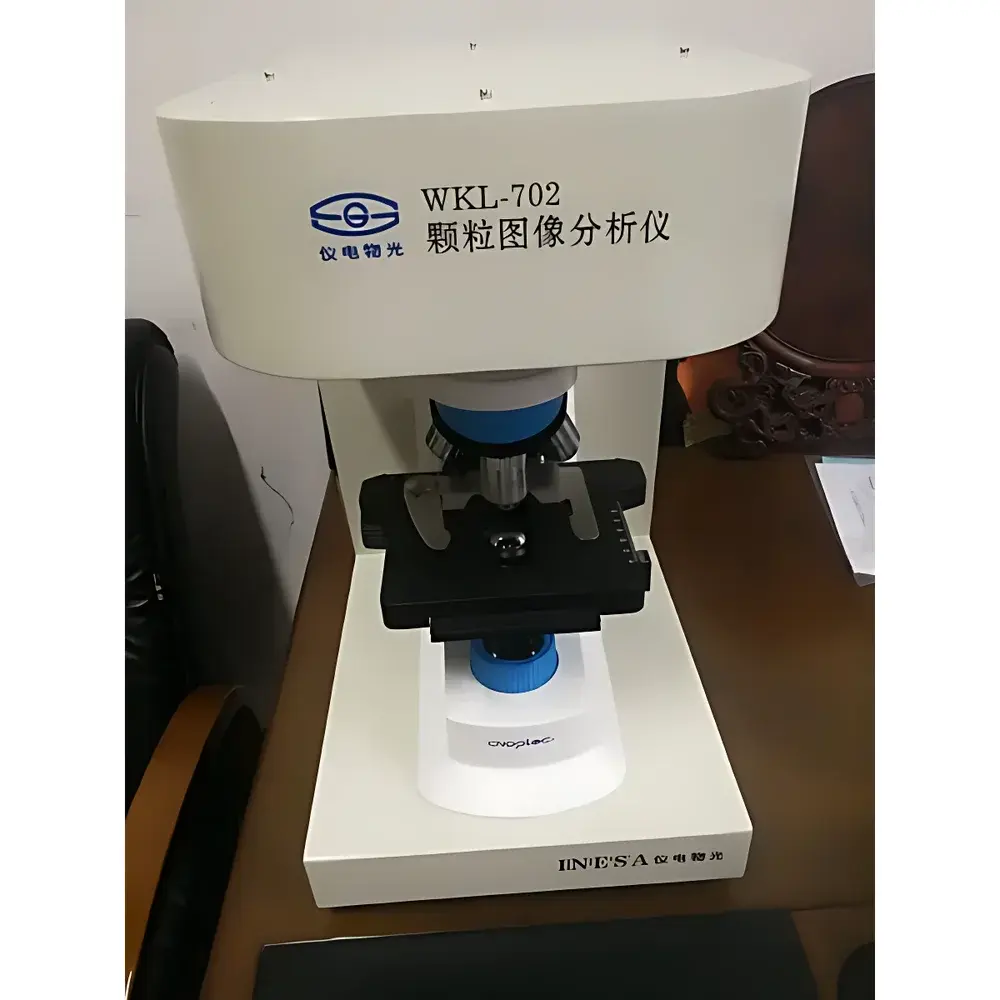
YDWG WKL-702 Particle Image Analyzer (with Domestic Microscope)
| Brand | YDWG |
|---|---|
| Origin | Shanghai, China |
| Model | WKL-702 (equipped with domestic optical microscope) |
| Dispersion Method | Dry Dispersion |
| Instrument Type | Laboratory Particle Image Analyzer |
| Measurement Range | 1–3000 µm |
| Repeatability | ≤ ±0.3% |
| Optical Magnification | Up to 8000× |
| Maximum Resolution | 0.1 µm/pixel |
| CCD Camera | 5 MP |
| Auto-Segmentation Speed | ≤1 s per image |
| Power Supply | AC 220 V ±10%, 50 Hz, 200 W |
| Dimensions | 270 × 410 × 440 mm |
| Net Weight | 15 kg |
| Expected Service Life | >25,000 hours |
Overview
The YDWG WKL-702 Particle Image Analyzer is a laboratory-grade digital imaging system engineered for quantitative morphological and dimensional characterization of solid particulates. Unlike laser diffraction or dynamic light scattering instruments, the WKL-702 employs static image analysis—capturing high-resolution micrographs of dispersed particles under controlled optical magnification, then applying deterministic segmentation and geometric feature extraction algorithms. This method provides direct visualization and measurement of individual particle attributes including shape, contour, surface texture, and size distribution based on equivalent-area diameter, Feret diameter, circularity, aspect ratio, convexity, and solidity. The system integrates an optical microscope platform (domestically manufactured), a 5-megapixel progressive-scan CCD camera, and proprietary image processing software optimized for binary thresholding, noise suppression, edge detection, and sub-pixel centroid localization. Its measurement range spans 1 to 3000 µm, making it suitable for coarse powders, granules, catalysts, pharmaceutical excipients, and mineral aggregates where shape-sensitive classification is critical.
Key Features
- High-fidelity static imaging architecture with up to 8000× total optical magnification and 0.1 µm/pixel spatial resolution
- Dry dispersion module enabling rapid, solvent-free sample presentation for moisture-sensitive or volatile materials
- Real-time image enhancement suite: contrast/brightness adjustment, histogram equalization, Gaussian smoothing, median filtering, and multi-scale sharpening
- Automated particle segmentation engine with adaptive thresholding and watershed-based splitting of agglomerates
- Comprehensive geometric parameter library: area, perimeter, major/minor axis length, bounding rectangle, convex hull, roundness, elongation, and fractal dimension
- Statistical output in customizable formats: cumulative distribution curves (linear/logarithmic x-axis), frequency histograms, scatter plots (e.g., circularity vs. size), and tabular CSV exports
- USB 3.0 and Gigabit Ethernet interfaces for low-latency image streaming and remote operation compatibility
Sample Compatibility & Compliance
The WKL-702 supports dry, free-flowing particulate samples across diverse industrial sectors—including ceramics, metallurgy, food processing, construction materials, and battery electrode powders. It complies with fundamental principles outlined in ISO 13322-1:2014 (Particle size analysis — Image analysis methods — Part 1: Static image analysis) and aligns with ASTM E2454-21 guidelines for digital image acquisition and calibration traceability. While not certified for GMP environments out-of-the-box, the system can be validated per user-defined SOPs; audit trails, user access controls, and electronic signature support may be implemented via third-party LIMS integration. All calibration standards are NIST-traceable micrometer graticules, and pixel-to-length conversion is verified using certified stage micrometers at each magnification level.
Software & Data Management
The embedded Windows-compatible software (compatible with Windows 98 through Windows 11) delivers full workflow control—from live focusing and exposure optimization to batch image acquisition, ROI-based cropping, and multi-parameter statistical reporting. Raw images are stored in lossless TIFF format; processed results include annotated overlays, metadata-rich XML logs, and export-ready Excel/CSV files. Data integrity is preserved through timestamped session records, operator ID tagging, and version-controlled analysis protocols. For regulated environments, the software architecture permits integration with 21 CFR Part 11-compliant electronic record systems when deployed alongside qualified validation documentation and role-based authentication layers.
Applications
- Pharmaceutical development: quantifying crystal habit changes during polymorph screening or milling process optimization
- Cement and concrete research: evaluating clinker particle angularity and porosity distribution affecting hydration kinetics
- Additive manufacturing feedstock qualification: verifying spherical morphology and surface defect density in metal and polymer powders
- Environmental science: characterizing airborne particulate matter (PM10/PM2.5) morphology for source apportionment modeling
- Geotechnical engineering: analyzing grain shape descriptors (e.g., sphericity, roundness) to predict soil compaction behavior and shear strength
- Quality control of abrasives, pigments, and filtration media where sharp edges or aspect ratio directly impact performance
FAQ
What particle size standards are recommended for routine calibration?
NIST-traceable glass microspheres (e.g., Duke Scientific 3000A series) or certified stage micrometers are advised for daily verification at multiple magnifications.
Can the system analyze wet-dispersed samples?
No—the WKL-702 is configured exclusively for dry dispersion; liquid suspension analysis requires optional environmental chamber retrofitting and refractive index compensation modules not included in base configuration.
Is GPU acceleration supported for real-time segmentation?
Segmentation is CPU-optimized for Intel Core i5 or higher; GPU offloading is not implemented in current firmware but may be enabled in future software releases.
How is measurement repeatability validated per ISO 13322-1?
Repeatability testing follows Clause 8.3 of ISO 13322-1: three independent preparations of the same sample, minimum 500 particles per field, repeated across five fields—reporting standard deviation of D10/D50/D90 values.
Does the system support automated focus stacking?
Manual focus is standard; motorized Z-axis control and focus-stacking capability require optional hardware upgrade and firmware license.



