
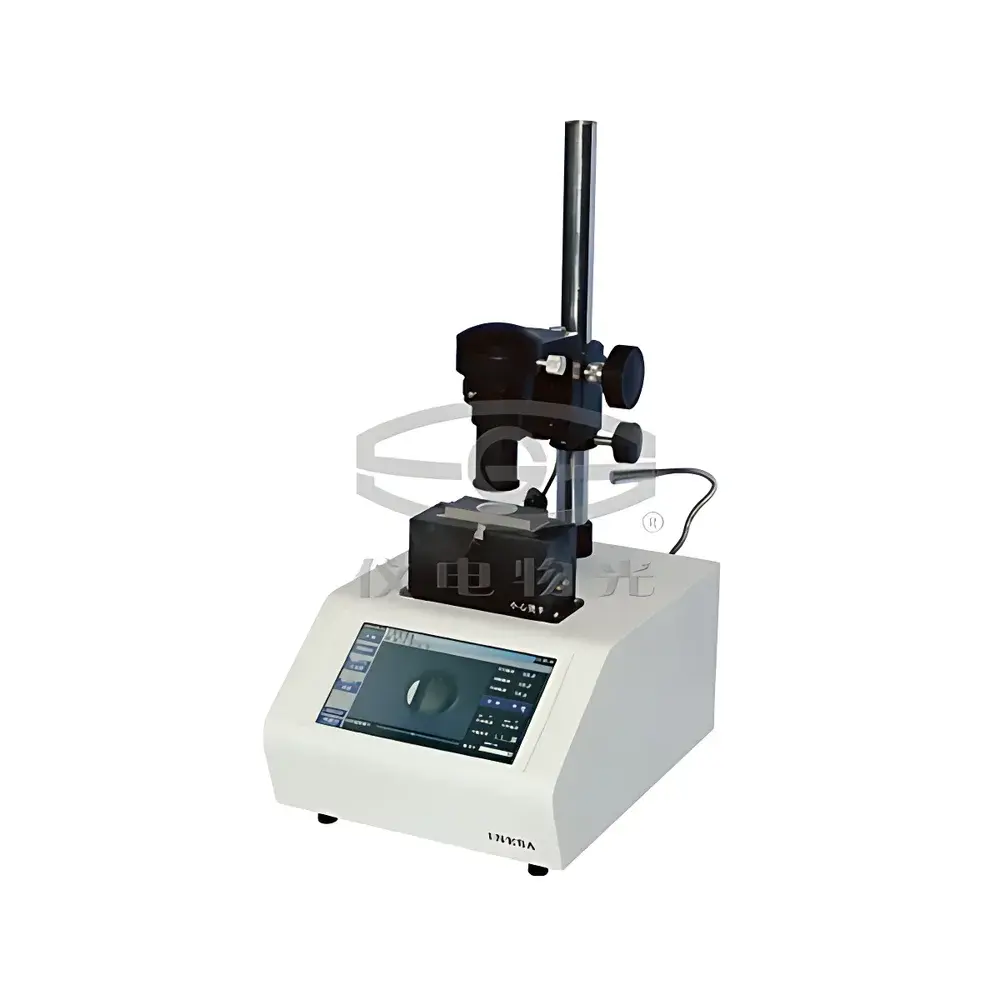
YDWG SGW® X-5 Microscopic Melting Point Apparatus
| Brand | YDWG |
|---|---|
| Origin | Shanghai, China |
| Model | SGW® X-5 |
| Temperature Range | Ambient to 360 °C |
| Heating Rates | 0.2, 0.5, 1.0, 1.5, 2.0, 3.0, 4.0, 5.0 °C/min |
| Temperature Repeatability | ±0.3 °C (at 1.0 °C/min) |
| Temperature Accuracy | Capillary Method — ≤200 °C: ±0.4 °C |
| >200 °C | ±0.7 °C |
| Hot Stage Method — Ambient–100 °C | ±0.4 °C |
| 100–200 °C | ±0.6 °C |
| 200–300 °C | ±0.8 °C |
| Capillary Dimensions | OD 1.4 mm, ID 1.0 mm, Length 90 mm |
| Sample Capacity | 1 sample per run |
| Temperature Resolution | 0.1 °C |
| Display | 7-inch TFT capacitive touchscreen |
| Data Storage | 1000 measurement records |
| Interface | USB host/device (PC connectivity & USB flash drive support) |
| Power Supply | 220 V ±10%, 50 Hz ±1 Hz, 150 W |
| Dimensions (W×D×H) | 310 × 230 × 505 mm |
| Net Weight | 4.0 kg |
Overview
The YDWG SGW® X-5 Microscopic Melting Point Apparatus is a precision thermal analysis instrument engineered for accurate, real-time determination of melting onset (onset temperature) and completion (clear point) of crystalline organic compounds, pharmaceutical intermediates, polymers, and reference standards. It operates on the principle of controlled linear heating combined with high-magnification optical observation—enabling direct visualization of solid-to-liquid phase transitions under calibrated thermal conditions. Unlike conventional analog melting point devices, the SGW® X-5 integrates a digital PID temperature controller, a high-resolution CMOS microscopic imaging system, and a 7-inch capacitive touchscreen interface to deliver traceable, operator-independent measurements. Designed for compliance with pharmacopeial methods—including USP , EP 2.2.14, and JP 2.60—the instrument supports both capillary tube and hot-stage measurement configurations, ensuring method flexibility across R&D, QC, and regulatory submission workflows.
Key Features
- PID-based closed-loop temperature control ensures stable ramping accuracy and minimal overshoot across all eight selectable heating rates (0.2–5.0 °C/min), with linearity deviation ≤±10% as verified per ASTM E324 calibration protocol.
- Integrated 10×–40× magnification optical path with LED-illuminated coaxial viewing enables clear resolution of crystal lattice disruption, meniscus formation, and sintering behavior during melt progression.
- Real-time video capture and synchronized thermal logging allow dual-parameter correlation: visual morphological change and corresponding temperature value (recorded at 0.1 °C resolution).
- Multi-point temperature calibration function supports NIST-traceable verification using certified reference materials (e.g., indium, caffeine, vanillin) across the full operating range (ambient to 360 °C).
- Dual-method capability: Capillary mode adheres to classical pharmacopeial procedures; hot-stage mode accommodates fragile, hygroscopic, or low-mass samples via standard microscope slides (76.2 × 25.4 × 0.8 mm) and coverslips (18 × 18 × 0.17 mm).
- Onboard data management stores up to 1000 complete test records—including timestamps, heating rate, operator ID, and annotated images—with export via USB mass storage or direct transfer to Windows-based LIMS/ELN systems.
Sample Compatibility & Compliance
The SGW® X-5 accommodates solid powders, recrystallized APIs, small-molecule organics, and polymer granules—provided sample mass is sufficient for unambiguous visual detection (minimum ~0.1–0.5 mg in capillary; ~1–3 mg on hot stage). Capillary tubes conform to ISO 11357-3 specifications (1.4 mm OD, 1.0 mm ID, 90 mm length), while hot-stage geometry maintains uniform thermal distribution within a 2.0 mm field-of-view diameter. The instrument meets essential requirements for GLP-compliant laboratories: audit-trail-capable data logging (with timestamp and user authentication), electronic signature readiness, and compatibility with FDA 21 CFR Part 11–enabled software environments when paired with validated PC applications. All thermal accuracy specifications are validated per ISO/IEC 17025-accredited procedures using reference substances with certified melting intervals.
Software & Data Management
Data acquisition and reporting are managed through the embedded firmware interface, which supports customizable report templates (PDF/CSV export), batch ID assignment, and pass/fail threshold configuration against specification limits. USB host functionality permits direct connection to external storage or legacy laboratory PCs running Windows 7–11; no proprietary drivers are required. Optional integration with third-party chromatography or spectroscopy platforms is enabled via ASCII-based serial command protocol (RS-232 emulation over USB CDC). For regulated environments, raw thermal-video datasets can be archived with SHA-256 hash integrity verification, satisfying long-term data retention mandates under ICH M7 and EU Annex 11 guidelines.
Applications
- Pharmaceutical quality control: Identity confirmation and purity assessment of active pharmaceutical ingredients (APIs) per USP monographs.
- Chemical synthesis validation: Monitoring reaction endpoints and intermediate stability during process development.
- Materials science: Characterizing thermal transitions in liquid crystals, metal-organic frameworks (MOFs), and biodegradable polymers.
- Educational laboratories: Teaching fundamental principles of phase equilibria, eutectic behavior, and polymorphism in undergraduate and graduate curricula.
- Forensic analysis: Differentiation of structurally similar compounds (e.g., isomers, hydrates/anhydrates) based on distinct melting profiles.
FAQ
Does the SGW® X-5 comply with pharmacopeial requirements for melting point determination?
Yes—it fully supports USP , EP 2.2.14, and JP 2.60 methodologies in both capillary and hot-stage modes, including specified sample preparation, heating rate selection, and endpoint interpretation criteria.
Can the instrument be calibrated using NIST-traceable reference standards?
Yes—multi-point calibration is supported across the full temperature range using certified reference materials with documented uncertainty budgets.
Is audit trail functionality available for regulated environments?
The embedded system logs operator ID, timestamp, method parameters, and result values; full 21 CFR Part 11 compliance requires integration with validated PC-based software that provides electronic signatures and immutable record archiving.
What is the minimum detectable sample mass for reliable measurement?
For capillary mode: ≥0.1 mg of uniformly packed, dry powder; for hot-stage mode: ≥1 mg applied evenly across the 2.0 mm observation zone.
Does the device support automated image annotation during melt observation?
Yes—users may manually tag key frames (onset, meniscus, clear point) with time-stamped notes directly on the touchscreen interface.
Related Products



