
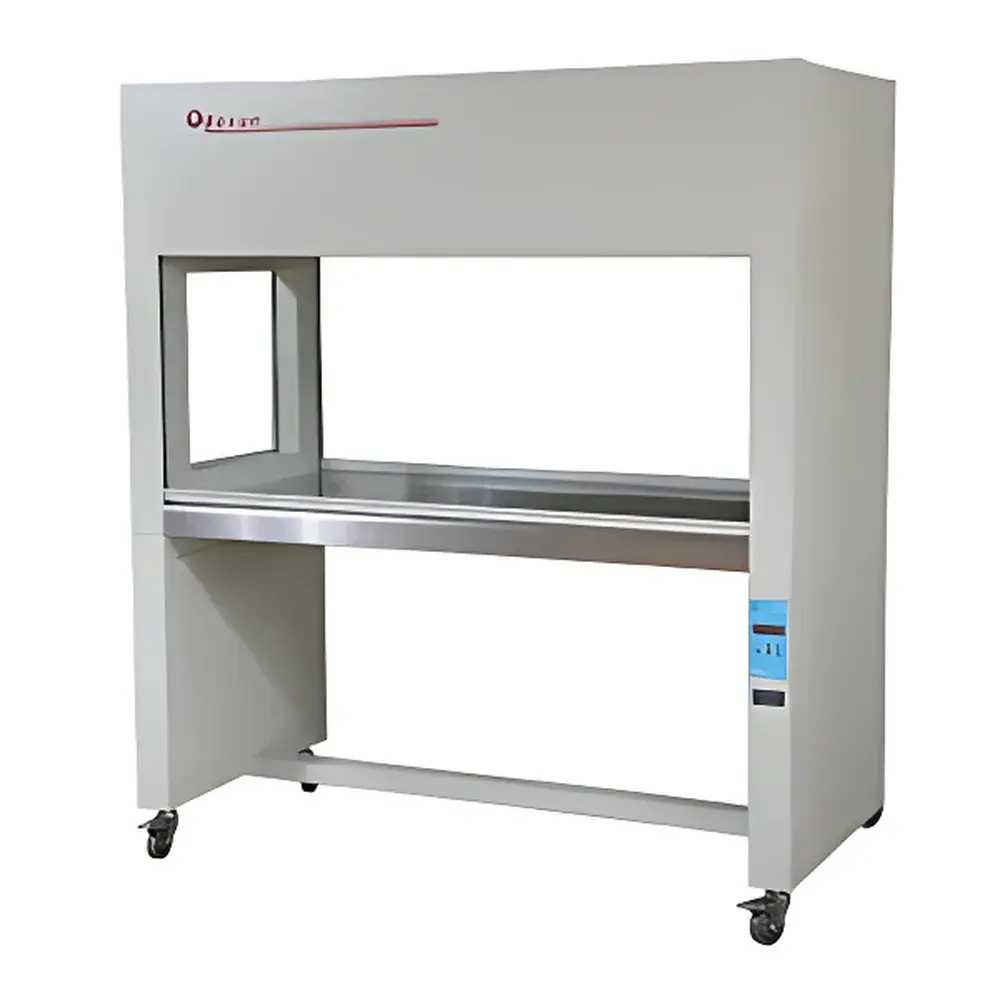
BOXUN SW-CJ-2F Vertical Laminar Flow Clean Bench
| Brand | BOXUN |
|---|---|
| Origin | Shanghai, China |
| Manufacturer Type | Authorized Distributor |
| Product Category | Domestic |
| Model | SW-CJ-2F |
| Instrument Type | Vertical Laminar Flow Clean Bench |
| Cleanliness Class | ISO Class 5 (100-level, ≥99.99% filtration efficiency for particles ≥0.5 µm) |
| Noise Level | ≤67 dB(A) |
| User Capacity | Dual-operator, dual-front configuration |
| Airflow Pattern | Vertical downward laminar flow |
| Working Surface Velocity Range | 0.3–0.6 m/s (adjustable in six discrete steps) |
| Vibration Amplitude (peak-to-peak) | ≤5 µm (X/Y/Z axes) |
| Illumination | ≥300 lux |
| Work Area Dimensions (W×D×H) | 1300 × 650 × 520 mm |
| Overall Dimensions (W×D×H) | 1460 × 700 × 1650 mm |
| HEPA Filter Specification | 1250 × 560 × 50 mm (single unit) |
| Pre-filter | Medium-efficiency panel filter |
| Lighting | One 40 W fluorescent lamp |
| UV Germicidal Lamp | One 20 W low-pressure mercury lamp with 0–999 min timer |
| Weight | 210 kg |
| Power Consumption | 0.3 kW |
| Electrical Supply | AC 220 V ±10%, 50/60 Hz |
Overview
The BOXUN SW-CJ-2F Vertical Laminar Flow Clean Bench is an ISO Class 5-certified local exhaust ventilation system engineered to provide a particle-controlled workspace for non-hazardous applications requiring microbiological or particulate-free conditions. It operates on the principle of vertical unidirectional airflow: ambient air is drawn through a pre-filter, then pressurized by a high-efficiency centrifugal blower, and finally passed through a certified HEPA filter (≥99.99% retention of ≥0.5 µm particles) before being delivered as laminar, downward-flowing air across the work surface. This design establishes a protective downward air curtain that isolates the work zone from room-sourced contaminants while preventing cross-contamination between adjacent users. Unlike biosafety cabinets, the SW-CJ-2F does not recirculate air nor provide personnel or environmental protection against biohazards; it is strictly intended for product protection in aseptic techniques where the process material—not the operator—is the critical element.
Key Features
- Robust structural architecture featuring cold-rolled steel housing with electrostatic powder coating and a 304 stainless steel work surface for corrosion resistance, cleanability, and long-term dimensional stability.
- Centrifugal blower system delivering stable, low-turbulence airflow with noise emission limited to ≤67 dB(A) — compliant with ISO 7235 and EN ISO 13849-1 acoustic performance benchmarks for laboratory equipment.
- Six-step adjustable air velocity control (0.3–0.6 m/s), managed via an LCD interface with tactile membrane switches, enabling precise optimization for diverse procedural requirements—from delicate cell handling to routine media preparation.
- Dual independent switching and programmable timing (0–999 minutes) for both UV germicidal irradiation (254 nm, 20 W) and general illumination (40 W fluorescent), supporting validated decontamination protocols and GLP-aligned operational documentation.
- Counterbalanced sash mechanism allowing smooth, tool-free positioning of the front access window within its specified vertical travel range—enhancing ergonomic access while maintaining consistent inflow velocity profiles.
- Integrated two-stage filtration architecture: a replaceable medium-efficiency pre-filter upstream of the HEPA unit extends filter service life and reduces maintenance frequency in moderate-dust environments such as QC labs or electronics assembly areas.
Sample Compatibility & Compliance
The SW-CJ-2F is suitable for handling non-pathogenic microorganisms, sterile pharmaceutical preparations, sensitive optical components, and precision electronic assemblies where airborne particulate contamination must be minimized. It complies with ISO 14644-1:2015 (Class 5), GB/T 25225-2010 (Chinese national standard for clean benches), and meets baseline mechanical safety requirements per IEC 61010-1:2010. While not certified to NSF/ANSI 49 or EN 12469, its design aligns with institutional SOPs for aseptic technique validation under USP , EU GMP Annex 1 (2022), and ISO 13408-1 for sterile processing environments. Users are advised to perform periodic airflow visualization (e.g., smoke studies), HEPA integrity testing (via DOP/PAO scanning), and velocity mapping per ISO 14644-3 to maintain documented conformance.
Software & Data Management
The SW-CJ-2F employs embedded microcontroller-based logic without external software dependency. All operational parameters—including fan speed setting, UV timer status, and lamp activation—are logged locally in non-volatile memory with timestamped event records accessible via service mode. Though not equipped with network connectivity or cloud integration, the unit supports audit-ready manual logging compatible with FDA 21 CFR Part 11-compliant quality systems when paired with controlled paper-based or validated electronic logbooks. Optional RS-485 communication modules (available upon request) enable integration into facility-wide environmental monitoring platforms for centralized alarm notification and trend analysis.
Applications
- Aseptic transfer of microbial cultures, plant tissue explants, and mammalian cell lines in academic and industrial biotechnology laboratories.
- Preparation of sterile culture media, buffers, and reagents in pharmaceutical quality control and R&D settings.
- Assembly and inspection of microelectromechanical systems (MEMS), semiconductor wafers, and optical sensors where sub-micron particulate adherence compromises functionality.
- Environmental sample processing—including air, water, and soil filtrates—in accredited testing laboratories adhering to ISO/IEC 17025 requirements.
- Calibration and handling of reference standards in metrology labs where static charge or airborne debris may affect gravimetric or dimensional accuracy.
FAQ
Is the SW-CJ-2F suitable for working with pathogenic organisms or hazardous chemicals?
No. This unit provides only product protection and is not designed for personnel or environmental protection. Biosafety Level 2 or higher work requires a certified Class II biological safety cabinet.
What is the recommended frequency for HEPA filter replacement?
Under typical laboratory use (8 hrs/day, 5 days/week), HEPA filters should be integrity-tested semiannually and replaced every 3–5 years—or sooner if differential pressure exceeds manufacturer-specified thresholds or airflow velocity falls below 0.3 m/s after cleaning.
Can the UV lamp be operated simultaneously with the main airflow system?
No. Interlocked safety circuitry automatically disables UV emission whenever the front sash is open or the laminar flow is active, preventing operator exposure and ozone generation.
Does the unit include validation documentation for IQ/OQ/PQ protocols?
Standard delivery includes a factory calibration certificate and filter test report. Full qualification packages—including installation, operational, and performance qualification templates—are available as optional add-ons for regulated environments.
Is the SW-CJ-2F compatible with glove port retrofits or custom ducting?
Yes. The cabinet frame accommodates third-party ISO-standard glove ports (e.g., 150 mm or 200 mm diameter) and can be adapted for hard-ducted exhaust configurations using certified transition kits—subject to site-specific airflow balancing and static pressure verification.



