
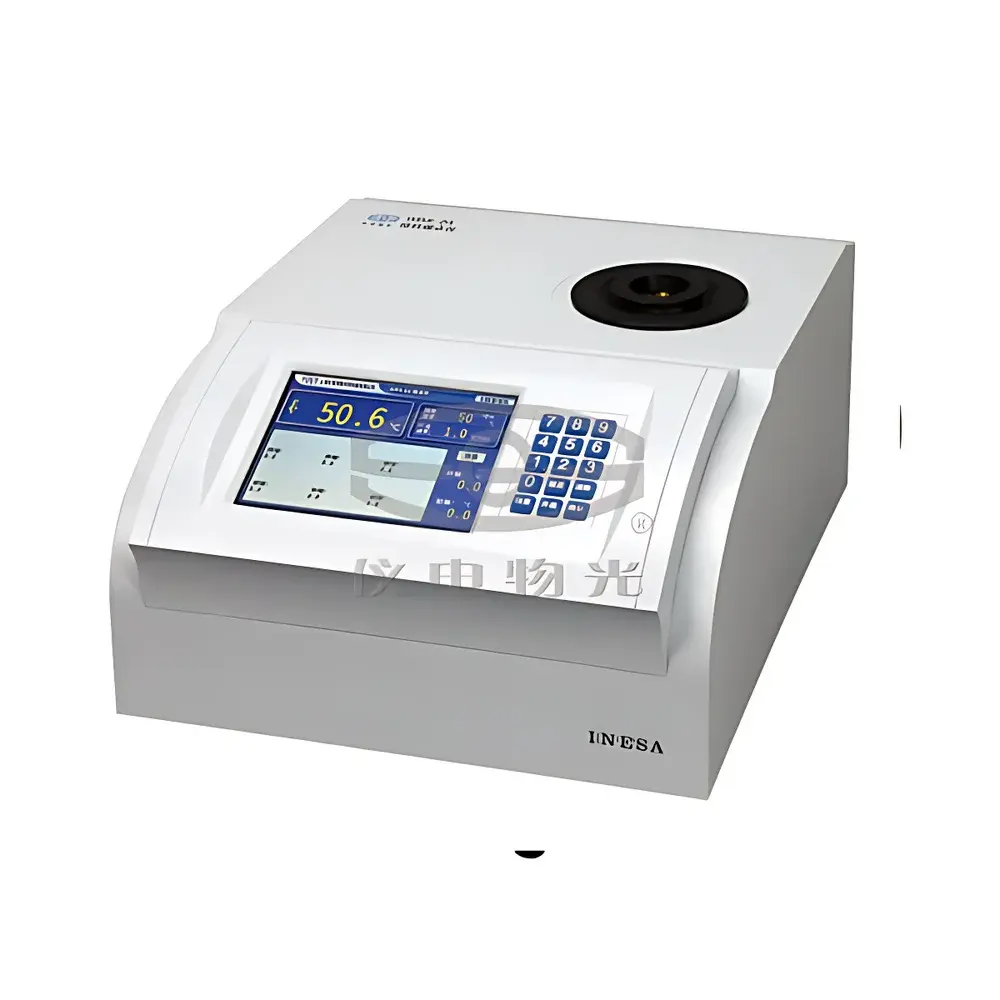
YDWG WRS-2 Microprocessor-Controlled Melting Point Apparatus
| Brand | YDWG |
|---|---|
| Origin | Shanghai, China |
| Model | WRS-2 |
| Temperature Range | Ambient to 300 °C |
| Heating Rates | 0.2, 0.5, 1.0, 1.5, 2.0, 3.0, 4.0, 5.0 °C/min (8 selectable steps) |
| Temperature Repeatability | ±0.3 °C at 1.0 °C/min |
| Temperature Accuracy | ±0.4 °C ≤200 °C |
| Temperature Resolution | 0.1 °C |
| Capillary Dimensions | OD 1.4 mm, ID 1.0 mm, Length 90 mm |
| Sample Capacity | 3 capillaries |
| Display | 5.6-inch color LCD |
| Interface | RS232 and USB |
| Power Supply | 220 V ±22 V, 50 Hz ±1 Hz, 100 W |
| Dimensions | 360 × 290 × 170 mm |
| Net Weight | 9 kg |
Overview
The YDWG WRS-2 Microprocessor-Controlled Melting Point Apparatus is a precision thermal analysis instrument engineered for reliable, reproducible determination of solid-phase transition temperatures in pharmaceuticals, fine chemicals, polymers, and organic compounds. It operates on the principle of optical detection of phase change: as a crystalline sample in a standard pharmacopoeial capillary undergoes solid-to-liquid transition, light transmission through the capillary increases sharply due to reduced scattering—this photometric signal is captured by a high-stability photodiode array and processed in real time. The system employs a platinum resistance thermometer (Pt100) as its primary temperature sensor, ensuring linearity and long-term stability across its full operating range (ambient to 300 °C). PID-controlled heating ensures minimal overshoot and consistent ramp fidelity, while microprocessor-based logic enables automatic detection of onset (initial melt) and offset (complete melt), along with real-time curve logging and statistical averaging across up to three parallel samples.
Key Features
- Triple-capillary measurement capability—simultaneous analysis of three independent samples for enhanced throughput and intra-batch repeatability assessment.
- Eight programmable linear heating rates (0.2–5.0 °C/min), enabling method optimization per ICH Q5A and USP <741> guidelines for polymorph screening and purity estimation.
- High-resolution thermal sensing: 0.1 °C digital resolution with verified accuracy of ±0.4 °C up to 200 °C and ±0.7 °C above—calibrated against NIST-traceable reference standards.
- 5.6-inch full-color TFT-LCD display with intuitive numeric keypad input—supports bilingual (English/Chinese) UI firmware for international laboratories.
- Integrated RS232 and USB interfaces for direct connection to LIMS or PC-based data acquisition software; supports ASCII-formatted export of raw temperature/time points and melt event metadata.
- Pharmacopoeia-compliant capillary compatibility: accepts standard 1.4 mm OD × 1.0 mm ID × 90 mm glass capillaries with 3 mm sample column height—fully aligned with EP 2.2.17, JP 2.60, and USP <741> specifications.
Sample Compatibility & Compliance
The WRS-2 is validated for use with crystalline and semi-crystalline organic solids, including APIs, excipients, intermediates, and reference standards. Its optical detection mechanism eliminates interference from colored or opaque samples that may compromise traditional visual-melt methods. All thermal protocols adhere to regulatory expectations for analytical instrument qualification (AIQ): temperature uniformity, ramp linearity (±10% deviation per ASTM E324), and repeatability are documented during factory calibration. The apparatus supports GLP-compliant operation when paired with audit-trail-enabled software—data files include timestamped operator ID, method name, ambient conditions, and calibration history. While not FDA 21 CFR Part 11–certified out-of-the-box, its data export architecture permits integration into compliant electronic lab notebook (ELN) or chromatography data systems (CDS) with appropriate validation protocols.
Software & Data Management
The WRS-2 communicates via standard serial or USB virtual COM port protocols, enabling seamless integration with third-party laboratory software such as LabSolutions, Empower, or custom Python/Matlab scripts using PySerial or VISA libraries. Raw output includes CSV-compatible records containing: acquisition timestamp, current temperature, heating rate setting, photometric intensity (normalized %), and automated event flags (onset, clear point, inflection). Multi-point calibration routines allow user-defined correction offsets at three independent temperatures (e.g., 90 °C, 150 °C, 250 °C), traceable to certified reference materials (e.g., indium, caffeine, potassium ferrocyanide). Instrument settings—including default ramp rate, auto-hold duration, and display brightness—are stored in non-volatile memory and survive power cycling.
Applications
- Pharmaceutical QC/QA: Identity verification and purity assessment of active pharmaceutical ingredients per USP <741> and EP 2.2.17.
- Polymorph characterization: Differentiation of crystal forms via subtle shifts in onset temperature and melt profile shape under controlled ramp conditions.
- Educational laboratories: Teaching fundamental thermal transitions with real-time visualization of melting curves and statistical reporting (mean, SD, RSD).
- Materials science R&D: Screening thermal stability of organic semiconductors, metal-organic frameworks (MOFs), and chiral resolving agents.
- Contract research organizations (CROs): Supporting regulatory submissions with auditable, instrument-generated melt reports meeting ICH M4Q(R2) documentation requirements.
FAQ
Does the WRS-2 support automated calibration verification?
Yes—the instrument includes a multi-point calibration mode where users can input certified reference material (CRM) melt temperatures and apply linear or quadratic correction curves. Calibration logs are exportable and include date, operator, CRM lot number, and deviation values.
Can it be used for decomposition point determination?
While primarily designed for sharp melting transitions, the WRS-2’s real-time photometric monitoring allows observation of discoloration, bubbling, or sublimation events preceding or overlapping melt—useful for preliminary thermal degradation screening under non-isothermal conditions.
Is capillary loading assistance provided?
No mechanical loader is included; however, the instrument’s sample stage features precision-aligned guide slots and an integrated LED illumination ring to facilitate consistent capillary insertion and optimal optical alignment.
What maintenance is required for long-term accuracy?
Annual verification using traceable reference standards is recommended. The Pt100 sensor and optical path require no routine servicing; cleaning of the viewing window with lens-grade isopropyl alcohol maintains photometric fidelity.
Is firmware upgrade supported remotely?
Firmware updates are delivered via USB flash drive using YDWG’s official utility software; no network connectivity or cloud interface is implemented—ensuring air-gapped security for regulated environments.



