
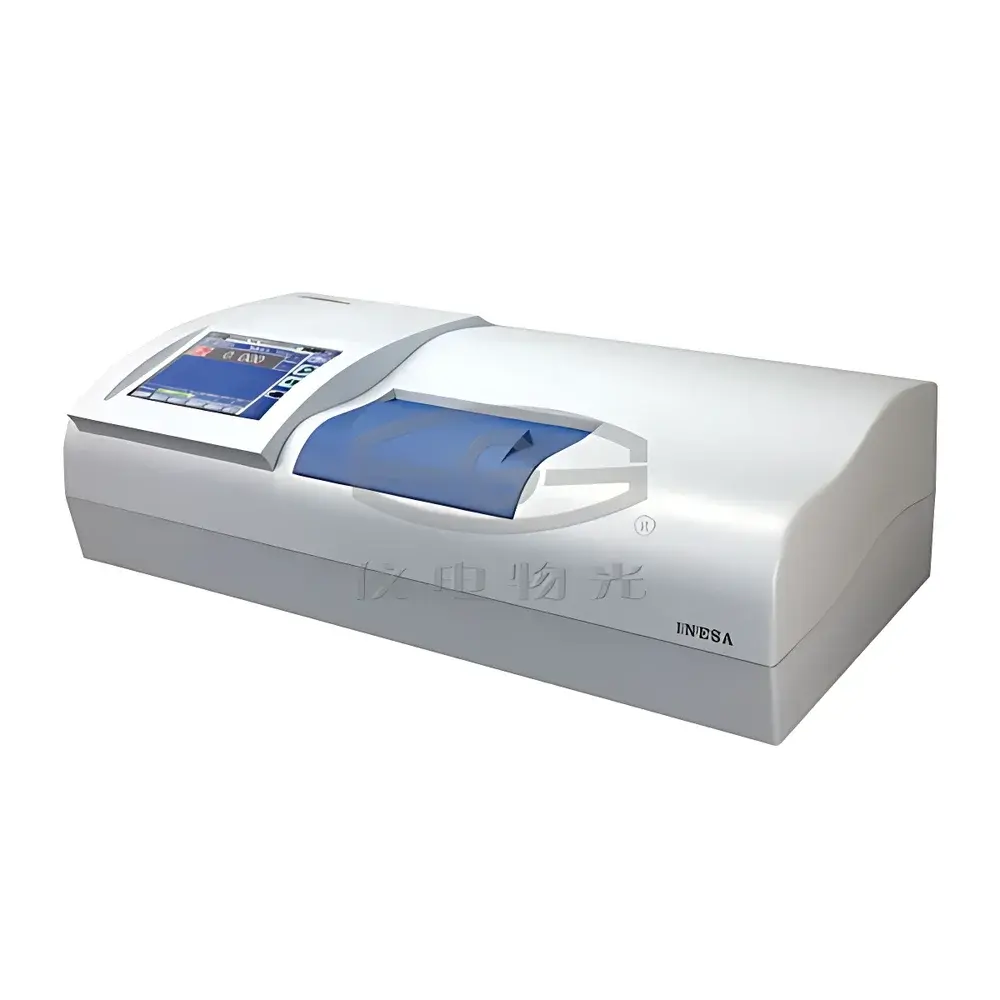
YDWG SGW®-533 Automatic High-Speed Polarimeter
| Brand | YDWG |
|---|---|
| Origin | Shanghai, China |
| Model | SGW®-533 |
| Product Type | Automatic Polarimeter |
| Temperature Control | Peltier-integrated, 10–50 °C (±0.2 °C accuracy) |
| Display | 8-inch color touch LCD |
| Light Source | LED (589 nm, Na D-line equivalent) with precision interference filter |
| Measurement Range | ±90° (optical rotation), ±259°Z (saccharimetric scale) |
| Minimum Resolution | 0.001° |
| Accuracy | ±0.004° |
| Repeatability (SD) | ≤0.002° |
| Zero Repeatability | 0.001° |
| Response Speed | 8°/s (full-scale) |
| Average Measurement Time | 26 s (6 measurements) |
| Sample Transmittance Limit | ≥0.05% |
| Data Storage | 16 GB internal |
| User Management | 4-tier password hierarchy, up to 500 users |
| Electronic Signatures & Audit Trail | Compliant with FDA 21 CFR Part 11 requirements |
| Predefined Methods | 1000 user-configurable protocols |
| Connectivity | USB, VGA, Ethernet, optional Wi-Fi & thermal printer |
| Standard Cells | 100 mm and 200 mm pathlength (ambient & thermostatted) |
| Dimensions | 702 × 376 × 240 mm |
| Net Weight | 21 kg |
| Compliance | JJG 536–2015 Class 0.01, USP <781>, EP 2.2.7, ISO 13871, GLP/GMP-ready |
Overview
The YDWG SGW®-533 Automatic High-Speed Polarimeter is a precision optical instrument engineered for quantitative measurement of optical rotation in chiral substances—primarily used in pharmaceutical quality control, fine chemical synthesis, food & beverage analysis (especially sucrose quantification), and academic research. Based on the fundamental principle of polarimetry—differential interaction of plane-polarized light with optically active molecules—the SGW®-533 employs a stabilized LED source emitting at 589 nm (equivalent to the sodium D-line), coupled with high-fidelity photoelectric detection and real-time digital signal processing. Its closed-loop Peltier temperature control system ensures strict thermal stability during measurement, directly supporting regulatory compliance for method validation under ICH Q2(R2) and pharmacopoeial monographs (e.g., USP , Ph. Eur. 2.2.7). Unlike conventional analog polarimeters, the SGW®-533 integrates a fully digital optical platform that eliminates mechanical drift, enhances long-term calibration retention, and delivers sub-milliarcsecond angular resolution.
Key Features
- High-speed acquisition architecture: Achieves full-range response in ≤8°/s with mean measurement cycle time of 26 seconds across six replicates—enabling throughput-critical environments such as QC release testing.
- Peltier-based thermostatic cell holder: Maintains sample temperature from 10 °C to 50 °C with ±0.2 °C accuracy; supports both ambient and temperature-controlled measurement modes without external chillers or baths.
- FDA 21 CFR Part 11–compliant software stack: Includes role-based 4-level user authentication, electronic signatures, immutable audit trails, and encrypted data storage—validated for GxP environments including GLP and GMP operations.
- Modular hardware interface: Native support for USB peripherals (keyboard, mouse, printers), VGA video output, Gigabit Ethernet, and optional Wi-Fi or thermal printing modules—facilitating seamless integration into LIMS and enterprise laboratory networks.
- Digital calibration protocol: Multi-point automatic zero and span calibration routines traceable to NIST-traceable quartz standards; maintains JJG 536–2015 Class 0.01 metrological certification.
- Expandable method library: Stores up to 1000 user-defined measurement protocols—including custom calculation formulas for specific rotation [α], concentration, and %w/w sugar—accessible via intuitive touchscreen navigation.
Sample Compatibility & Compliance
The SGW®-533 accommodates standard 100 mm and 200 mm pathlength cells (glass or quartz), plus optional 50 mm micro-cells for precious or low-volume samples. All cell holders are chemically resistant and compatible with aqueous, alcoholic, and mildly acidic/basic solutions common in API and excipient analysis. The instrument meets national and international metrological standards: JJG 536–2015 (China), ISO 13871:2000 (polarimeter performance criteria), and pharmacopoeial requirements per USP , EP 2.2.7, and JP 6.0. Its embedded security architecture satisfies data integrity mandates under FDA 21 CFR Part 11, EU Annex 11, and WHO TRS 996 Annex 5—making it suitable for regulated submissions and routine batch release in cGMP facilities.
Software & Data Management
Running on Windows OS, the proprietary PolarSoft™ application provides full lifecycle data governance. Raw and processed results—including timestamps, operator IDs, instrument conditions, and environmental metadata—are stored in encrypted binary format on the onboard 16 GB flash drive. Data export supports CSV, PDF, and XML formats compliant with LIMS ingestion schemas. Optional 256 GB SSD and 4 GB RAM upgrades enhance concurrent multi-user access and large-dataset handling. All modifications to methods, parameters, or results generate timestamped, signed audit records—enabling full forensic reconstruction during regulatory inspections.
Applications
- Pharmaceutical QC: Quantitative assay of chiral APIs (e.g., levodopa, ibuprofen, chloramphenicol) per USP monographs; verification of enantiomeric purity post-synthesis or crystallization.
- Sugar industry: Direct determination of sucrose concentration (%w/w) in raw cane juice, syrups, and refined products using the Z-scale mode—calibrated against certified saccharimetric standards.
- Academic research: Kinetic studies of enzymatic racemization, asymmetric catalysis monitoring, and structural conformational analysis of biomolecules (e.g., polysaccharides, peptides).
- Food & beverage: Verification of honey authenticity, fruit juice adulteration screening, and quality grading of maple syrup and molasses.
- Chemical manufacturing: In-process control of chiral intermediates in fine chemical and agrochemical production lines.
FAQ
Does the SGW®-533 support remote calibration verification?
Yes—via built-in reference check routines using factory-installed quartz control plates; traceable certificates available upon request.
Can the instrument be integrated into an existing LIMS via API or HL7?
It supports bidirectional data exchange through standard TCP/IP protocols and configurable ODBC drivers; custom API wrappers are available under NDA.
Is the 589 nm LED source stable enough for daily calibration-free operation?
With >100,000-hour lifetime and thermal feedback stabilization, the LED maintains wavelength consistency within ±0.1 nm over its operational life—eliminating lamp replacement and spectral recalibration.
What level of cybersecurity is implemented for network-connected units?
All network interfaces enforce TLS 1.2+ encryption, role-based port lockdown, and firmware signature validation; optional FIPS 140-2 Level 1 cryptographic module upgrade available.
How does the SGW®-533 handle turbid or low-transmittance samples?
Its high-sensitivity photodetector array achieves reliable signal capture down to 0.05% transmittance—validated with opalescent antibiotic suspensions and colloidal carbohydrate solutions.




