
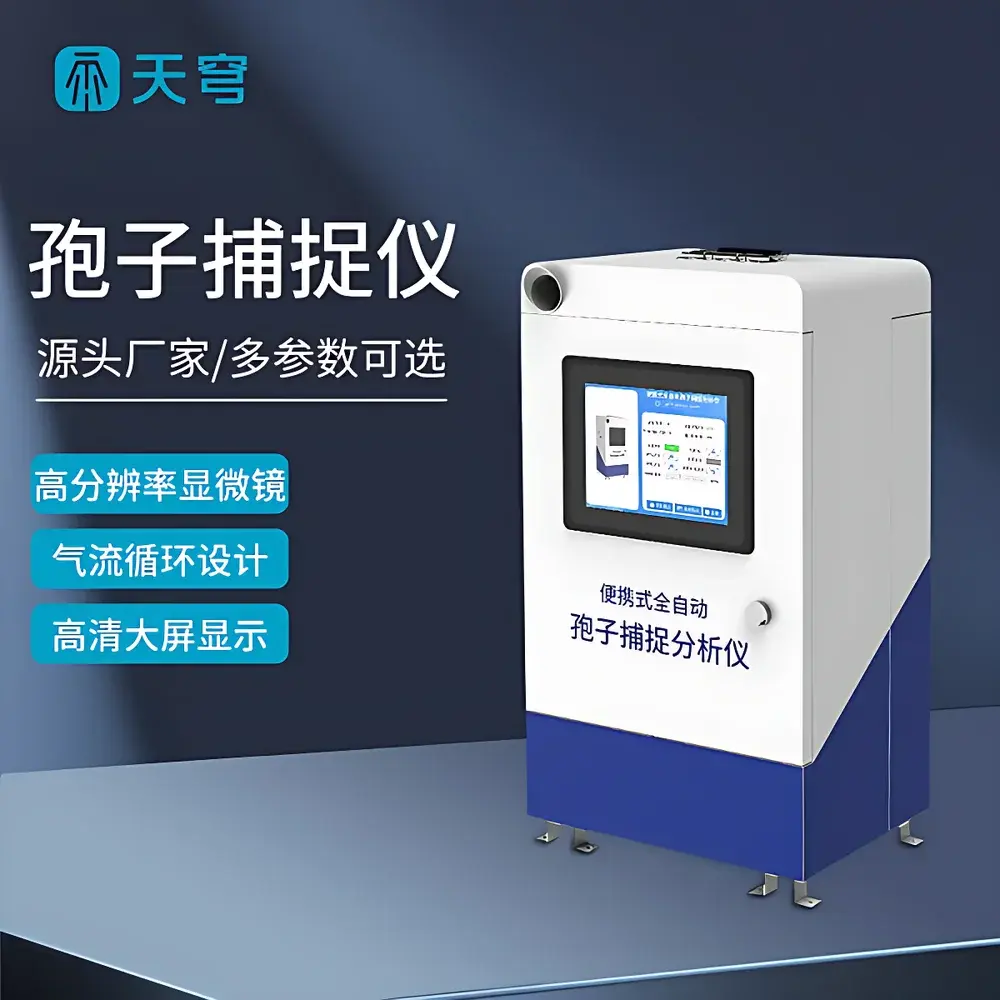
Fengtu TQ-BZ2 Spore Trap
| Brand | Fengtu |
|---|---|
| Origin | Shandong, China |
| Manufacturer Type | Authorized Distributor |
| Country of Origin | China |
| Model | TQ-BZ2 |
| Price | USD 3,200 (FOB) |
| Power Supply | 220 VAC / Optional 480 W–200 Ah Solar Kit |
| Operating Temperature | −20 °C to +70 °C |
| Relative Humidity | 0–95% RH (non-condensing) |
| Dimensions | 600 × 640 × 1418 mm |
| Imaging Sensor | 8 MP CMOS |
| Microscopy Resolution | Capable of resolving spores 5–100 µm in diameter |
| Sampling Area | 50 × 21 mm per capture cycle |
| Sampling Duration | Adjustable from 60 to 1200 minutes |
| Data Transmission | 4G LTE (TCP/IP), DNS-enabled, SIM-based |
| Display | 10.4″ TFT-LCD with Windows 10 OS |
| Power Consumption | ≤65 W (startup), ≤50 W (operational), ≤26.4 W (standby) |
| Insulation Resistance | ≥2.5 MΩ |
| Slide Carrier Lifespan | Up to 365 days at 3 captures/day |
| Motorized Stage | Dual-axis (X/Y) precision stepper control |
| Airflow Design | Optimized laminar ducting for reduced particle re-entrainment and improved collection efficiency |
Overview
The Fengtu TQ-BZ2 Spore Trap is an automated, field-deployable aerobiological monitoring instrument engineered for continuous, non-destructive capture and digital imaging of airborne fungal spores in agricultural ecosystems. It operates on the principle of volumetric air sampling combined with inertial impaction onto a moving adhesive substrate—specifically, a calibrated glass slide carrier. Ambient air is drawn through a precisely engineered inlet duct at controlled flow rates, inducing particle-laden airflow across a defined impact surface. Spores ≥5 µm in aerodynamic diameter are deposited via inertial impaction onto the coated slide, preserving morphological integrity for subsequent high-resolution optical analysis. The integrated 8-megapixel microscope system captures in-focus images under programmable LED illumination, enabling morphometric characterization without chemical fixation or staining. This design aligns with established ISO 21501-4 and ASTM D6324 guidelines for aerosol particle counting and sizing in environmental surveillance applications.
Key Features
- Dual-axis motorized stage with microstepping precision for repeatable slide positioning and multi-field mosaic imaging.
- Intelligent slide lifecycle management: real-time usage tracking, configurable low-slide alerts, password-protected manual reset, and field-replaceable slide cassette architecture.
- Configurable operational modes: fully autonomous scheduling (with start time, duration, interval, and pulse-count-driven slide advancement) or manual on-demand control via local HMI.
- 10.4″ industrial-grade Windows 10 touchscreen interface supporting local image review, parameter configuration, device diagnostics, and firmware updates.
- Optimized airflow path with minimized recirculation zones, validated to reduce duplicate sampling artifacts and improve temporal resolution of spore flux events.
- Adjustable sampling parameters: user-defined suction duration (60–1200 min), daily capture frequency, and slide motion increments (pulse-based step control).
- Robust environmental enclosure: powder-coated steel chassis rated IP55 equivalent; operational tolerance from −20 °C to +70 °C and up to 95% RH (non-condensing).
- Integrated power management: compatible with standard 220 VAC grid supply or optional solar-battery hybrid (480 W panel + 200 Ah LiFePO₄ bank) for off-grid deployment.
Sample Compatibility & Compliance
The TQ-BZ2 is validated for capture and imaging of morphologically distinct spore types commonly associated with cereal rusts (e.g., Puccinia triticina), powdery mildews (Blumeria graminis), smuts (Ustilago maydis), and foliar pathogens such as Alternaria, Cladosporium, and Fusarium spp. Its 5–100 µm effective capture range covers >92% of agriculturally relevant fungal propagules based on aerodynamic diameter distributions reported in EPPO PM 7/114 and FAO Crop Protection Guidelines. The device complies with IEC 61000-6-2 (immunity) and IEC 61000-6-4 (emissions) standards. While not certified under FDA 21 CFR Part 11, its audit trail functionality—including timestamped image metadata, configuration change logs, and remote command history—supports GLP-aligned data governance frameworks when deployed within institutional QA protocols.
Software & Data Management
Data acquisition and remote supervision are managed through a secure, role-based cloud platform accessible via web browser or dedicated desktop client. All captured images are tagged with GPS coordinates, UTC timestamps, ambient temperature/humidity (if external sensors are connected), and device-specific identifiers. Image uploads occur via TLS-encrypted 4G LTE connections using TCP/IP over dynamic DNS—requiring only a standard IoT SIM card. The platform implements server-side image enhancement (contrast normalization, noise reduction, edge sharpening) prior to human-in-the-loop annotation. Manual classification labels are stored alongside raw images, enabling supervised model training for future AI-assisted identification. Audit logs record all user actions (login, parameter changes, slide resets, image deletions) with immutable timestamps, satisfying traceability requirements for research reproducibility and regulatory documentation.
Applications
- Early-warning surveillance for regional-scale disease forecasting networks (e.g., national plant protection organizations).
- On-farm precision scouting to inform fungicide application timing and reduce input use by up to 30%, per FAO Field Guide No. 122.
- Long-term phenological studies correlating spore flux dynamics with microclimate variables and host phenology stages.
- Validation of atmospheric dispersion models (e.g., HYSPLIT) used in cross-border pathogen risk assessment.
- Supporting breeding programs by quantifying field exposure pressure of target pathogens during critical growth windows.
FAQ
Does the TQ-BZ2 require consumables other than the adhesive slide carrier?
No—only the pre-coated glass slide cassette requires periodic replacement. No filters, reagents, or calibration gases are needed.
Can the device operate autonomously for extended periods without network connectivity?
Yes. All sampling, imaging, and local storage functions remain fully operational offline. Images and metadata queue locally and transmit automatically upon network restoration.
Is the Windows 10 OS locked down to prevent unauthorized software installation?
Yes. The system boots into kiosk mode with restricted admin access; only signed firmware updates and platform-certified drivers may be installed.
How is time synchronization maintained across distributed units?
The device performs automatic NTP synchronization daily via the 4G connection; fallback to GPS-derived UTC time is available if enabled.
What level of technical support is provided for integration with third-party GIS or ERP platforms?
RESTful API documentation and JSON schema definitions are included with enterprise licenses, enabling direct ingestion into platforms compliant with OGC SensorThings API or ISO 19156 Observations & Measurements standards.






