
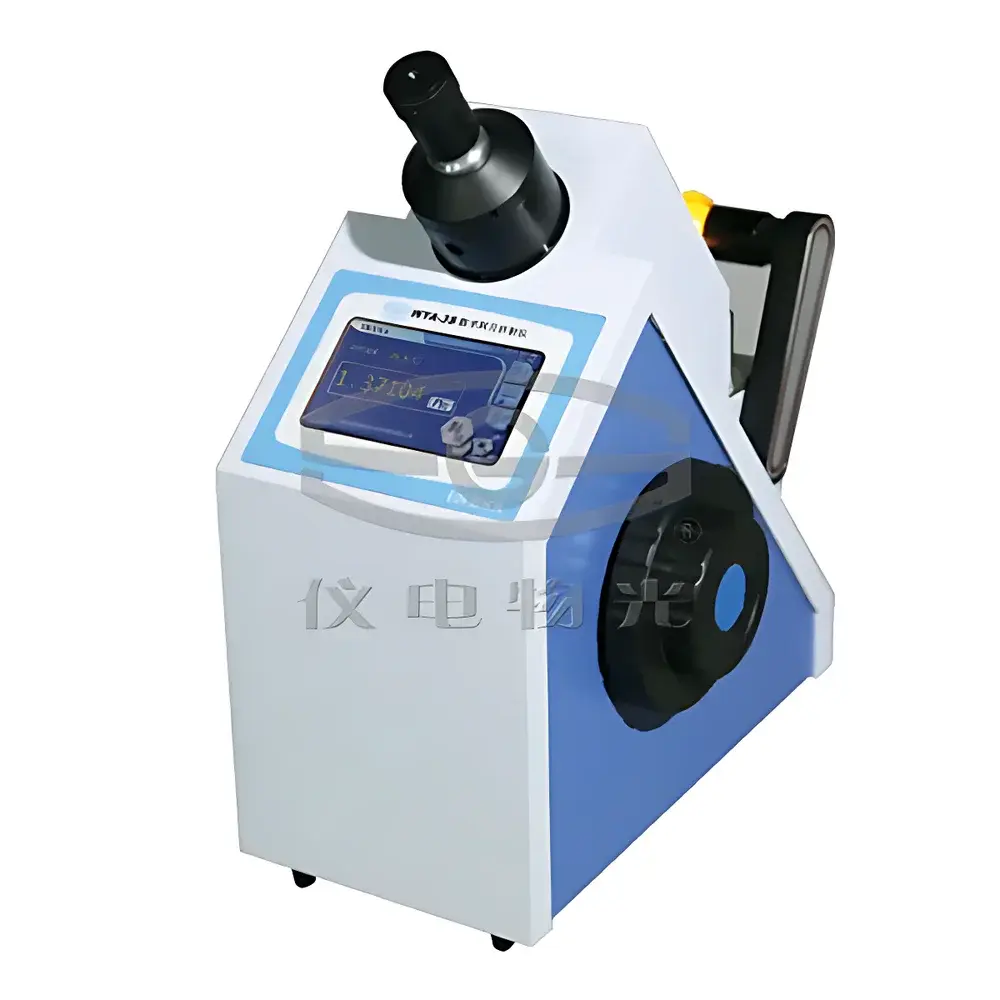
YDWO WYA-3S Digital Abbe Refractometer
| Brand | YDWO (Yidian Woguang) |
|---|---|
| Origin | Shanghai, China |
| Model | WYA-3S |
| Type | Benchtop Abbe Refractometer |
| Display | Color LCD Touchscreen |
| Measurement Range (nD) | 1.30000–1.72000 |
| Measurement Range (Brix) | 0–100% |
| Resolution (nD) | 0.00001 |
| Resolution (Brix) | 0.01% |
| Accuracy (nD) | ±0.0002 |
| Accuracy (Brix) | ±0.1% |
| Temperature Display Range | −20–120 °C |
| Data Storage Capacity | 500 sets |
| Interface | RS232 & USB |
| Power Supply | 220 V ±22 V, 50 Hz ±1 Hz, 30 W |
| Dimensions | 290 × 180 × 390 mm |
| Net Weight | 10 kg |
| Compliance | GB/T 12143–2008, GB/T 18963–2012, GB/T 21730–2008 |
Overview
The YDWO WYA-3S Digital Abbe Refractometer is a precision benchtop instrument engineered for accurate and repeatable measurement of refractive index (nD) and Brix concentration in transparent and semi-transparent liquids and solids. Based on the classical Abbe principle—utilizing total internal reflection at the prism-sample interface—the WYA-3S determines nD at the sodium D-line wavelength (589.3 nm) using a stabilized, imported LED light source. This optical architecture eliminates thermal drift and ensures long-term photometric stability without lamp aging or warm-up delay. The instrument supports direct determination of sucrose, glucose, F42/F55 high-fructose corn syrup (HFCS), fruit juice solids, honey moisture content, and canned food dry matter—making it suitable for quality control laboratories in food & beverage, pharmaceutical excipient, and chemical manufacturing sectors where traceable, ISO/IEC 17025-aligned measurements are required.
Key Features
- Hard-glass measuring prism with enhanced corrosion resistance and scratch durability for extended service life under routine lab use.
- High-resolution color LCD touchscreen interface with intuitive icon-driven navigation, real-time parameter display, and on-device data review.
- Integrated temperature sensor with ±0.2 °C accuracy over −20–120 °C range; compatible with external recirculating chillers or thermostatic water baths via optional flow cell (not included).
- Dual-mode operation: manual visual alignment via built-in telescope eyepiece + digital readout confirmation—ensuring both operator verification and instrument repeatability.
- Eight pre-programmed measurement modes (e.g., nD, Brix, % dry solids, % water in honey) with automatic temperature compensation per ASTM D1218 and ISO 2173 protocols.
- Stable 589.3 nm LED illumination source: zero warm-up time, negligible heat generation, >50,000-hour lifetime, and spectral consistency compliant with CIE illuminant A reference conditions.
- Built-in non-volatile memory storing up to 500 measurement records with timestamp, sample ID, operator tag, and environmental metadata.
Sample Compatibility & Compliance
The WYA-3S accommodates samples ranging from low-viscosity aqueous solutions (e.g., soft drink syrups) to viscous media such as honey, jam, and condensed milk—provided surface homogeneity and optical clarity permit clean critical angle detection. Solid samples (e.g., polymer films, optical glasses) require polished flat surfaces and appropriate contact fluid (e.g., bromonaphthalene). All measurements adhere to national standards GB/T 12143–2008 (for soft drinks), GB/T 18963–2012 (for honey), and GB/T 21730–2008 (for fruit juices). While not inherently 21 CFR Part 11 compliant, audit trails and exportable CSV logs support GLP/GMP documentation workflows when integrated into validated laboratory information management systems (LIMS).
Software & Data Management
Data acquisition and reporting are enabled via dual communication interfaces: USB 2.0 for direct PC connection (Windows-compatible drivers provided) and RS232 for legacy printer integration (e.g., CK NT-T24S thermal printer, optional). Exported datasets include nD, Brix, temperature, measurement mode, and user-defined identifiers. No proprietary software is required—raw ASCII output allows seamless import into Excel, MATLAB, or statistical process control (SPC) platforms. Firmware updates are delivered via USB stick; configuration parameters (e.g., calibration offsets, default units, auto-shutdown delay) are retained across power cycles.
Applications
- Quality assurance of sugar-based formulations: sucrose equivalence validation in confectionery syrups and HFCS blends.
- Moisture analysis in honey per AOAC 984.23—correlating nD to water content without destructive Karl Fischer titration.
- In-process monitoring of fruit juice concentration during evaporation or reconstitution stages.
- Raw material verification of glycerin, propylene glycol, and ethylene glycol used in pharmaceutical excipients.
- Refractive index mapping of optical adhesives and encapsulants in electronics manufacturing.
- Academic teaching labs: demonstration of dispersion relationships, critical angle phenomena, and temperature-dependent optical property trends.
FAQ
Does the WYA-3S support automatic temperature control?
No—it displays sample temperature via an embedded Pt100 sensor but requires external thermostatic circulation (e.g., Huber chiller or Polyscience bath) for controlled measurements.
Can the instrument measure opaque or turbid samples?
Not reliably; Abbe refractometry requires optically homogeneous, translucent-to-transparent media. Suspensions, emulsions, or heavily pigmented liquids yield inconsistent critical angle detection.
Is factory calibration traceable to NIST or PTB standards?
Calibration uses certified reference fluids (e.g., distilled water, standard sucrose solutions) traceable to national metrology institutes per JJG 616–2006. Full traceability documentation available upon request.
What maintenance is required for long-term accuracy?
Annual verification against certified standards is recommended. Prism cleaning with lens-grade tissue and anhydrous ethanol after each use prevents residue buildup and refractive index drift.
How is Brix calculated from nD?
The WYA-3S applies polynomial interpolation based on the ICUMSA sucrose conversion tables (1994 edition), with built-in correction for temperature deviation from 20 °C per ISO 2173 Annex B.






