
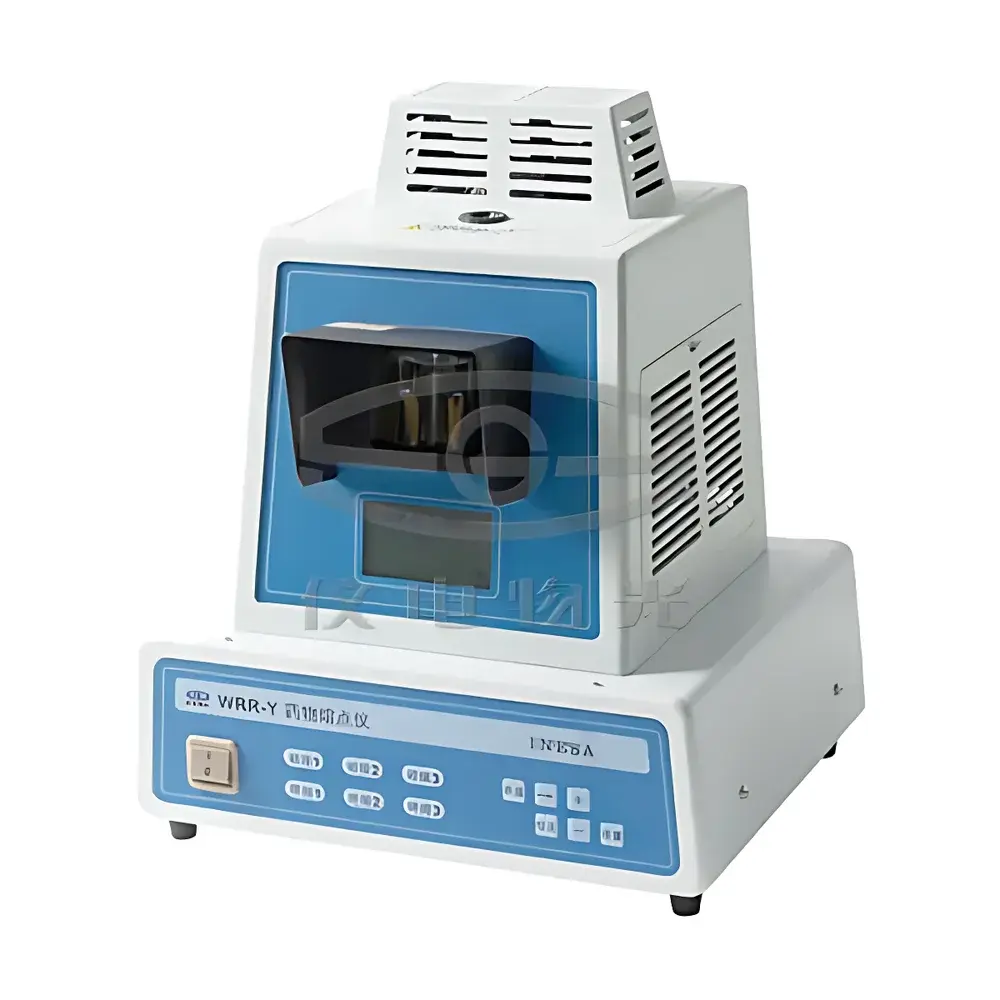
YDWG WRR Visual Melting Point Apparatus
| Brand | YDWG |
|---|---|
| Origin | Shanghai, China |
| Model | WRR |
| Temperature Range | Ambient to 280 °C |
| Heating Rates | 0.5, 1.0, 1.5, 3.0 °C/min (four fixed steps) |
| Temperature Repeatability | ±0.3 °C at 1.0 °C/min |
| Temperature Accuracy | ±0.4 °C ≤200 °C |
| Capillary Dimensions | OD 1.4 mm, ID 1.0 mm, Length 120 mm |
| Sample Capacity | 3 capillaries simultaneously |
| Temperature Resolution | 0.1 °C |
| Display | LCD |
| Interface | RS232/USB |
| Power Supply | 220 V ±22 V, 50 Hz ±1 Hz, 100 W |
| Dimensions | 270 × 310 × 400 mm |
| Net Weight | 11 kg |
Overview
The YDWG WRR Visual Melting Point Apparatus is a precision thermal analysis instrument engineered for the manual, observer-based determination of melting point intervals—specifically the onset (initial melt) and completion (final melt) temperatures—of crystalline organic compounds and pharmaceutical substances. It operates on the classical capillary tube method defined in pharmacopoeial standards including the Chinese Pharmacopoeia (ChP), United States Pharmacopeia (USP <741>), and European Pharmacopoeia (Ph. Eur. 2.2.14). The instrument employs a thermally stabilized metal heating block immersed in silicone oil as the heat-transfer medium, ensuring uniform temperature distribution across three parallel capillary positions. This configuration enables simultaneous measurement of replicate samples under identical thermal conditions, supporting statistical evaluation via mean value calculation—a requirement for quality control laboratories operating under GLP or GMP frameworks.
Key Features
- Triple-capillary design allows concurrent analysis of three independent samples, improving throughput and enabling intra-batch repeatability assessment.
- Four discrete, user-selectable heating rates (0.5, 1.0, 1.5, and 3.0 °C/min) comply with pharmacopoeial method flexibility requirements; rate selection is mechanically interlocked to prevent drift during operation.
- High-stability heating block with PID-controlled silicon oil bath delivers consistent thermal gradients and minimizes overshoot, critical for accurate detection of subtle phase transitions.
- Optical viewing system includes dual magnification lenses (10× and 20×) and adjustable LED illumination, optimized for visual discrimination of meniscus formation, shrinkage, and collapse—particularly for deeply colored or opaque samples where automated optical detection may fail.
- LCD display with 0.1 °C resolution provides real-time temperature readout synchronized with analog scale calibration traceability.
- RS232 and USB interfaces support external data logging, instrument control via host software, and integration into laboratory information management systems (LIMS) for audit-ready record retention.
Sample Compatibility & Compliance
The WRR accommodates standard thin-walled glass capillaries (1.4 mm OD, 1.0 mm ID, 120 mm length) filled to a nominal height of 3 mm—consistent with USP <741> and ChP IV general chapter specifications. Its silicone oil bath permits reliable measurement of thermally sensitive, high-melting-point, or optically dense materials—including dyes, polymers, and API intermediates—that exhibit poor transmission in automated photometric systems. The apparatus meets essential metrological criteria outlined in ISO/IEC 17025:2017 for calibration traceability, with temperature accuracy validated against NIST-traceable reference standards. It supports full compliance with FDA 21 CFR Part 11 when paired with compliant data acquisition software, offering electronic signature capability, audit trail generation, and user access controls.
Software & Data Management
While the WRR operates as a standalone visual instrument, its RS232/USB connectivity enables integration with third-party thermal analysis suites or custom LIMS modules. Exported data include timestamped temperature readings, selected heating rate, operator ID, sample ID, and observed melt events (onset/completion). All digital records maintain immutable timestamps and are structured in CSV or XML format for seamless import into statistical process control (SPC) platforms. Optional firmware updates ensure alignment with evolving pharmacopoeial revisions and regulatory expectations for data integrity in QC environments.
Applications
- Pharmaceutical raw material and finished product release testing per USP, EP, and ChP monographs.
- Quality assurance of fine chemicals, agrochemicals, and cosmetic actives requiring identity and purity verification.
- Academic and industrial research labs conducting structure–property correlation studies involving polymorphism, solvate formation, or eutectic behavior.
- Regulatory submission support, including batch documentation for ANDA, NDA, and DMF filings where visual melt point remains a compendial requirement.
- Method transfer between R&D and manufacturing sites due to its standardized, operator-independent protocol design.
FAQ
Is the WRR suitable for dark or opaque samples?
Yes—the visual observation mode eliminates reliance on light transmission, making it uniquely appropriate for deeply colored, turbid, or carbon-black-containing substances.
Does the instrument provide automatic melt point detection?
No—it is a manually operated visual apparatus; final interpretation of melt events rests with the trained analyst, in accordance with pharmacopoeial guidelines.
Can calibration certificates be provided with traceability to national standards?
Yes—certified calibration services are available through authorized YDWG service centers, including uncertainty budgets aligned with ISO/IEC 17025.
What maintenance is required for long-term stability?
Routine cleaning of the optical path and periodic replacement of silicone oil (recommended annually or after 500 test cycles) ensures consistent thermal performance and image clarity.
Is the WRR compatible with 21 CFR Part 11-compliant data handling?
When used with validated third-party software that implements electronic signatures, audit trails, and role-based access control, the instrument satisfies core Part 11 requirements for electronic records.



