
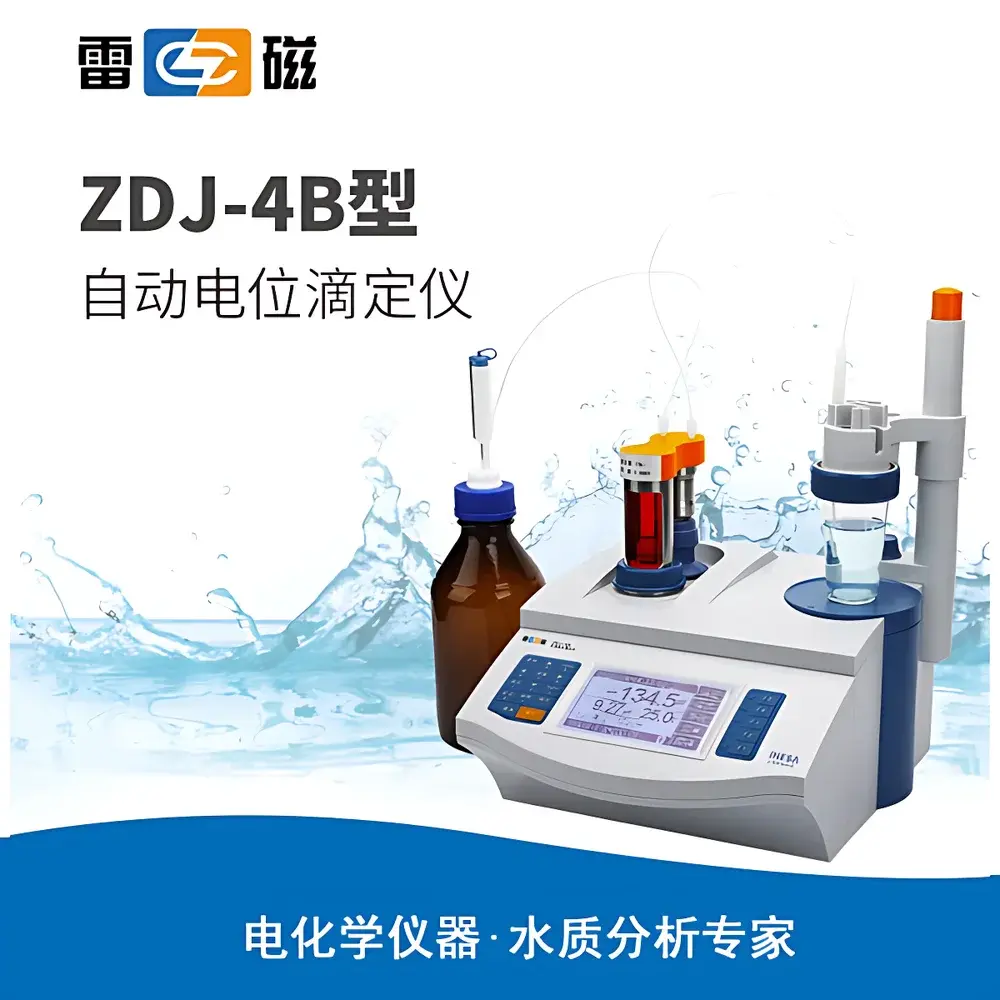
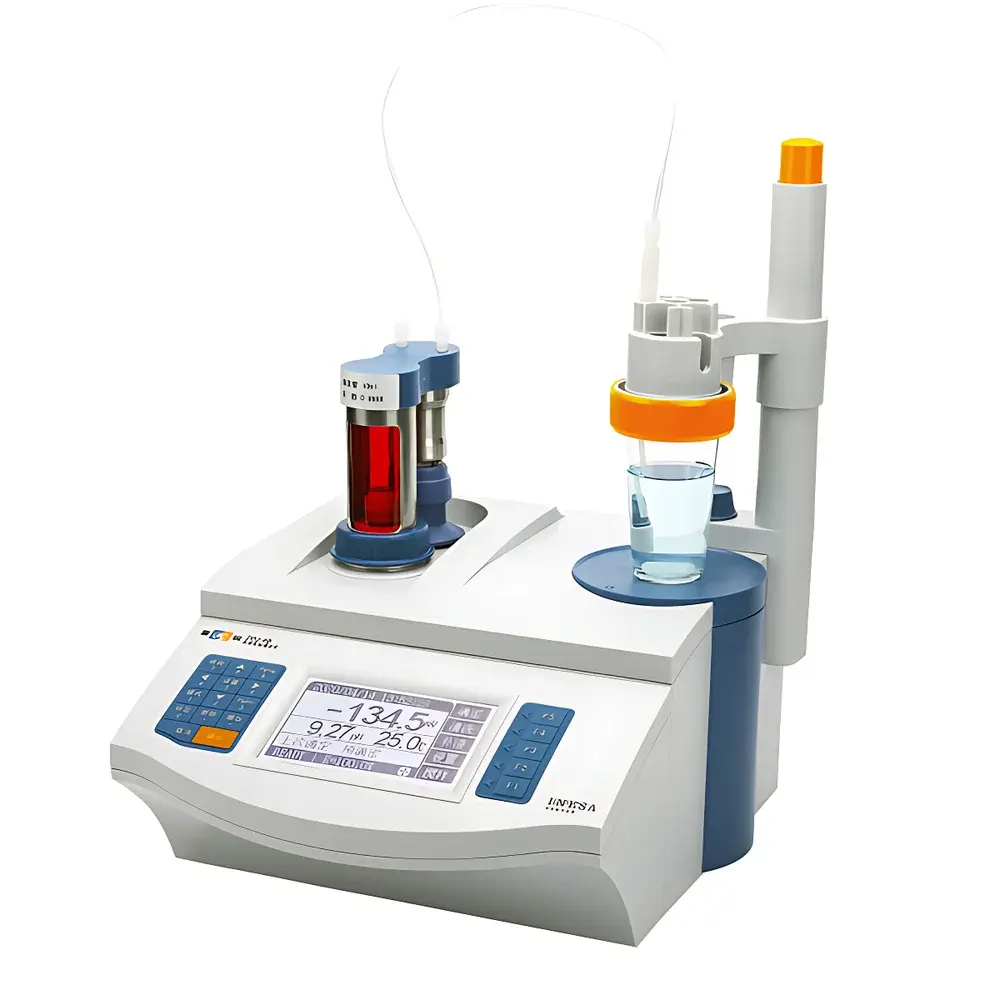
Leici ZDJ-4B Automatic Potentiometric Titrator
| Brand | Leici |
|---|---|
| Origin | Shanghai, China |
| Model | ZDJ-4B |
| Instrument Type | General-purpose Potentiometric Titrator |
| Application Scope | Universal |
| Measurement Range | (0.00–14.00) pH |
| Meter Accuracy | ±0.2% of full scale |
| Meter Resolution | 0.01 pH |
| Titration Accuracy | (±0.3 mV ± 1 digit)/3 h |
| Titration Resolution | 10 mL burette: 1/20,000 |
| 20 mL burette | 1/10,000 |
| Burette Volume Error | 10 mL: ±0.025 mL |
| 20 mL | ±0.035 mL |
| Temperature Compensation Range | (−5.0–105.0) °C |
| Resolution | 0.1 °C |
| Accuracy | ±0.3 °C |
| Power Supply | AC (220 ± 22) V, (50 ± 1) Hz |
| Dimensions (W×D×H) | 340 × 400 × 400 mm |
| Weight | 10 kg |
Overview
The Leici ZDJ-4B Automatic Potentiometric Titrator is a benchtop electrochemical analyzer engineered for precision potentiometric endpoint detection in routine and method-developed titrations. It operates on the fundamental principle of monitoring potential change (mV) or pH shift across a redox, acid-base, precipitation, complexometric, or non-aqueous titration system using a high-stability reference electrode and an ion-selective or inert indicator electrode. The instrument employs a closed-loop feedback algorithm to control reagent delivery via precision syringe-driven burettes, enabling reproducible volumetric addition with real-time potential/pH tracking. Designed for compliance-critical environments, it supports GLP-aligned data integrity through embedded audit trails, timestamped measurements, and structured result storage—making it suitable for QC laboratories in pharmaceuticals, fine chemicals, food safety, and environmental testing where traceable, repeatable titration outcomes are mandated.
Key Features
- Integrated valve-burette module with quick-release design for rapid, contamination-free exchange between titrant systems—eliminating cross-contamination risks during multi-analyte workflows.
- Dual-control architecture: independent operation via front-panel dot-matrix LCD with tactile keypad, or remote command execution via PC-connected Leici Titrator Software (Windows-based, USB/RS-232 compatible).
- Comprehensive titration mode library: dynamic (inflection-point), preset-endpoint, constant-dosage, blank-corrected, manual stepwise, and user-defined custom protocols—all configurable with adjustable slope thresholds, delay times, and volume increments.
- Multi-method support: validated for ASTM E2087 (acid number), ISO 661 (free fatty acids), USP (perchloric acid titrations), and ISO 9964-1 (complexometric EDTA assays), with built-in method templates and editable parameters.
- Real-time visualization: simultaneous display of titration curve (E vs. V or pH vs. V), derivative plot (dE/dV), current titrant volume, measured potential/pH, and endpoint confidence index.
- Firmware upgradability via USB flash drive; optional integration with third-party autosamplers (e.g., Leici AS-20) through PC-mediated serial coordination.
Sample Compatibility & Compliance
The ZDJ-4B accommodates aqueous, alcoholic, acetic anhydride, and mixed-solvent systems—enabling accurate determination of total acidity, chloride, sulfate, calcium/magnesium hardness, peroxide value, and iodine number. Electrode compatibility includes standard Ag/AgCl, calomel, platinum, glass pH, and specialized sensors for fluoride, cyanide, or sulfide. All measurement records adhere to GLP data integrity requirements: each stored result (up to 200 complete titrations + 1 full curve) contains operator ID, date/time stamp, electrode calibration history, burette serial number, ambient temperature, and raw mV/pH timestamps at 0.1 s intervals. Data export supports CSV and proprietary .TIT formats for LIMS integration. While not natively 21 CFR Part 11 compliant, its audit trail structure satisfies pre-validated internal QA documentation standards under ISO/IEC 17025 and GMP Annex 11 when deployed with controlled access and procedural SOPs.
Software & Data Management
The included Leici Titrator Software provides method development, sequence programming, and post-run analysis tools. Users define titration sequences with conditional logic (e.g., “if ΔpH > 0.5 within last 0.1 mL, pause and verify”), set automatic recalibration triggers, and generate PDF reports with embedded curves, statistical summaries (RSD, mean equivalence volume), and digital signatures. Raw data files retain full acquisition metadata—including electrode impedance logs and temperature-compensated mV drift correction coefficients. Data deletion requires administrator-level authentication; USB export enforces write-protected file transfer. Firmware updates preserve all user methods and calibration profiles, ensuring continuity across maintenance cycles.
Applications
- Pharmaceutical QC: assay of active ingredients (e.g., amine HCl salts via non-aqueous titration), residual solvent quantification, and excipient purity verification.
- Food & Beverage: titratable acidity (TA) in wines and juices, salt content (argentometric), free SO₂, and peroxide value in edible oils per AOAC 965.33.
- Environmental Labs: alkalinity profiling (APHA 2320-B), chloride in wastewater (ASTM D3223), and cyanide speciation using silver nitrate titration.
- Chemical Manufacturing: acid number (ASTM D974), base number (ASTM D2896), and Karl Fischer water content validation via coulometric correlation.
- Academic Research: kinetic studies of slow-reacting systems using programmable pause intervals, and teaching labs requiring intuitive endpoint visualization for undergraduate electrochemistry courses.
FAQ
What electrode types are compatible with the ZDJ-4B?
Standard single-junction Ag/AgCl and double-junction reference electrodes, combined pH electrodes, platinum redox electrodes, and ion-selective electrodes (e.g., fluoride, bromide) with BNC or DIN connectors.
Can the ZDJ-4B perform thermometric or photometric titrations?
No—it is strictly a potentiometric platform. Thermometric and spectrophotometric endpoints require dedicated hardware modules not supported by this model.
Is the instrument certified for ISO/IEC 17025 accreditation?
The ZDJ-4B itself is not certified, but its measurement traceability, documented uncertainty budget (based on NIST-traceable pH buffers and certified KCl standards), and GLP-compliant data handling enable laboratory accreditation when used within a validated quality system.
How is temperature compensation applied during titration?
An integrated Pt1000 sensor measures solution temperature in real time; the software applies the Nernst equation correction factor to mV readings and adjusts pH calibration slopes per IUPAC recommendations.
What is the maximum allowable ambient operating temperature?
The unit is rated for continuous operation at 10–40 °C with ≤80% relative humidity (non-condensing), per IEC 61010-1 safety specifications.



