
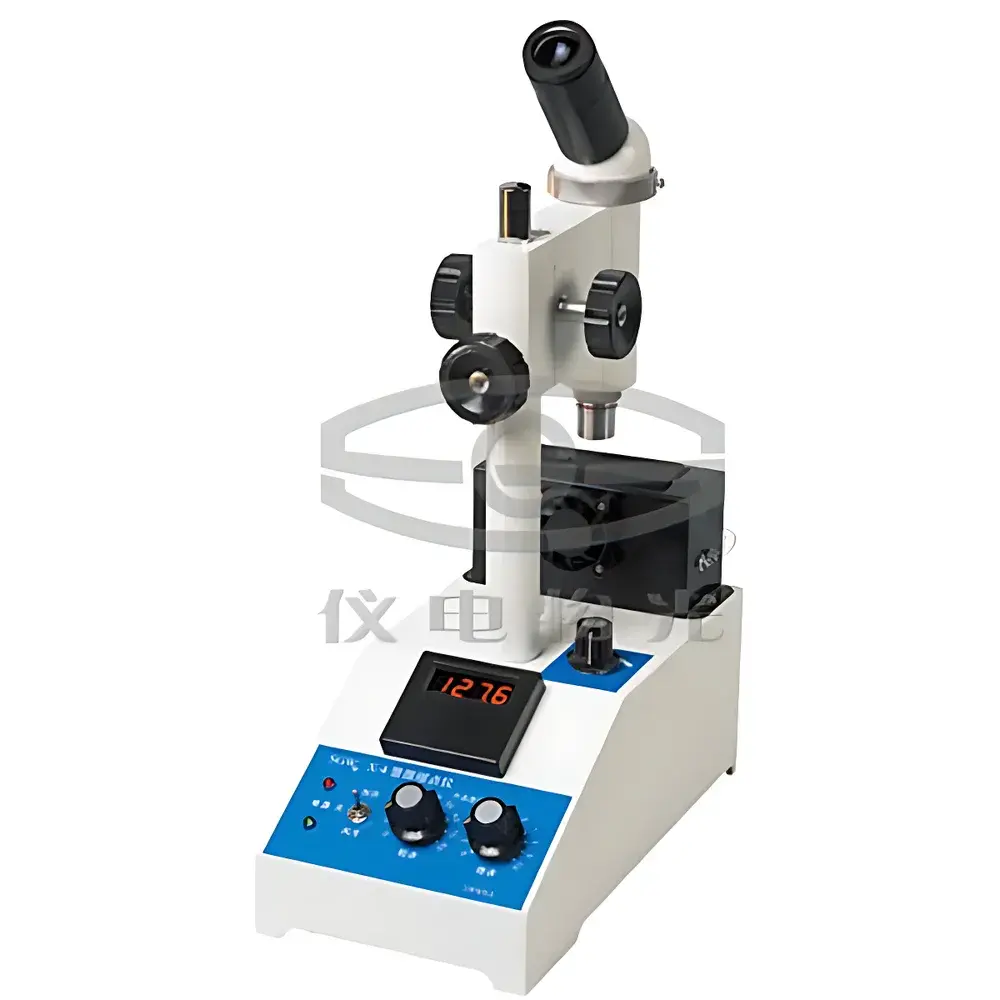
YDWG SGW® X-4A Microscopic Melting Point Apparatus
| Brand | YDWG |
|---|---|
| Origin | Shanghai, China |
| Model | SGW® X-4A |
| Temperature Range | Ambient to 330 °C |
| Temperature Repeatability | ±1 °C at ≤200 °C, ±2 °C at >200 °C |
| Temperature Accuracy | ±0.1 °C |
| Temperature Resolution | 0.1 °C |
| Viewing System | Monocular Microscope, 40× Magnification |
| Power Supply | 220 V ±22 V, 50 Hz ±1 Hz |
| Dimensions | 215 × 140 × 395 mm |
| Net Weight | 3.6 kg |
Overview
The YDWG SGW® X-4A Microscopic Melting Point Apparatus is a precision thermal analysis instrument engineered for the accurate determination of melting point ranges in crystalline organic compounds. It operates on the principle of controlled heating combined with real-time optical observation—enabling direct visualization of phase transitions (solid-to-liquid) under magnified conditions. Unlike automated digital systems, the SGW® X-4A retains a manual, operator-guided methodology grounded in classical pharmacopeial and industrial testing standards (e.g., USP <741>, EP 2.2.14, and ISO 11357-3). Its dual measurement capability—capillary tube method and hot-stage (slide-cover slip) method—provides flexibility across sample types and purity assessment requirements. The integrated monocular microscope (40× fixed magnification) ensures clear identification of meniscus formation, sintering, collapse, and full liquefaction stages, critical for distinguishing eutectic behavior or polymorphic transitions.
Key Features
- Stable temperature control system with PID regulation, delivering linear ramp rates and minimal overshoot across the full operating range (ambient to 330 °C)
- High-resolution digital temperature display (0.1 °C resolution) calibrated against traceable NIST-traceable reference standards
- Optimized thermal chamber design with built-in draft shield to minimize ambient air currents—reducing measurement variance in non-climate-controlled lab environments
- Robust aluminum alloy heating block with uniform thermal conductivity and low thermal inertia for rapid equilibration and reproducible heating profiles
- Ergonomic mechanical stage and coarse/fine focus controls for precise sample positioning and sustained visual monitoring during transition events
- Compliance-ready architecture: supports documented calibration records, user-accessible calibration offset adjustment, and audit-log-compatible operation logs when paired with external data capture protocols
Sample Compatibility & Compliance
The SGW® X-4A accommodates both standard 1.0 mm OD capillary tubes (90 mm length) and conventional glass slides/cover slips—making it suitable for powders, recrystallized solids, pharmaceutical intermediates, dyes, fragrances, and polymer additives. Sample preparation follows ICH Q5C and USP general chapter <741> guidelines, with particular attention to particle size, packing density, and moisture content—factors known to influence observed onset temperatures. While the instrument itself does not provide electronic audit trails, its operational consistency and manual recording interface align with GLP-compliant workflows when used in conjunction with controlled documentation practices (e.g., bound lab notebooks, SOP-mandated observation timing, and secondary verification by qualified personnel). Optional traceable calibration services—including as-found/as-left reports and uncertainty budgets—are available through authorized YDWG service centers accredited to ISO/IEC 17025.
Software & Data Management
The SGW® X-4A is a hardware-only platform with no embedded firmware or proprietary software. All temperature readings are displayed via an analog-style digital LED panel, ensuring electromagnetic immunity and long-term operational stability without driver dependencies or OS compatibility constraints. Users record observations manually—or integrate the unit into broader LIMS or ELN ecosystems using external USB thermal cameras (e.g., FLIR A35) synchronized with time-stamped video capture. For regulated environments requiring 21 CFR Part 11 compliance, third-party validation packages—including IQ/OQ documentation templates, alarm logic verification, and temperature uniformity mapping procedures—are supported through YDWG’s certified validation partners. Raw data export is achieved via optional RS-232 or USB-to-serial adapters (sold separately), enabling CSV logging compatible with MATLAB, Python pandas, or LabArchives ingestion pipelines.
Applications
- Pharmaceutical quality control: identity confirmation and purity assessment of active pharmaceutical ingredients (APIs) per USP monographs
- Organic synthesis validation: monitoring reaction completion and isolating pure fractions during column chromatography or recrystallization
- Materials science research: characterization of small-molecule semiconductors, metal-organic frameworks (MOFs), and chiral resolving agents
- Forensic chemistry: differentiation of structurally similar compounds (e.g., isomers, hydrates, solvates) based on sharpness and breadth of melting intervals
- Educational laboratories: hands-on training in thermal behavior, phase diagrams, and solid-state characterization fundamentals
FAQ
Is the SGW® X-4A compliant with pharmacopeial standards such as USP <741> or EP 2.2.14?
Yes—the instrument meets the essential hardware and operational criteria specified in these chapters, including temperature accuracy, visual observation capability, and ramp rate control. Final compliance depends on site-specific validation and procedural adherence.
Can the unit be calibrated internally by the user?
Yes—calibration offset adjustment is accessible via front-panel menu; however, full metrological calibration requires certified reference materials (e.g., pure naphthalene, adipic acid, anthraquinone) and traceable thermometry equipment.
What maintenance is required for long-term reliability?
Annual cleaning of the heating block bore and microscope optics is recommended; replacement of capillary holders and slide clamps every 2–3 years ensures consistent thermal contact and mechanical alignment.
Does YDWG offer 3Q validation support (IQ/OQ/PQ)?
Yes—qualified validation documentation kits and on-site execution services are available through authorized distributors, aligned with GMP Annex 15 and ASTM E2500-13 principles.



