
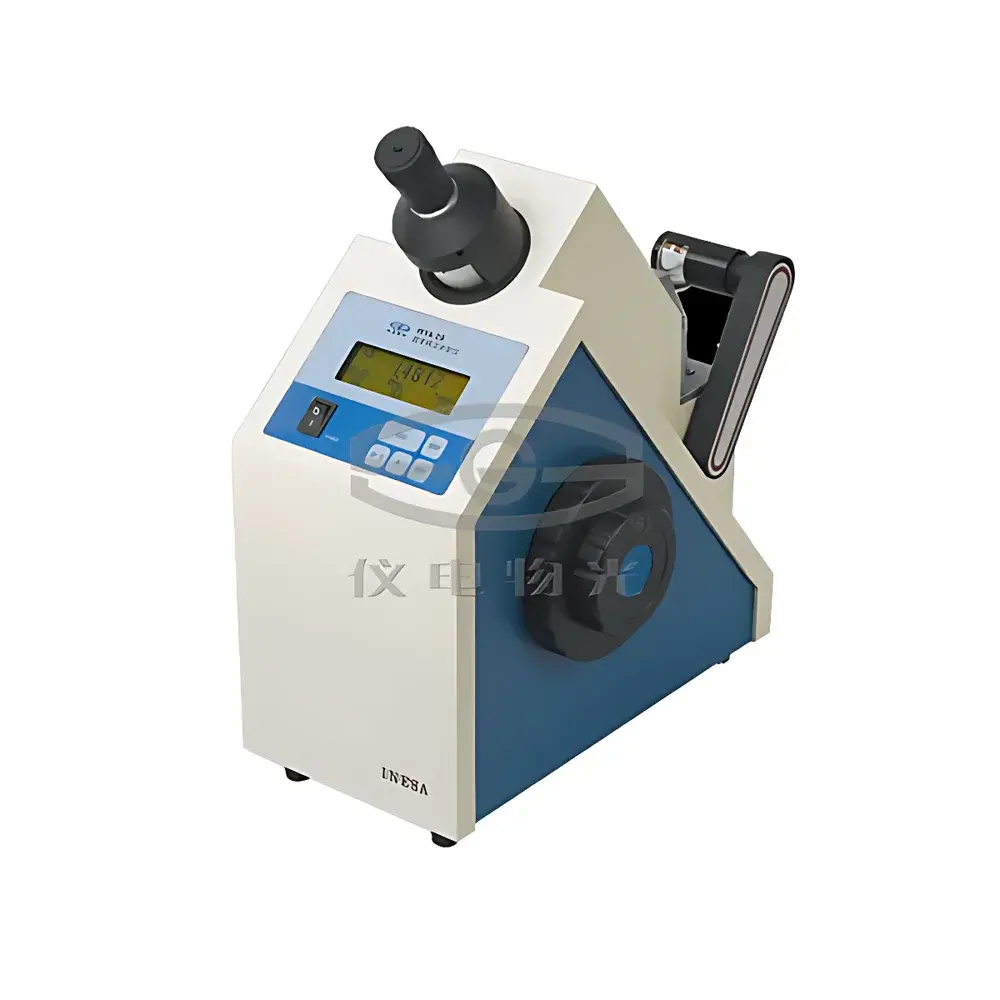
YDWO WYA-2S Digital Abbe Refractometer
| Brand | YDWO |
|---|---|
| Origin | Shanghai, China |
| Model | WYA-2S |
| Product Type | Benchtop Refractometer |
| Display | Digital LCD |
| Measurement Range (nD) | 1.3000–1.7000 |
| Resolution (nD) | 0.0001 |
| Accuracy (nD) | ±0.0002 |
| Temperature Display Range | 0–50 °C |
| Power Supply | 220 V ± 22 V, 50 Hz ± 1 Hz, 30 W |
| Dimensions | 290 × 180 × 390 mm |
| Net Weight | 10 kg |
| Compliance | GB/T 12143–2008, GB/T 18963–2012, GB/T 21730–2008 |
Overview
The YDWO WYA-2S Digital Abbe Refractometer is a precision benchtop instrument engineered for accurate and repeatable measurement of refractive index (nD) and Brix concentration across liquid and transparent semi-solid samples. Based on the classical Abbe principle—utilizing total internal reflection at the prism-sample interface—the instrument determines nD by precisely locating the critical angle of refraction. Its optical path incorporates high-quality, hardened optical glass prisms with enhanced resistance to chemical corrosion and mechanical abrasion—critical for long-term stability in QC laboratories handling solvents, pharmaceutical formulations, food extracts, and polymer solutions. Unlike analog Abbe refractometers, the WYA-2S integrates a digital readout system with real-time nD and %Brix calculation, eliminating parallax error and enabling direct traceability of measurement values. While it does not feature integrated active temperature control, its built-in high-accuracy thermistor enables reliable ambient or externally stabilized temperature monitoring (0–50 °C), supporting manual thermal equilibration protocols required by ISO 21748 and ASTM D1218.
Key Features
- Hardened optical glass prisms ensuring long-term dimensional stability and resistance to solvent-induced etching and surface scratching
- Digital LCD display with simultaneous dual-parameter output: refractive index (nD) to 0.0001 resolution and %Brix to 0.1% resolution
- Measurement accuracy of ±0.0002 nD—validated per GB/T 21730–2008 and aligned with international metrological expectations for Class B refractometers
- Minimal sample requirement (typically 0.1–0.3 mL), suitable for high-value or limited-availability materials including APIs, essential oils, and micro-volume calibration standards
- Built-in RS232 serial interface for external data logging, instrument control, and integration into LIMS environments under GLP-compliant workflows
- Compact benchtop footprint (290 × 180 × 390 mm) and low power consumption (30 W), optimized for shared lab spaces and continuous operation in regulated quality control settings
Sample Compatibility & Compliance
The WYA-2S accommodates homogeneous, optically transparent liquids and low-viscosity gels—including aqueous solutions, organic solvents, syrups, glycerol-water mixtures, and purified hydrocarbon fractions. It is unsuitable for opaque, highly scattering, or strongly fluorescent samples. The instrument conforms to multiple Chinese national standards governing refractometric analysis: GB/T 12143–2008 (for soft drink beverages), GB/T 18963–2012 (honey purity assessment), and GB/T 21730–2008 (general technical requirements for Abbe refractometers). These specifications define performance criteria for scale linearity, temperature sensitivity, repeatability, and optical alignment—ensuring compatibility with routine verification procedures in food, beverage, pharmaceutical, and chemical manufacturing QA/QC labs. Though not certified to ISO/IEC 17025, its documented accuracy and stable optical architecture support use within ISO 9001 and GMP-aligned quality systems when operated with defined SOPs and periodic calibration against NIST-traceable sucrose standards.
Software & Data Management
The WYA-2S operates as a standalone instrument with no embedded software stack. Its RS232 interface supports ASCII-based command-response communication, allowing integration with third-party acquisition platforms such as LabVIEW, MATLAB, or custom Python scripts via standard serial protocols. Users may configure automated data capture—including timestamped nD, %Brix, and temperature readings—for export to CSV or Excel formats. While the unit lacks onboard memory or audit trail functionality, its deterministic output stream enables full compliance with FDA 21 CFR Part 11 when paired with validated external software that implements electronic signatures, user access controls, and immutable record retention. No proprietary drivers or cloud services are required; connectivity relies solely on industry-standard null-modem cabling and terminal emulation.
Applications
- Concentration determination of sucrose, glucose, and fructose solutions in food and beverage R&D and production release testing
- Quality control of ethylene glycol and propylene glycol antifreeze formulations via refractive index correlation
- Verification of solvent purity (e.g., ethanol, acetone, toluene) in pharmaceutical excipient manufacturing
- Monitoring of resin dilution ratios and monomer conversion in coating and adhesive development
- Educational use in undergraduate physical chemistry and analytical instrumentation laboratories for teaching optical property–composition relationships
FAQ
Does the WYA-2S include built-in temperature regulation?
No. It features a high-precision thermistor for temperature monitoring (0–50 °C), but requires external thermostatic control—such as a circulating water bath connected to the optional flow cell—for measurements at fixed temperatures.
Can this refractometer measure opaque or turbid samples?
No. It is designed exclusively for optically clear, non-scattering media. Turbid, emulsified, or particulate-laden samples will yield unreliable or non-convergent readings.
What calibration standards are recommended?
NIST-traceable sucrose solutions (e.g., 10%, 30%, and 60% w/w) or certified refractive index oils (e.g., Cargille series) are recommended for daily verification and periodic calibration.
Is the RS232 interface compatible with modern Windows or macOS systems?
Yes—when used with a USB-to-serial adapter and standard terminal software (e.g., PuTTY, Tera Term) or custom acquisition code, provided baud rate and parity settings match the instrument’s default configuration (typically 9600 bps, 8N1).
How often should the prism surface be cleaned and maintained?
After each measurement, wipe gently with lens tissue moistened with reagent-grade ethanol or acetone; avoid abrasive cleaners or excessive pressure to preserve prism coating integrity and optical flatness.



