
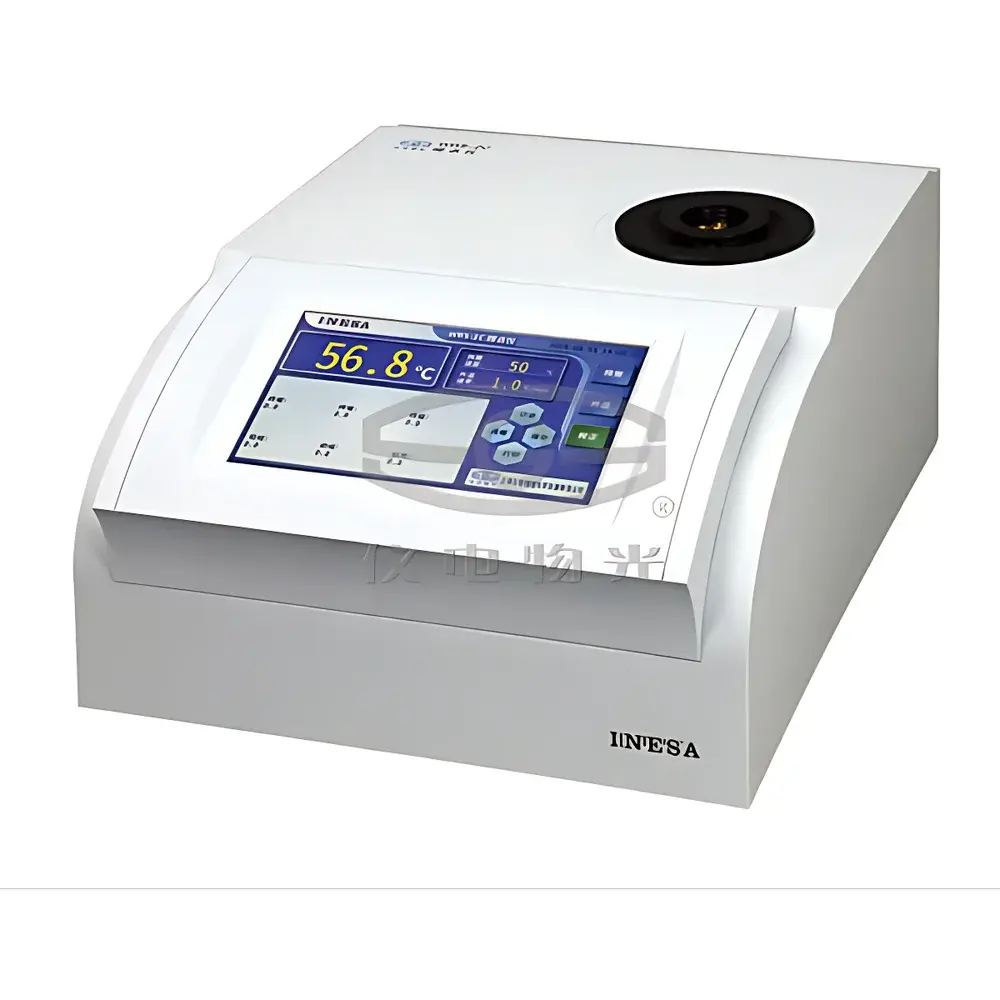
YDWG WRS-1C Digital Melting Point Apparatus
| Brand | YDWG |
|---|---|
| Origin | Shanghai, China |
| Model | WRS-1C |
| Temperature Range | Ambient to 400 °C |
| Heating Rate | 0.1–20 °C/min (continuously adjustable) |
| Temperature Repeatability | ±0.3 °C (at 1 °C/min) |
| Temperature Accuracy | ±0.4 °C ≤200 °C |
| Temperature Resolution | 0.1 °C |
| Capillary Dimensions | OD 1.4 mm, ID 1.0 mm, Length 90 mm |
| Sample Capacity | 1 capillary per run |
| Display | 7-inch color TFT touchscreen |
| Data Storage | 1000 measurement records |
| Interface | RS232 and USB |
| Power Supply | 220 V ±10%, 50 Hz, 80 W |
| Dimensions | 360 × 290 × 170 mm |
| Net Weight | 9 kg |
Overview
The YDWG WRS-1C Digital Melting Point Apparatus is a precision thermal analysis instrument engineered for accurate, reproducible determination of melting point ranges in solid organic compounds, pharmaceuticals, polymers, and reference standards. It operates on the principle of optical detection of phase transition—specifically, the onset and completion of solid-to-liquid transformation—using a high-sensitivity photodiode array to monitor light transmission through a heated capillary tube. The system integrates a platinum resistance thermometer (PT100) as the primary temperature sensing element, coupled with PID-based closed-loop control and PWM-driven heating regulation to ensure stable thermal ramping and minimal overshoot. Designed in full compliance with pharmacopoeial requirements—including USP , EP 2.2.17, and ChP IV—this apparatus employs standardized 1.0 mm ID capillaries (90 mm length) and supports both manual and automated interpretation of onset (initial melt) and offset (complete melt) temperatures. Its ambient-to-400 °C operating range accommodates low-melting excipients and high-melting crystalline APIs alike, while the 0.1 °C resolution and traceable multi-point calibration capability support routine GLP/GMP laboratory workflows.
Key Features
- 7-inch full-color TFT capacitive touchscreen interface with intuitive icon-driven navigation and real-time graphical display of melting curves
- PID + PWM temperature control architecture delivering exceptional thermal stability (<±0.3 °C repeatability at 1 °C/min ramp rate)
- Continuously adjustable heating rate from 0.1 to 20 °C/min, enabling method optimization for thermally sensitive or highly crystalline samples
- Automatic detection and digital recording of both initial and final melting points, with on-screen overlay of derivative (dI/dT) curve for enhanced endpoint discrimination
- Built-in data logging for up to 1000 complete test records, each timestamped and annotated with ramp rate, operator ID, and calibration status
- Dual communication interfaces (RS232 and USB) supporting bidirectional data exchange with LIMS or ELN systems and optional thermal printer integration (RD-TH32-SC)
- Pharmaceutical-grade construction: stainless-steel heating block, sealed optical path, and ESD-safe enclosure meeting IEC 61010-1 safety standards
Sample Compatibility & Compliance
The WRS-1C is validated for use with standard pharmacopoeial capillaries (outer diameter 1.4 mm, inner diameter 1.0 mm, length 90 mm), ensuring compatibility with USP, EP, JP, and ChP methodologies. Sample loading height is precisely controlled at 3 mm to minimize convection artifacts and improve inter-laboratory reproducibility. The instrument conforms to ISO/IEC 17025:2017 requirements for calibration traceability, with factory-provided NIST-traceable certificate covering three-point verification (e.g., 100 °C, 200 °C, 300 °C). Its firmware supports audit-trail-enabled operation under FDA 21 CFR Part 11 when connected to compliant PC software—recording user actions, parameter changes, and result modifications with time stamps and electronic signatures. All thermal profiles adhere to ASTM E324-20 “Standard Test Methods for Melting Point of Organic Solids” and are suitable for regulatory submissions in drug substance and product characterization dossiers.
Software & Data Management
Data acquisition and reporting are fully integrated via embedded firmware—no external software installation is required for basic operation. However, optional PC software (provided on USB drive) enables advanced functions including batch report generation (PDF/CSV), statistical trend analysis across multiple lots, and automatic comparison against specification limits. Each stored record includes raw photometric signal traces, temperature vs. time arrays, and metadata such as calibration date, ambient humidity, and operator login. USB export supports direct transfer to network drives or secure cloud repositories. The system logs all calibration events—including date, technician ID, reference standard lot number, and deviation values—ensuring full traceability during internal audits or regulatory inspections. Firmware updates are delivered via signed .bin files to prevent unauthorized modification.
Applications
- Quality control testing of active pharmaceutical ingredients (APIs) and excipients per ICH Q5 and Q6A guidelines
- Polymorph screening and solid-state characterization in preformulation studies
- Identity confirmation and purity assessment of synthetic intermediates and fine chemicals
- Stability-indicating assay development for accelerated and long-term storage studies
- Educational use in university chemistry and pharmacy laboratories for teaching thermal behavior fundamentals
- Regulatory filing support for ANDA, NDA, and DMF submissions requiring documented melting point data
FAQ
Is the WRS-1C compliant with 21 CFR Part 11 for electronic records?
Yes—when used with the optional validated PC software and configured with user access controls, electronic signature enforcement, and immutable audit trails, it meets predicate rule requirements for regulated environments.
Can the instrument be calibrated using certified reference standards?
Yes—it supports multi-point calibration using NIST-traceable melting point standards (e.g., indium, tin, zinc), with user-defined calibration points stored in non-volatile memory.
What is the recommended maintenance schedule?
Optical window cleaning every 50 runs; annual verification of PT100 sensor drift and heater uniformity; biannual full-system performance qualification (PQ) per internal SOP.
Does the WRS-1C support GMP-compliant reporting?
Yes—reports include instrument ID, software version, calibration status, analyst name, sample ID, environmental conditions, and digital signature fields for reviewer approval.
Is remote monitoring or network connectivity available?
The base model does not include Ethernet or Wi-Fi; however, RS232/USB output allows integration into centralized lab automation platforms via serial-to-Ethernet gateways or custom middleware.
Related Products



