
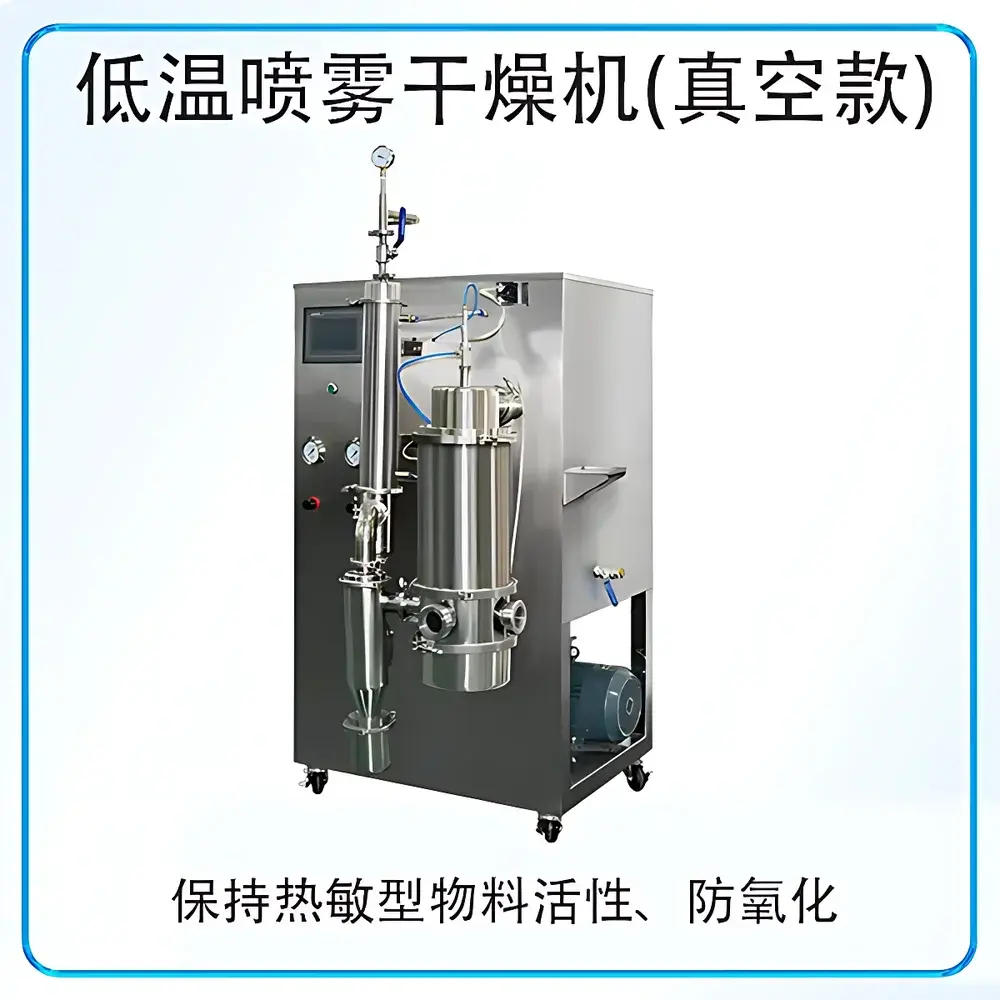
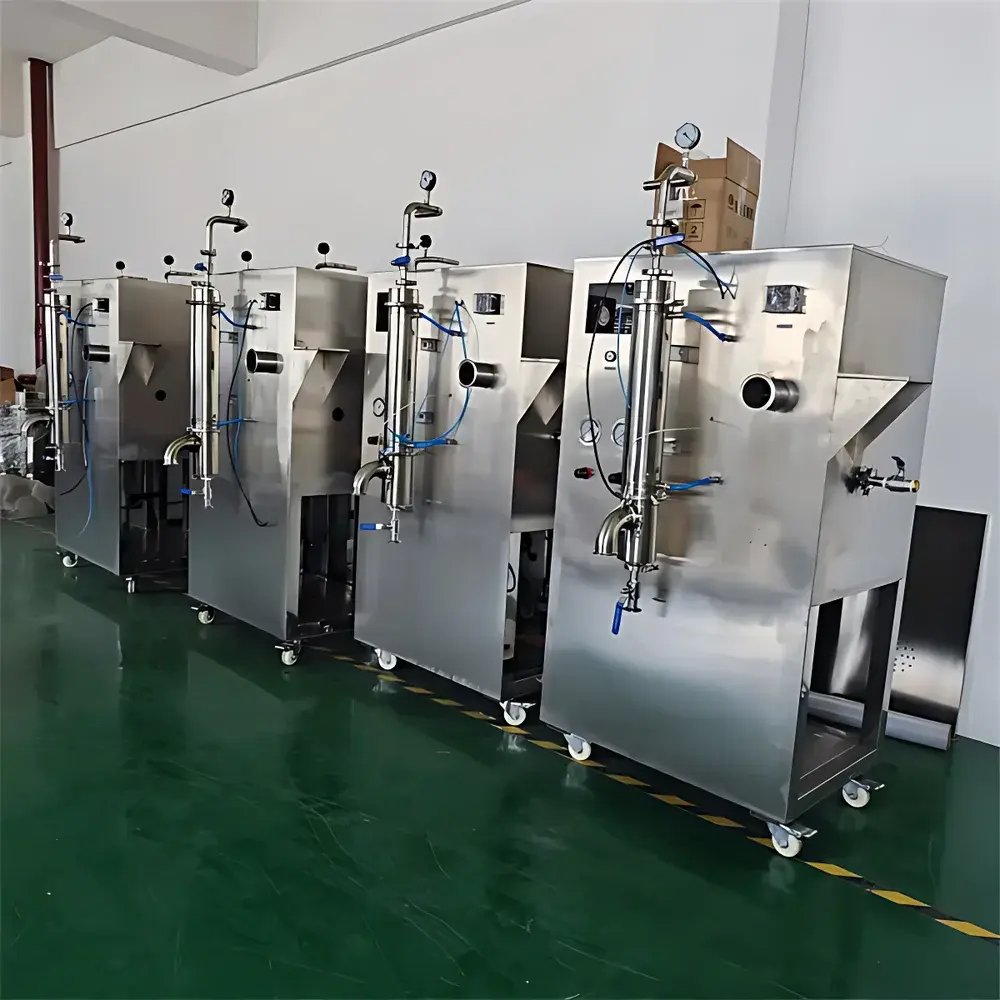
AnYuJie AYJ-GZJ300 Vacuum Spray Dryer
| Brand | AnYuJie |
|---|---|
| Origin | Zhejiang, China |
| Model | AYJ-GZJ300 |
| Max Feed Rate | 1500 mL/h |
| Temperature Range | Ambient to 50 °C |
| Vacuum Range | −0.05 to −0.06 MPa |
| Particle Size Range | 5–250 µm |
| Moisture Content (Dried Powder) | <1% w/w |
| Feed Types | Aqueous solutions, emulsions, suspensions |
| Heating Control Accuracy | ±1 °C (PID) |
| Nozzle Orifice Options | 0.5 / 0.7 / 1.0 / 1.5 / 2.0 mm |
| Power Supply | 6 kW / 380 V AC |
Overview
The AnYuJie AYJ-GZJ300 Vacuum Spray Dryer is an engineered laboratory-scale system designed for the gentle, low-temperature drying of thermolabile, oxidizable, and volatile compounds. Unlike conventional atmospheric spray dryers operating at inlet temperatures of 120–200 °C, this unit performs continuous atomization and drying under controlled vacuum conditions (−0.05 to −0.06 MPa), enabling full process completion at a maximum chamber temperature of 50 °C. This operational principle leverages the depression of boiling point under reduced pressure—allowing rapid solvent evaporation without thermal degradation. The system employs a concentric two-fluid nozzle configuration, ensuring symmetrical雾化 (atomization) and eliminating wall impingement; combined with mid-chamber nozzle positioning, it supports both co-current and counter-current drying flow patterns to optimize residence time for sensitive biopolymers, enzymes, probiotics, liposomes, and pharmaceutical actives.
Key Features
- Vacuum-enabled low-temperature operation (ambient to 50 °C), preserving structural integrity and bioactivity of heat-sensitive materials
- Integrated oil-free air compressor delivering consistent, contaminant-free atomizing gas—critical for GMP-aligned lab environments
- Full-color LCD touchscreen with intuitive Chinese interface (software localizable upon request) and real-time animated process visualization
- Dual-mode control: fully automated one-button startup with pre-programmed protocols, plus seamless manual override for in-process parameter adjustment
- Intelligent safety architecture—including interlocked heater/fan sequencing, automatic shutdown protection, and error-triggered operator alerts
- Self-cleaning nozzle system with adjustable-frequency needle (‘clearing pin’) to prevent clogging during high-viscosity feed processing
- Modular stainless-steel construction (AISI 304 standard) across spray chamber, drying tower, cyclone collector, and feed lines—ensuring corrosion resistance, cleanability, and compliance with ISO 14644-1 Class 8 cleanroom handling practices
- PID-controlled heating with ±1 °C stability across full temperature range, coupled with peristaltic feed pump (0–1500 mL/h adjustable)
Sample Compatibility & Compliance
The AYJ-GZJ300 accommodates aqueous solutions, oil-in-water emulsions, colloidal suspensions, and nano-dispersions—with demonstrated efficacy for proteins (e.g., BSA, lysozyme), polysaccharides (chitosan, alginate), lipid nanoparticles, and small-molecule APIs. Its vacuum-driven drying pathway meets essential requirements for stability-indicating method development per ICH Q5C and supports early-phase formulation work under GLP-compliant documentation frameworks. While not certified to UL/CE or FDA 510(k) standards out-of-the-box, its material traceability (certified SS304), absence of lubricants in airflow path, and audit-ready operational logs (via optional data export) facilitate integration into regulated R&D workflows. All wetted parts are fully disassemblable for CIP validation and residue testing per USP Analytical Instrument Qualification guidelines.
Software & Data Management
The embedded control firmware records time-stamped process variables—including chamber temperature, vacuum level, feed rate, inlet/outlet air temperature differentials, and compressor duty cycle—at 1 Hz resolution. Data exports directly to CSV via USB port, supporting traceability for internal SOPs and external regulatory submissions. Optional Ethernet connectivity enables remote monitoring through secure HTTP-based dashboards (firmware v2.3+). Audit trails comply with ALCOA+ principles: attributable, legible, contemporaneous, original, accurate, complete, consistent, enduring, and available. Though not Part 11-compliant by default, the system supports third-party electronic signature modules and role-based access control when deployed behind institutional IT infrastructure.
Applications
- Stabilization of monoclonal antibodies and vaccine candidates via amorphous solid dispersion
- Production of inhalable dry powder formulations with aerodynamic particle size distribution (MMAD 2–5 µm)
- Rapid screening of excipient compatibility for lyophilization alternatives
- Scalable synthesis of metal-organic framework (MOF) nanoparticles and ceramic precursors
- Encapsulation of volatile flavors, fragrances, or essential oils into silica or maltodextrin matrices
- Preparation of standardized reference materials for chromatographic calibration and dissolution testing
FAQ
What vacuum level does the system achieve, and how is it maintained?
The AYJ-GZJ300 utilizes a dual-stage rotary vane vacuum pump capable of sustaining −0.05 to −0.06 MPa (50–60 kPa absolute) during continuous operation. Vacuum stability is actively monitored and adjusted via feedback-controlled throttle valve integrated into the exhaust line.
Can the system handle feeds with >20% total solids content?
Yes—viscous feeds up to ~35% w/w solids have been processed successfully using the 0.7 mm or 1.0 mm nozzle orifice and optimized feed rate (≤800 mL/h). For higher viscosities, the auto-clearing needle function prevents nozzle occlusion.
Is the dried powder collection efficiency validated?
Under standard operating conditions (1500 mL/h aqueous maltodextrin 10% w/v, 40 °C), gravimetric recovery exceeds 92% in the main cyclone collector, with <5% retained in the optional secondary filter trap—verified per ASTM E2904-20 Annex A1.
Does the unit support inert gas purging for oxygen-sensitive materials?
While not factory-equipped with N₂ manifold ports, the sealed chamber design allows retrofitting of gas inlet/outlet fittings. Users commonly integrate external nitrogen sparging systems upstream of the feed reservoir and atomizing air line.
What maintenance intervals are recommended for the vacuum pump and compressor?
The vacuum pump requires oil replacement every 500 operational hours; the oil-free compressor has no scheduled lubrication but benefits from quarterly intake filter inspection and desiccant cartridge replacement per manufacturer service bulletin SB-AYJ-VAC-2023.



