
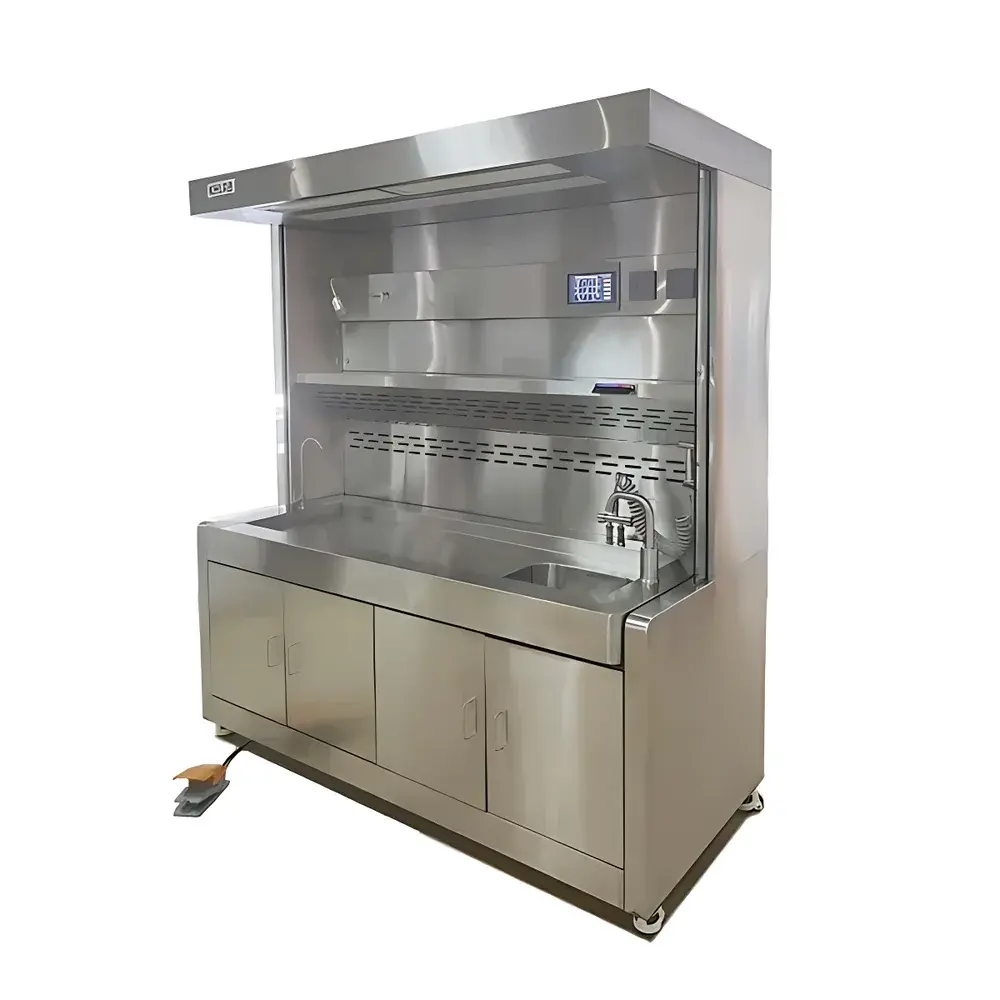
KHLAB Pathology Tissue Sampling Station
| Brand | KHLAB |
|---|---|
| Origin | Zhejiang, China |
| Manufacturer Type | Authorized Distributor |
| Country of Origin | China |
| Model | Pathology Tissue Sampling Station |
| Instrument Type | Premium Stainless Steel Tissue Sampling Station |
| Material | 304 Stainless Steel |
| Air Purification System | Integrated LED-UV + Photocatalytic TiO₂ Nanocoating |
| UV Disinfection | Top-Mounted UVC (254 nm), Full-Coverage Irradiation |
| Environmental Monitoring | Dual-Channel Imported TVOC Sensors, Real-Time Color LCD Display with Temperature & Humidity Readout |
| Control Mode | Intelligent Auto-Trigger (Threshold-Based) or Manual |
| Remote Operation | Wi-Fi Enabled |
| Sink Cabinet | Press-Formed Radius-Corner Stainless Steel Construction |
| Optional Accessories | Movable Rinse Shower Assembly |
Overview
The KHLAB Pathology Tissue Sampling Station is an engineered biosafety workstation designed for primary tissue dissection and grossing in clinical pathology laboratories, academic histopathology cores, and translational research facilities. It operates on a dual-layer containment principle: physical barrier integrity (via seamless 304 stainless steel construction) combined with active air decontamination (UVC irradiation and photocatalytic oxidation). Unlike conventional laminar flow cabinets or basic dissecting benches, this station integrates real-time environmental monitoring with automated response logic—ensuring consistent compliance with occupational exposure limits (OELs) for formaldehyde, xylene, and other volatile organic compounds (VOCs) commonly generated during tissue fixation and processing. Its architecture conforms to the functional requirements outlined in ISO 15190:2020 (Medical laboratories — Requirements for safety) and supports adherence to CLIA, CAP, and College of American Pathologists (CAP) checklist item ANP.42700 (Grossing area ventilation and contamination control).
Key Features
- Monolithic 304 stainless steel fabrication—including work surface, splash guard, sink basin, and lower cabinet—with press-formed radius corners (R ≥ 15 mm) to eliminate crevices and facilitate cleaning per ISO 15883-1 standards.
- Top-mounted UVC lamp array (254 nm, ≥100 µW/cm² at 1 m) delivering uniform irradiance across the entire grossing field; programmable auto-activation via time-scheduled or motion-triggered logic.
- Integrated air purification module featuring high-efficiency particulate air (HEPA)-pre-filtered intake, followed by LED-driven UV-A (365 nm) activation of immobilized titanium dioxide (TiO₂) nanocoating—degrading VOCs into CO₂ and H₂O without ozone generation.
- Dual-channel electrochemical TVOC sensors (detection range: 0–10 ppm, resolution: 0.01 ppm), calibrated against certified reference gases; data logged and displayed on a 7-inch color TFT-LCD with real-time temperature (±0.5°C) and relative humidity (±3% RH) readouts.
- Intelligent operation mode: when TVOC concentration exceeds user-defined thresholds (e.g., 0.1 ppm formaldehyde equivalent), the air treatment system activates automatically; status, runtime, and alarm history are stored locally for GLP-compliant audit trails.
- Modular accessory interface supporting optional add-ons including articulated rinse shower arm with thermostatic mixing valve, specimen labeling station, and integrated barcode scanner mounting bracket.
Sample Compatibility & Compliance
The station accommodates human and animal tissue specimens across all major organ systems—including but not limited to brain, lung, gastrointestinal tract, lymphoid tissues, and surgical resections up to 20 cm × 15 cm × 10 cm. Its non-porous, corrosion-resistant surface resists degradation from formalin, ethanol, xylene, and sodium hypochlorite solutions used in routine grossing protocols. The unit meets structural requirements for Class II Biosafety Cabinet equivalence per NSF/ANSI 49 Annex E (for non-aerosol-generating tasks) and complies with electrical safety standards IEC 61010-1:2010. All electronic components—including Wi-Fi module and sensor circuitry—are CE-marked and RoHS-compliant.
Software & Data Management
The embedded microcontroller runs a deterministic real-time OS (RTOS) with firmware versioning and secure over-the-air (OTA) update capability via WPA2-encrypted Wi-Fi. Sensor data—including TVOC concentration trends, UVC dose accumulation (J/m²), ambient temperature/humidity logs, and system event timestamps—is exportable as CSV files via USB-C port or cloud-synced to KHLAB’s validated LIMS integration gateway (compatible with Thermo Fisher SampleManager, LabVantage, and Oracle Health Sciences). Audit trail functionality satisfies FDA 21 CFR Part 11 requirements for electronic records and signatures, including user authentication, immutable log entries, and role-based access control (RBAC).
Applications
- Clinical gross pathology: standardized specimen handling prior to embedding, ensuring traceability and minimizing cross-contamination between cases.
- Research tissue banking: preprocessing of biospecimens under monitored VOC conditions to preserve molecular integrity for downstream omics analysis.
- Pathology training labs: safe demonstration of dissection techniques with engineered safeguards for trainee exposure reduction.
- Molecular diagnostics workflows: integration with nucleic acid extraction platforms where airborne inhibitors (e.g., phenol, chloroform vapors) must be actively scavenged.
- Forensic pathology units: compliant handling of decomposed or chemically treated specimens requiring enhanced decontamination assurance.
FAQ
Does the station require external ducting or room exhaust modification?
No. It is a self-contained recirculating system with internal air purification; no external venting is necessary.
Can the UV disinfection cycle be scheduled independently of air purification?
Yes. UVC timing is fully decoupled and programmable via the LCD interface or remote web portal.
Is the TVOC sensor calibrated traceable to NIST standards?
Yes. Each sensor is factory-calibrated using NIST-traceable gas standards; calibration certificates are supplied with each unit.
What is the expected service life of the TiO₂ nanocoating under continuous operation?
Based on accelerated aging tests per ISO 10545-13, the coating maintains ≥90% photocatalytic efficiency after 10,000 hours of rated UV-A exposure.
Does the unit support integration with hospital EMR or LIS systems?
Yes—via HL7 v2.5.1 or ASTM E1384-compliant API endpoints, enabling automatic logging of grossing start/end timestamps and environmental metadata.





