
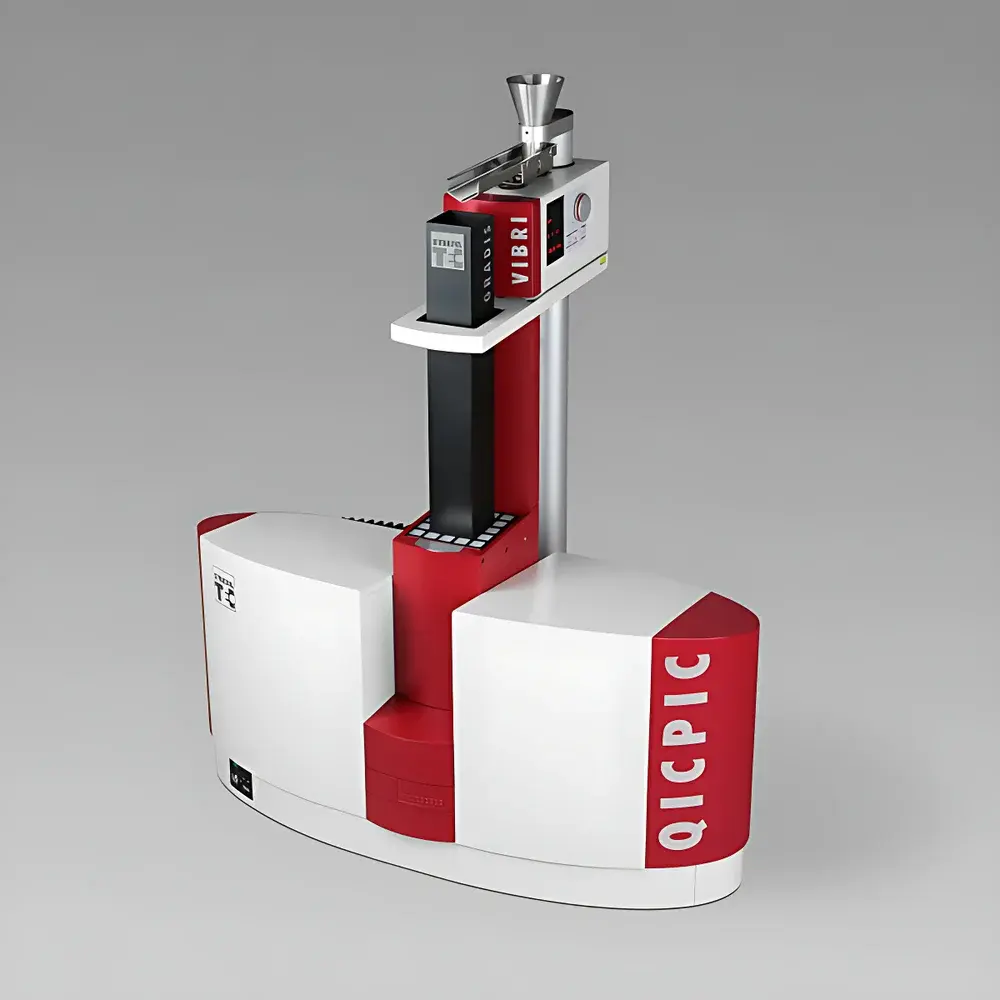
SYMPATEC QICPIC & GRADIS Dry-Gravity Dispersed Dynamic Image Analysis System
| Brand | SYMPATEC |
|---|---|
| Origin | Germany |
| Manufacturer | SYMPATEC GmbH |
| Type | Dynamic Image-Based Particle Analyzer |
| Model | QICPIC & GRADIS |
| Lens Count | 5 |
| Measurement Range | 1.8–33,792 µm |
| Dispersion Method | Free-Fall Gravity Dispersion |
| Image Resolution | 4.2 MP |
| Measured Parameters | Chord Length, Feret Diameter (max/min/mean), Fiber Length, Fiber Diameter, Equivalent Circular Diameter (ECD), Circularity (Sphericity), Aspect Ratio, Convexity, Flatness, Elongation, LEFI, DIFI, VBFD, PED |
Overview
The SYMPATEC QICPIC & GRADIS is a high-throughput, dry-mode dynamic image analysis system engineered for statistically robust characterization of particle size and shape in free-falling powder streams. It operates on the principle of pulsed backlight illumination combined with high-speed, multi-angle imaging: a precisely timed, high-intensity LED flash illuminates particles during unassisted gravitational descent through the measurement zone; five synchronized, telecentric optical paths capture orthogonal and oblique projections of each particle in real time. This multi-view acquisition enables unambiguous 2D silhouette reconstruction and eliminates orientation bias inherent in single-lens systems. Unlike static or fluid-based imaging methods, the GRADIS dispersion module ensures gentle, non-destructive sample presentation—preserving fragile agglomerates or irregular morphologies while delivering representative sampling of bulk powders. The system complies with ISO 13322-2:2020 (Particle Size Analysis – Image Analysis Methods – Part 2: Dynamic Image Analysis) and supports traceable calibration via NIST-traceable reference microspheres.
Key Features
- Integrated GRADIS gravity dispersion unit with adjustable nozzle widths (1–10 mm) to optimize particle velocity and inter-particle separation for diverse material densities and flow properties
- Five independently aligned, telecentric imaging lenses with synchronized 4.2 MP CMOS sensors—enabling simultaneous top, side, and angular views per particle
- Real-time particle detection at up to 10,000 particles per second, with statistical confidence validated for populations exceeding 106 particles per measurement
- Patented pulse synchronization architecture ensures sub-microsecond timing alignment between flash duration (3 m/s
- Modular collision plate system (up to 3 stages) for controlled mechanical deagglomeration of cohesive or electrostatically charged powders
- Conductive, anti-static dispersion tube coating (surface resistivity <10⁶ Ω/sq) mitigates charge accumulation in insulating materials such as polymers or pharmaceutical excipients
- Integrated sample recovery drawer with sealed containment—enabling reuse of valuable or hazardous samples post-analysis
Sample Compatibility & Compliance
The QICPIC & GRADIS accommodates dry, free-flowing powders ranging from coarse granules (e.g., fertilizer pellets, roasted coffee beans) to fine micronized APIs and nanostructured catalysts. It is routinely deployed in regulated environments requiring audit-ready documentation: raw data files include full metadata (timestamp, instrument ID, operator, calibration status), and software supports 21 CFR Part 11-compliant user access control, electronic signatures, and immutable audit trails. All shape descriptors—including sphericity (calculated as 4π·A/P²), aspect ratio (Feret max/Feret min), convexity (A/convex hull area), and fiber-specific metrics (LEFI, DIFI, VBFD)—are derived directly from binary silhouettes without model fitting or assumptions. The system meets ISO 9001 quality management requirements and is validated for use in GLP and GMP workflows per ICH Q5A and USP .
Software & Data Management
WINDOX 7 software provides comprehensive analysis, visualization, and reporting capabilities. Each measurement generates a searchable particle database containing individual particle images, coordinates, timestamps, and all 30+ geometric descriptors. Users may apply Boolean filters (e.g., “Circularity 5”) to isolate morphologically distinct subpopulations for targeted review or export. Statistical outputs include cumulative and differential distributions for size (ECD, chord length), shape (sphericity, convexity), and anisotropy (flatness, elongation). Video exports (AVI/MKV) preserve frame-accurate particle trajectories; batch processing supports automated comparison across multiple lots or process conditions. Data export formats include CSV, PDF reports with embedded metadata, and XML for LIMS integration.
Applications
The QICPIC & GRADIS is applied across industries where morphology governs functional performance: in pharmaceutical manufacturing, it quantifies granule sphericity and surface roughness to predict flowability and tablet compaction behavior; in mineral processing, it distinguishes angular crushed rock from rounded river sand using convexity and Feret diameter ratios; in food science, it characterizes starch granule aspect ratio and porosity to correlate with gelatinization kinetics; in battery materials R&D, it evaluates graphite flake thickness-to-diameter ratios critical for electrode slurry rheology and packing density. Its ability to count and classify particles by shape class also supports QC release testing for inhalable dry powder formulations per USP .
FAQ
How does GRADIS ensure representative sampling of heterogeneous powders?
GRADIS achieves statistical representativeness by combining high-throughput imaging (>1 million particles per run) with volumetric sampling across the full cross-section of the dispersion channel—enabled by the 5-lens array’s wide field-of-view coverage.
Can the system analyze transparent or semi-transparent particles?
Yes—pulse illumination intensity and exposure gain are independently adjustable per lens; low-contrast particles (e.g., glass beads, sugar crystals) are enhanced via dynamic thresholding and edge-preserving noise reduction algorithms.
Is calibration traceable to international standards?
All calibrations use SYMPATEC-certified NIST-traceable microsphere sets (PSL and silica); WINDOX 7 logs calibration date, operator, standard ID, and residual error per session.
What maintenance is required for long-term operational stability?
The GRADIS module requires only periodic inspection of nozzle wear and cleaning of optical windows with spectroscopic-grade solvents; no consumables or recalibration intervals are mandated under normal operation.
Does the system support method transfer from laser diffraction or sieve analysis?
Yes—WINDOX includes cross-method correlation tools that map ECD distributions to laser diffraction Dv50 or sieve cut-points using ISO 13320:2020-compliant conversion models.



