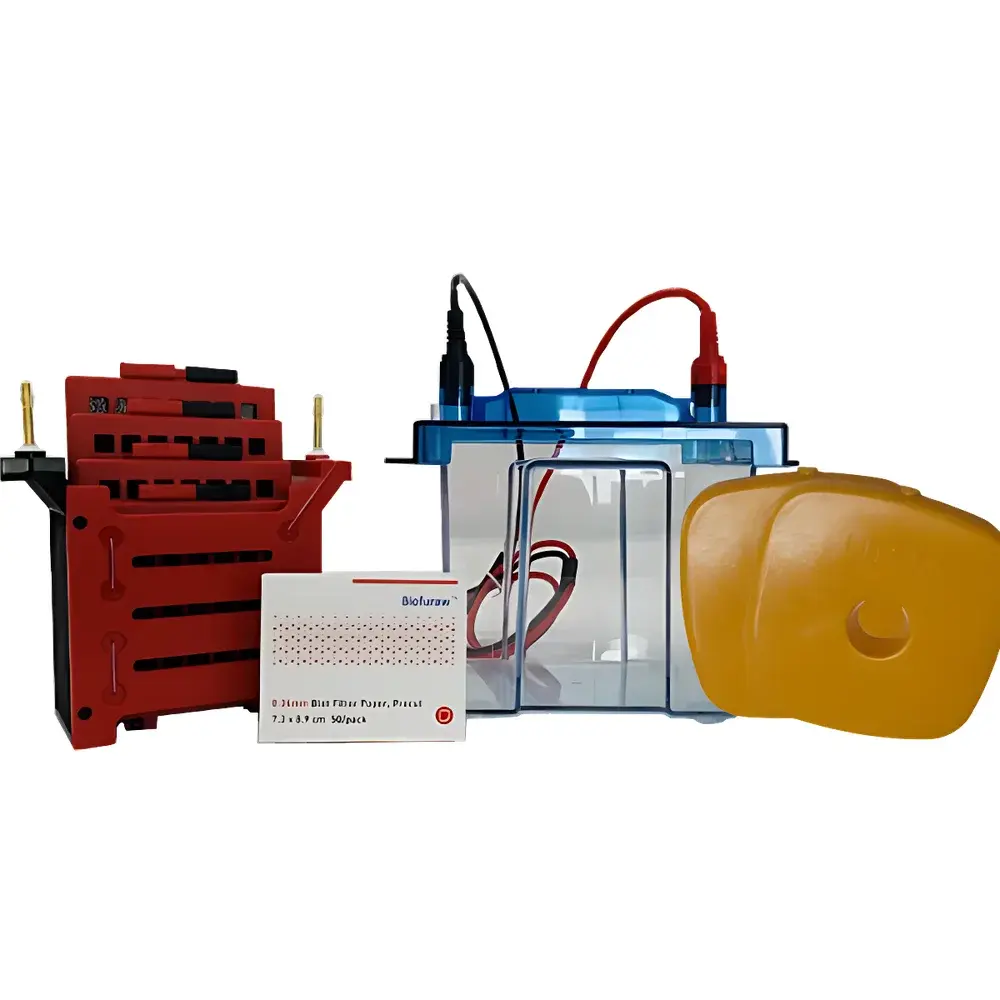
Tanon VE-586 Semi-Dry Electrophoretic Transfer Cell
| Brand | Tanon |
|---|---|
| Model | VE-586 |
| Type | Semi-Dry Transfer Electrophoresis Cell |
| Origin | Shanghai, China |
| Compatible Power Supply | EPS-200 / EPS-300 / EPS-600 |
| Compatible Vertical Electrophoresis Units | VE-680 / VE-180 |
| Max Gel Capacity | 4 × standard mini-gels (e.g., 8.5 × 7.5 cm) |
| Electrode Design | Patented perforated electrode frame |
| Cooling | Passive heat dissipation via optimized electrode geometry and open-frame architecture |
| Accessories Supported | 586-1700 transfer filter paper, VE-10 single-well antibody incubation box, VE-110 multi-well antibody incubation box |
| Compliance | Designed for routine laboratory use in accordance with standard molecular biology workflows per ISO/IEC 17025-aligned practices |
Overview
The Tanon VE-586 Semi-Dry Electrophoretic Transfer Cell is an engineered solution for efficient, reproducible protein and nucleic acid transfer from polyacrylamide or agarose gels to solid supports—including nitrocellulose, PVDF, and nylon membranes. It operates on the principle of semi-dry electrophoretic transfer, where a low-resistance buffer-saturated sandwich (gel–membrane–filter paper stack) is placed directly between parallel platinum-coated stainless-steel electrodes. Under applied DC voltage, charged macromolecules migrate orthogonally out of the gel matrix and into the membrane under controlled electric field strength—typically 10–25 V for 15–60 min—enabling high-fidelity retention of band morphology and spatial resolution. The VE-586 is purpose-built for laboratories performing routine immunoblotting (Western blot), nucleic acid hybridization (Northern/Southern blot), and post-electrophoresis downstream analysis requiring consistent transfer efficiency across multiple samples.
Key Features
- Patented open-frame gel cassette design allows rapid assembly and visual confirmation of sandwich alignment—reducing operator-induced misalignment and buffer channeling artifacts.
- Simultaneous transfer of up to four standard mini-gels (e.g., 8.5 × 7.5 cm) within a single run, enhancing throughput without compromising transfer uniformity.
- Perforated electrode support structure minimizes localized Joule heating by promoting even current distribution and passive thermal dispersion—critical for preserving epitope integrity during protein transfer.
- Modular construction enables tool-free disassembly for thorough cleaning and long-term electrode maintenance; all wetted components are chemically resistant to common transfer buffers (e.g., Tris-glycine-methanol, CAPS-based systems).
- Integrated buffer reservoir channels ensure continuous capillary action across the entire transfer stack, eliminating dry-spot formation at gel peripheries.
Sample Compatibility & Compliance
The VE-586 accommodates gels cast in standard vertical electrophoresis units including Tanon’s VE-180 and VE-680 systems, as well as third-party mini-gel formats conforming to IEC 61010-1 safety dimensions. It supports both wet and semi-dry transfer protocols, though optimized performance is achieved using semi-dry conditions with low-conductivity transfer buffers. All materials in contact with samples or buffers comply with USP Class VI biocompatibility standards and are free of detectable leachables per ASTM D4296. The system is routinely deployed in GLP-compliant environments where traceability of transfer parameters (voltage, duration, ambient temperature) is maintained manually or via integration with compatible power supplies (EPS-200/EPS-300/EPS-600) that log output settings.
Software & Data Management
As a standalone electrophoretic transfer device, the VE-586 does not incorporate embedded firmware or digital interfaces. However, when paired with Tanon EPS-series power supplies, users may record and archive transfer parameters—including voltage setpoint, elapsed time, and current draw—via the EPS unit’s front-panel display and optional RS-232/USB data export. For regulated environments requiring audit trails, these logs can be exported to LIMS or ELN platforms supporting CSV ingestion. No proprietary software installation is required; operation remains fully manual and protocol-driven, aligning with FDA 21 CFR Part 11 principles for instrument qualification where electronic records are not generated at the transfer cell level.
Applications
- Western blotting: High-efficiency transfer of denatured proteins (10–250 kDa) for subsequent antibody probing and chemiluminescent detection.
- Northern and Southern blotting: Reproducible immobilization of RNA and DNA fragments onto positively charged membranes for hybridization with labeled probes.
- Quality control in recombinant protein production: Verification of expression, cleavage, and post-translational modification profiles across multiple batches.
- Method development labs: Rapid optimization of transfer conditions (buffer composition, voltage, time) using replicate gels under identical field geometry.
- Educational settings: Demonstrating fundamental principles of electrokinetic macromolecule migration and membrane binding kinetics.
FAQ
What gel thicknesses are compatible with the VE-586 transfer cassette?
The VE-586 is calibrated for gels 0.75 mm to 1.5 mm thick. Thicker gels (e.g., 2.0 mm) may require extended transfer time or supplemental buffer saturation to maintain uniform field penetration.
Can the VE-586 be used for wet transfer?
While technically feasible, the open-frame architecture and electrode spacing are optimized for semi-dry conditions. Wet transfer requires external tank integration and is not supported by the VE-586 mechanical design.
Is the electrode material resistant to oxidation during prolonged use?
Yes—the electrodes consist of stainless steel substrates with durable platinum plating, validated for >500 transfer cycles under standard laboratory buffer conditions without measurable surface degradation.
How is temperature managed during high-voltage runs?
Heat dissipation relies on passive conduction through the metal frame and evaporative cooling from buffer-saturated filter paper; no active cooling is integrated, so ambient lab temperature should remain ≤25 °C for optimal reproducibility.
Are replacement parts such as electrode frames or gasket seals available separately?
Yes—Tanon offers OEM-specified spares including 586-EF electrode frames, 586-GK silicone gasket kits, and 586-SP spring-loaded clamping assemblies, all traceable to manufacturing lot numbers for quality assurance.
Related Products