
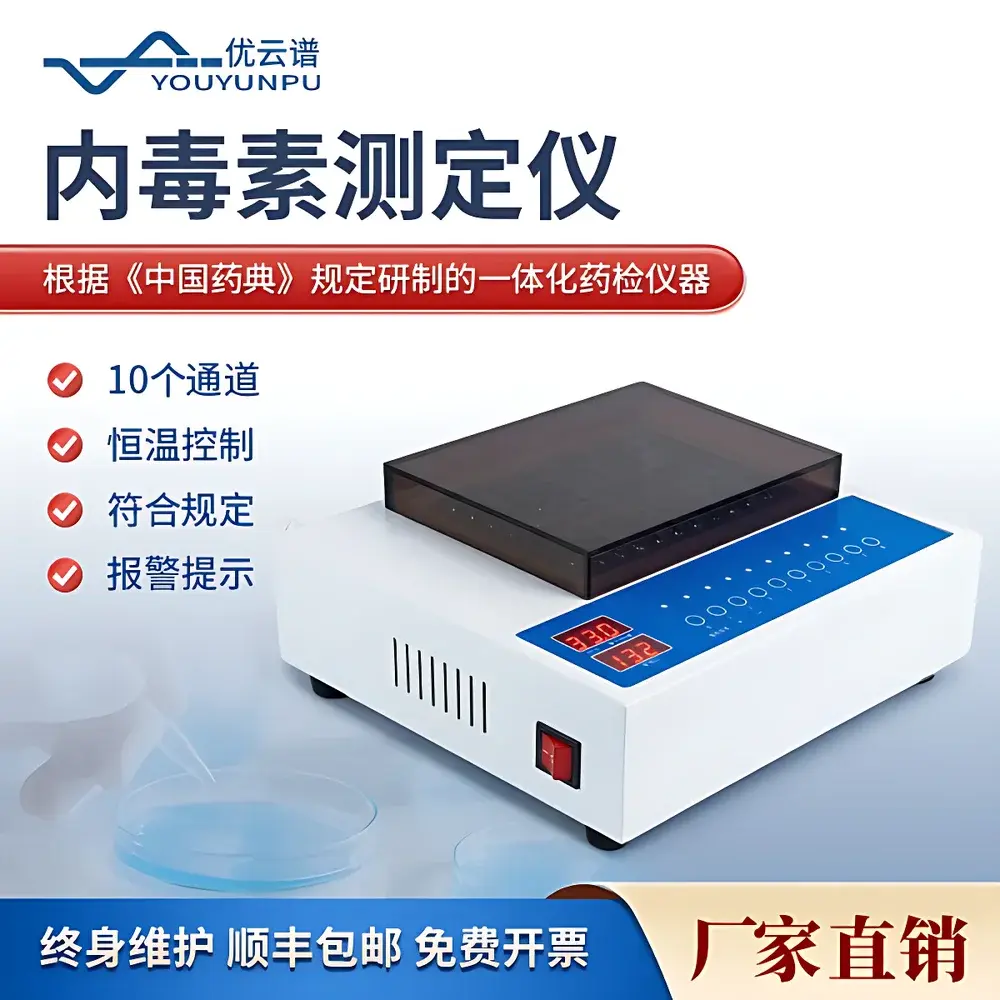
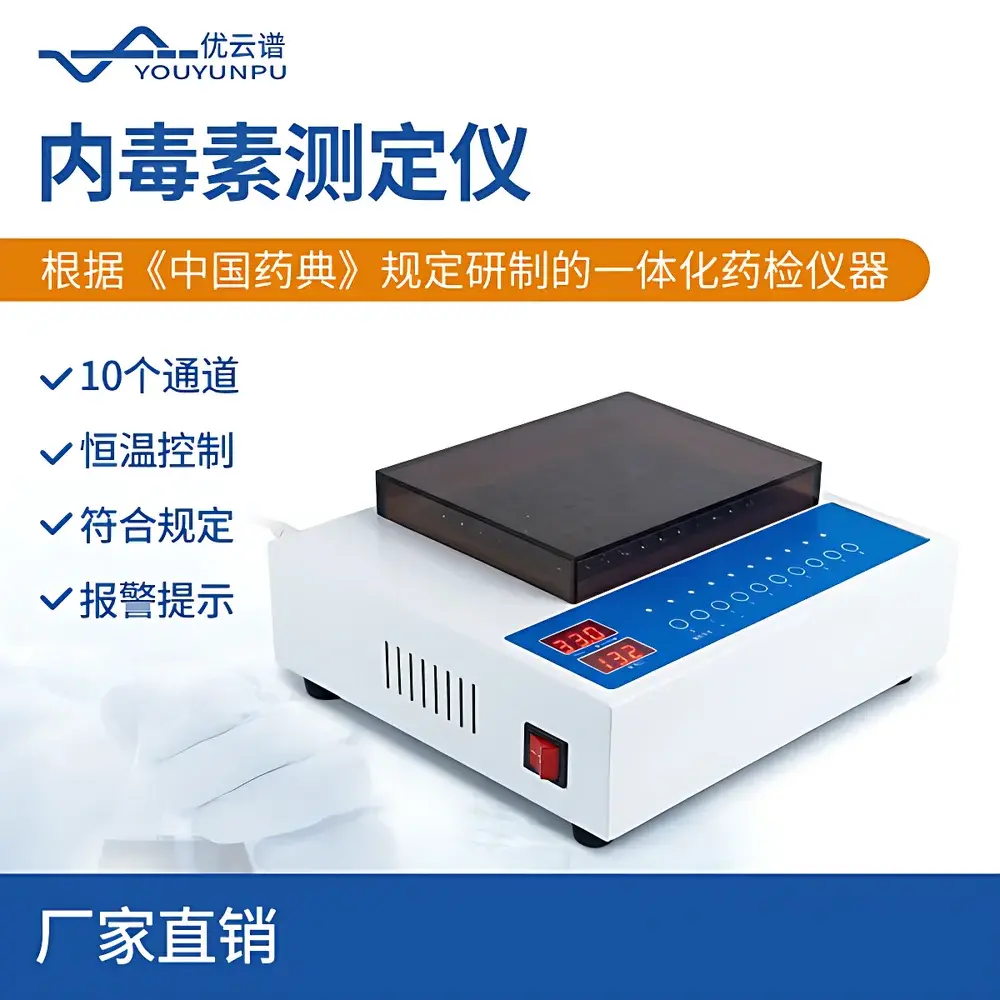
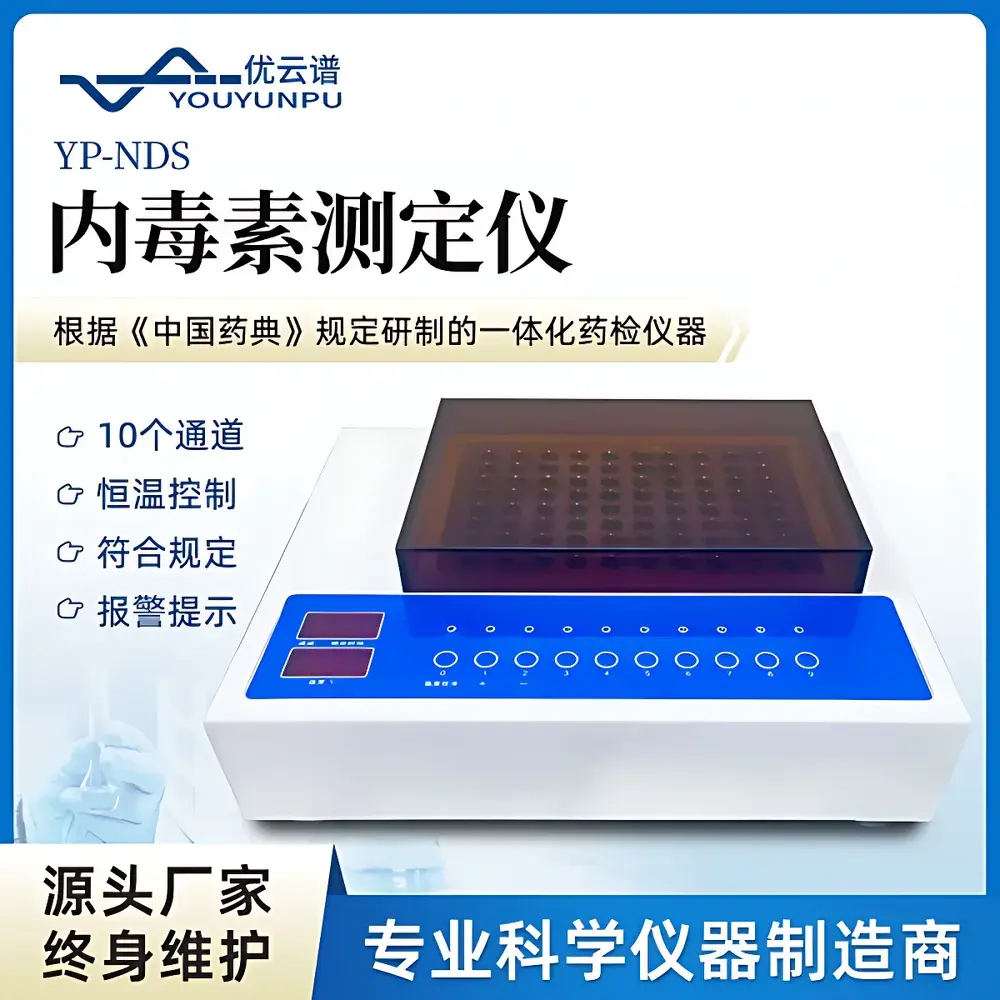
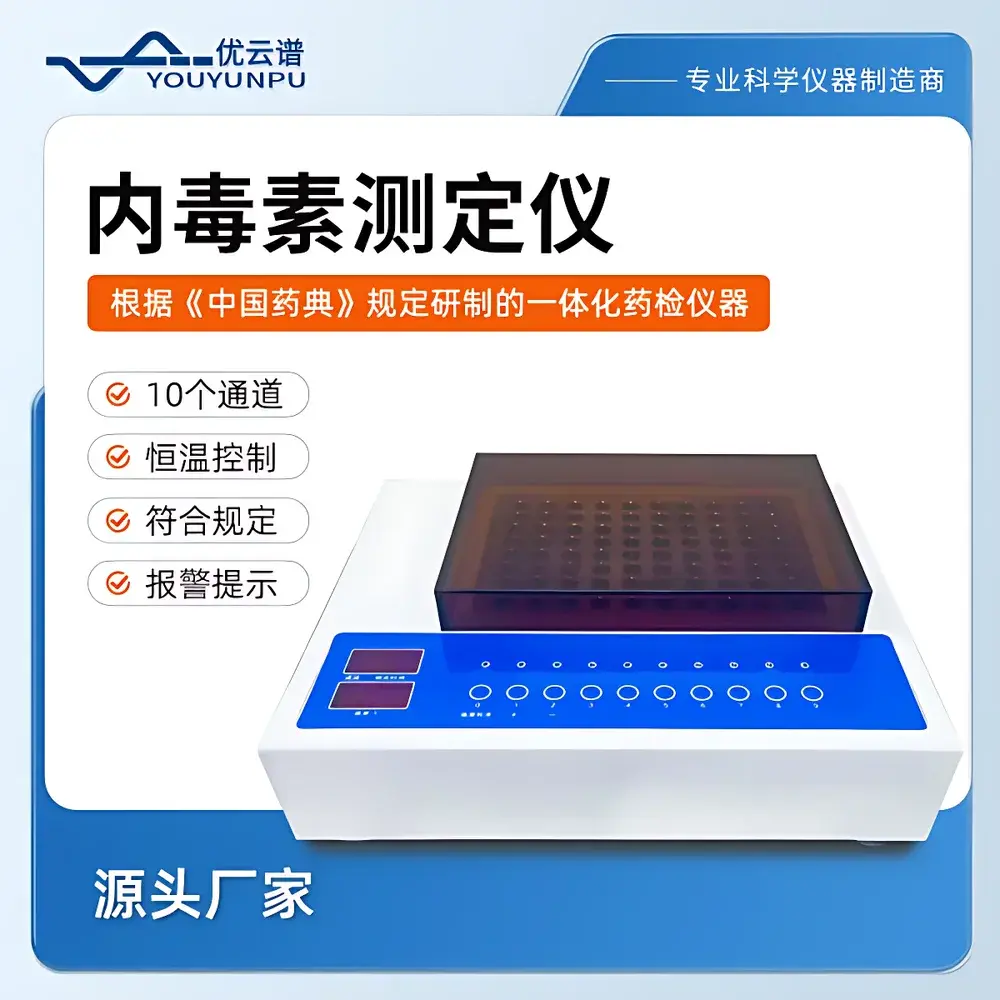
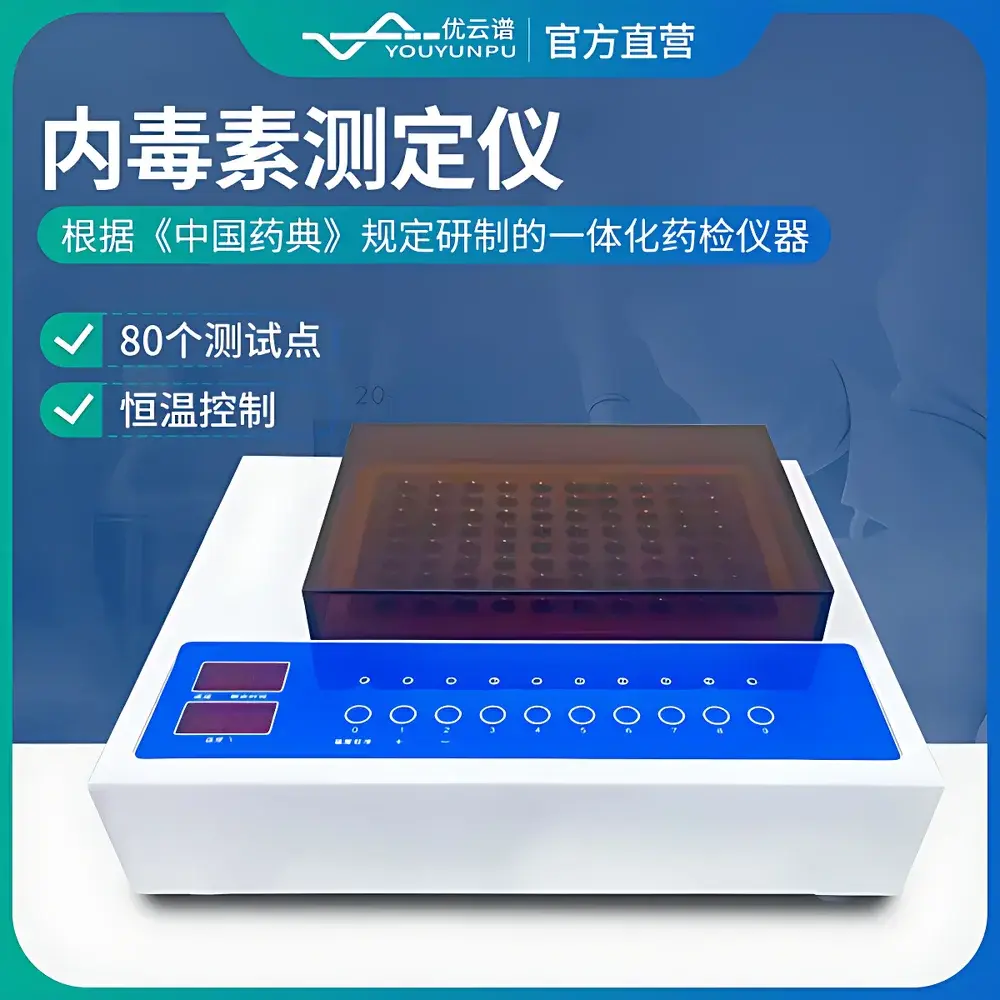
Youyunpu YP-NDS Bacterial Endotoxin Testing Instrument (Gel-Clot Method)
| Brand | Youyunpu |
|---|---|
| Origin | Shandong, China |
| Manufacturer Type | Direct Manufacturer |
| Country of Origin | China |
| Model | YP-NDS |
| Power Supply | AC 220 V, 50 Hz |
| Temperature Setpoint | 37 °C (Resolution: 0.1 °C |
| Stability | ±0.4 °C) |
| Timer Range | 60 min (Resolution: 1 min) |
| Channels | 10 independent thermal blocks |
| Total Test Wells | 80 (8 wells per channel) |
| Well Diameter | 12 mm |
| Warm-up Time to Thermal Equilibrium | ~30 min |
| Dimensions (W×D×H) | 350 × 280 × 10 mm |
| Weight | 7 kg |
Overview
The Youyunpu YP-NDS Bacterial Endotoxin Testing Instrument is a dedicated gel-clot–based endotoxin assay system engineered for compliance with pharmacopoeial monographs governing bacterial endotoxin testing in parenteral pharmaceuticals, medical devices, and raw materials. It operates on the principle of Limulus Amebocyte Lysate (LAL) gelation kinetics: in the presence of endotoxin, the LAL reagent undergoes a temperature-dependent enzymatic cascade culminating in visible gel formation within defined time and thermal conditions. The instrument maintains precise thermal uniformity across all 80 test wells—distributed across 10 independently controlled aluminum heating blocks—to ensure reproducible endpoint detection at 37 °C, the standard incubation temperature mandated by USP <85>, EP 2.6.14, JP XVII, and ChP (Chinese Pharmacopoeia) Section 1143. Its microcontroller-based architecture integrates digital temperature sensing and closed-loop PID regulation to achieve ±0.4 °C thermal accuracy, minimizing inter-well variability and supporting GLP-aligned assay execution.
Key Features
- 10 independently programmable thermal channels, each accommodating eight standardized 12-mm-diameter test tubes—enabling parallel processing of up to 80 samples per run without cross-channel interference.
- Digital temperature control via high-stability NTC sensors embedded in solid aluminum heating blocks, ensuring rapid thermal equilibration (~30 minutes) and long-term stability under continuous operation.
- Programmable 60-minute incubation timer with 1-minute resolution and audible/visual alert activation 60 seconds prior to assay completion—supporting timely endpoint evaluation and operator readiness.
- Integrated fault-detection logic: automatic alarm triggers upon sensor disconnection, thermal runaway (>±1.5 °C deviation), or power anomaly, coupled with hardware-level thermal cutoff for safety-critical protection.
- Compact benchtop footprint (350 × 280 × 10 mm) and lightweight design (7 kg) optimized for shared QC laboratories, cleanroom-adjacent staging areas, and mobile validation units.
Sample Compatibility & Compliance
The YP-NDS supports all commercially available LAL reagents validated for gel-clot methodology—including kinetic-turbidimetric and chromogenic alternatives—when used in accordance with manufacturer instructions and pharmacopoeial requirements. Each channel’s isolated thermal control allows simultaneous testing of diverse sample matrices (e.g., saline-diluted APIs, polysorbate-containing formulations, low-conductivity water for injection) without thermal crosstalk. The system meets functional equivalence criteria outlined in USP <85> Appendix “Instrumentation Requirements for Gel-Clot Assays”, ISO 11737-3:2021 Annex B (endotoxin testing of medical devices), and ChP General Chapter 1143. While the instrument itself does not generate electronic records, its operational parameters (time, temperature, channel status) are manually documented in paper-based or hybrid lab notebooks compliant with FDA 21 CFR Part 11–aligned recordkeeping practices when paired with controlled SOPs.
Software & Data Management
The YP-NDS operates via embedded firmware with no external PC dependency or proprietary software layer. All configuration (temperature setpoint, timer duration) is executed through tactile membrane buttons and an LED display. This architecture eliminates software validation burden typically associated with computerized systems—making it suitable for environments where regulatory simplicity, audit readiness, and minimal IT infrastructure are prioritized. For labs implementing electronic data capture, the instrument’s deterministic output (pass/fail gel formation observed visually at defined endpoints) integrates seamlessly into ELN platforms via structured manual entry or barcode-scanned assay logs. No firmware updates or cybersecurity patches are required, ensuring long-term operational continuity without version drift or compatibility risk.
Applications
- Final container testing of sterile injectables, ophthalmic solutions, and dialysis fluids per USP <85> and Ph. Eur. 2.6.14.
- Raw material qualification of excipients (e.g., polysorbates, phospholipids) and active pharmaceutical ingredients where endotoxin limits are specified in drug master files.
- Process validation support: monitoring of ultrafiltration membranes, depyrogenation tunnels, and autoclave cycles using challenge vials containing known endotoxin concentrations.
- Environmental monitoring of cleanrooms and isolators via water-for-injection (WFI) sampling and subsequent LAL testing.
- Educational use in pharmacopeial training programs and QC technician certification courses requiring hands-on gel-clot assay instrumentation.
FAQ
Does the YP-NDS support quantitative LAL methods such as kinetic turbidimetric or chromogenic assays?
No—the YP-NDS is specifically designed for qualitative and semi-quantitative gel-clot endpoint determination. It does not provide optical density or absorbance measurement capability required for kinetic methods.
Can multiple channels be programmed to different temperatures?
No—all 10 channels are fixed at 37 °C, the pharmacopoeially mandated incubation temperature for gel-clot assays. Independent channel control applies only to on/off timing and alarm activation—not thermal setpoints.
Is calibration verification required before each use?
Per USP <85>, daily verification of thermal uniformity across all wells using calibrated traceable thermometers is recommended. The instrument includes no built-in calibration certificate; users must maintain their own calibration logs per ISO/IEC 17025 or internal QA procedures.
What maintenance is required to ensure long-term performance?
Routine cleaning of aluminum block surfaces with lint-free isopropyl alcohol wipes; annual inspection of thermal sensor integrity and electrical grounding by qualified biomedical engineers.
Is the YP-NDS compatible with international regulatory submissions?
Yes—its operational parameters and physical design align with pharmacopoeial instrumentation expectations. Validation documentation (IQ/OQ) must be generated by the end user per GMP Annex 15 and referenced in regulatory filings as part of the overall endotoxin testing method validation package.






