
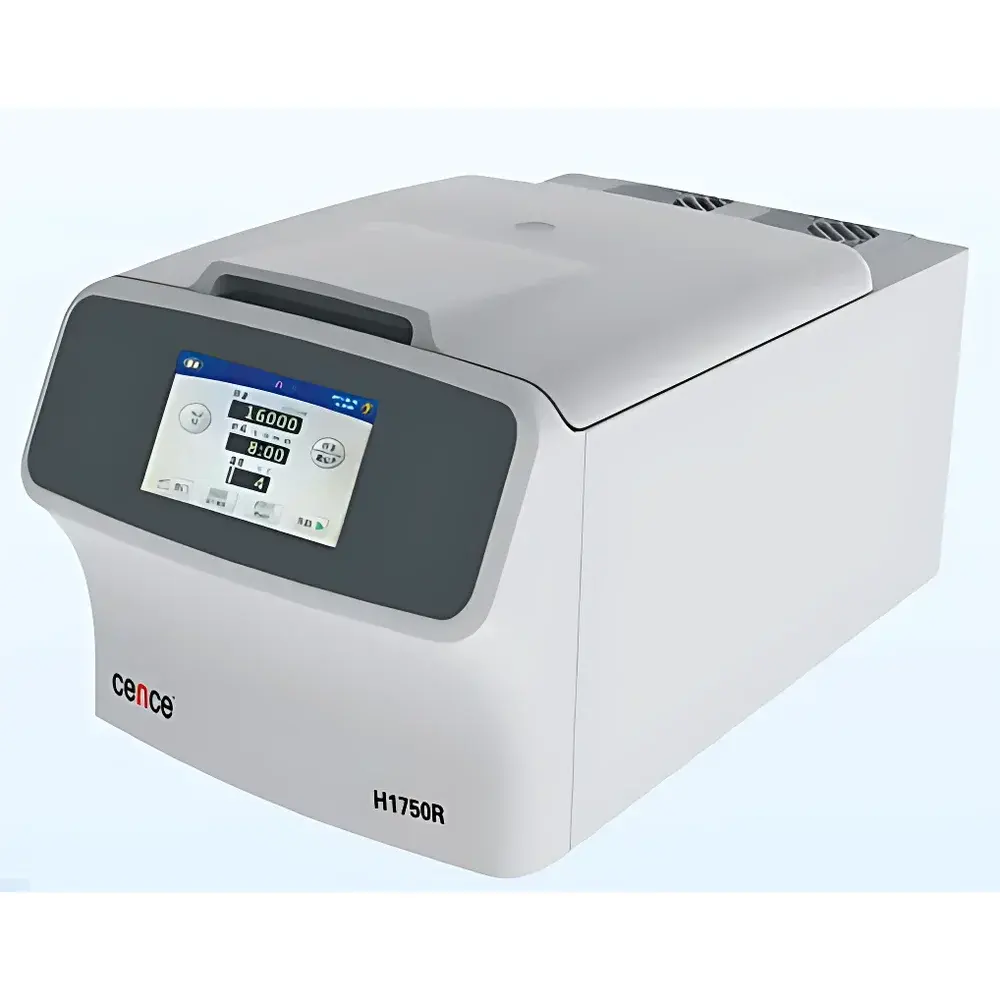
Xiangyi H1750 Benchtop High-Speed Centrifuge
| Brand | Xiangyi |
|---|---|
| Origin | Hunan, China |
| Manufacturer Type | Direct Manufacturer |
| Product Category | Domestic |
| Model | H1750 |
| Instrument Type | Benchtop Centrifuge |
| Speed Range | 10,000–30,000 rpm (High-Speed) |
| Max. Speed | 17,500 rpm |
| Max. RCF | 29,302 ×g |
| Max. Capacity | 4 × 100 mL (with sealed lid) |
| Dimensions (W×D×H) | 380 × 505 × 360 mm |
| Weight | 32 kg |
| Noise Level | <65 dB(A) |
| Speed Accuracy | ±10 rpm |
| Timer Range | 1 min – 99 h 59 min |
| Power Supply | AC 220 V ±22 V, 50/60 Hz |
| Power Consumption | 700 W |
| Rotor Compatibility | 13 interchangeable rotors (including fixed-angle, swing-out, PCR, capillary, and microplate types) |
Overview
The Xiangyi H1750 Benchtop High-Speed Centrifuge is an engineered solution for laboratories requiring reliable, high-precision separation of biological, clinical, and chemical samples under controlled rotational forces. Operating on the principle of sedimentation acceleration via centrifugal force—governed by rotor geometry, rotational speed, and sample density—the H1750 delivers up to 29,302 ×g at its maximum speed of 17,500 rpm. Its compact footprint (380 × 505 × 360 mm) and optimized mechanical architecture make it suitable for standard biosafety cabinets, shared core facilities, and QC/QA labs where space efficiency and operational consistency are critical. Designed for daily use in academic research, pharmaceutical development, and clinical diagnostics, the system meets fundamental performance requirements aligned with ISO 21501-4 (particle size analysis instrumentation standards) and supports GLP-compliant workflows through traceable parameter logging and user-defined program storage.
Key Features
- 7-inch high-resolution capacitive touchscreen interface with intuitive icon-driven navigation and real-time graphical display of speed, RCF, time, and temperature (if equipped with refrigerated variant).
- Automatic rotor recognition across 13 certified rotor configurations—eliminating manual input errors and ensuring safe operation within defined mechanical limits.
- Airtight rotor design compliant with IEC 61010-2-020 safety standards, minimizing aerosol generation during high-speed pelleting of infectious or volatile samples.
- Programmable acceleration and deceleration profiles: 9 ramp-up and 10 brake-down curves to mitigate resuspension of delicate pellets—particularly critical for nucleic acid isolation, exosome recovery, and subcellular fractionation.
- Acoustically damped housing and balanced drive assembly reduce operational noise to <65 dB(A) at full speed—supporting low-disturbance environments such as teaching labs and adjacent analytical workspaces.
- Multi-step program memory supporting up to 99 user-defined protocols, each assignable with alphanumeric labels for rapid recall and audit-ready documentation.
- Comprehensive safety architecture including overspeed protection, motor overtemperature cutoff, lid interlock verification, stainless-steel chamber liner, and triple-layer mechanical containment per EN 61010-1.
Sample Compatibility & Compliance
The H1750 accommodates diverse sample formats through its modular rotor ecosystem—including fixed-angle rotors for high-RCF pelleting (e.g., No.1: 24 × 1.5/2.0 mL at 17,500 rpm), swing-bucket configurations for volume-sensitive applications (e.g., No.13: 4 × 100 mL horizontal carriers), and specialized accessories for PCR tubes (No.9), capillaries (No.10), and microtiter plates (No.14). All rotors undergo static and dynamic balancing certification per ISO 1940-1 Grade G2.5. The instrument’s construction adheres to CE marking directives (2014/30/EU EMC, 2014/35/EU LVD), and its operational parameters align with common method validation frameworks referenced in USP , EP 2.2.27, and CLSI EP17-A2 for centrifugation-based assay reproducibility.
Software & Data Management
While the H1750 operates via embedded firmware without external PC dependency, its onboard memory logs timestamped run records—including rotor ID, set parameters, actual speed/RCF, elapsed time, and fault codes—for local review and manual export via USB interface (optional firmware upgrade). Audit trail functionality supports basic GLP traceability: user ID tagging (via login-enabled firmware version), program modification history, and session timestamps. For regulated environments requiring FDA 21 CFR Part 11 compliance, integration with third-party laboratory information management systems (LIMS) is achievable through RS-232 or optional Ethernet module (H1750-Net variant), enabling remote monitoring, electronic signature capture, and automated data archiving.
Applications
- Cellular fractionation: Isolation of mitochondria, lysosomes, and nuclear extracts from mammalian, bacterial, or yeast cultures.
- Clinical specimen processing: Serum/plasma separation from whole blood (using No.13 swing-bucket rotor with vacuum tube adapters).
- Molecular biology workflows: Plasmid DNA purification, RNA precipitation, and viral particle concentration prior to TEM or NTA analysis.
- Pharmaceutical quality control: Clarification of protein formulations, removal of aggregates in monoclonal antibody batches, and excipient compatibility testing.
- Environmental and food testing: Concentration of microbial cells from water or homogenized food matrices for subsequent qPCR or culture-based enumeration.
FAQ
What rotor configurations are included standard with the H1750?
The base configuration includes one fixed-angle rotor (No.1: 24 × 1.5/2.0 mL). Additional rotors—including swing-bucket, PCR, capillary, and microplate types—are available as optional accessories; full compatibility is verified via automatic rotor ID detection.
Is refrigeration available for the H1750 model?
The standard H1750 is air-cooled and non-refrigerated. A dedicated refrigerated variant (H1750R) with -20°C to +40°C temperature control is offered separately, featuring enhanced condensation management and compressor-based thermal regulation.
Can the H1750 be integrated into a networked lab environment?
Yes—via optional RS-232 serial port or Ethernet interface (H1750-Net), enabling remote start/stop commands, real-time status polling, and centralized log aggregation compatible with major LIMS platforms.
Does the H1750 meet international safety and electromagnetic compatibility standards?
Yes—it carries CE marking per 2014/30/EU (EMC Directive) and 2014/35/EU (Low Voltage Directive), and complies with IEC 61010-1 for laboratory equipment safety and IEC 61000-6-3 for radiated emissions.
How is rotor lifetime managed and validated?
Each rotor is assigned a unique serial number and tracked via the instrument’s internal database. Recommended service intervals, maximum cycle counts, and fatigue inspection guidelines follow ISO 15363 and manufacturer-recommended maintenance schedules documented in the technical manual.



