
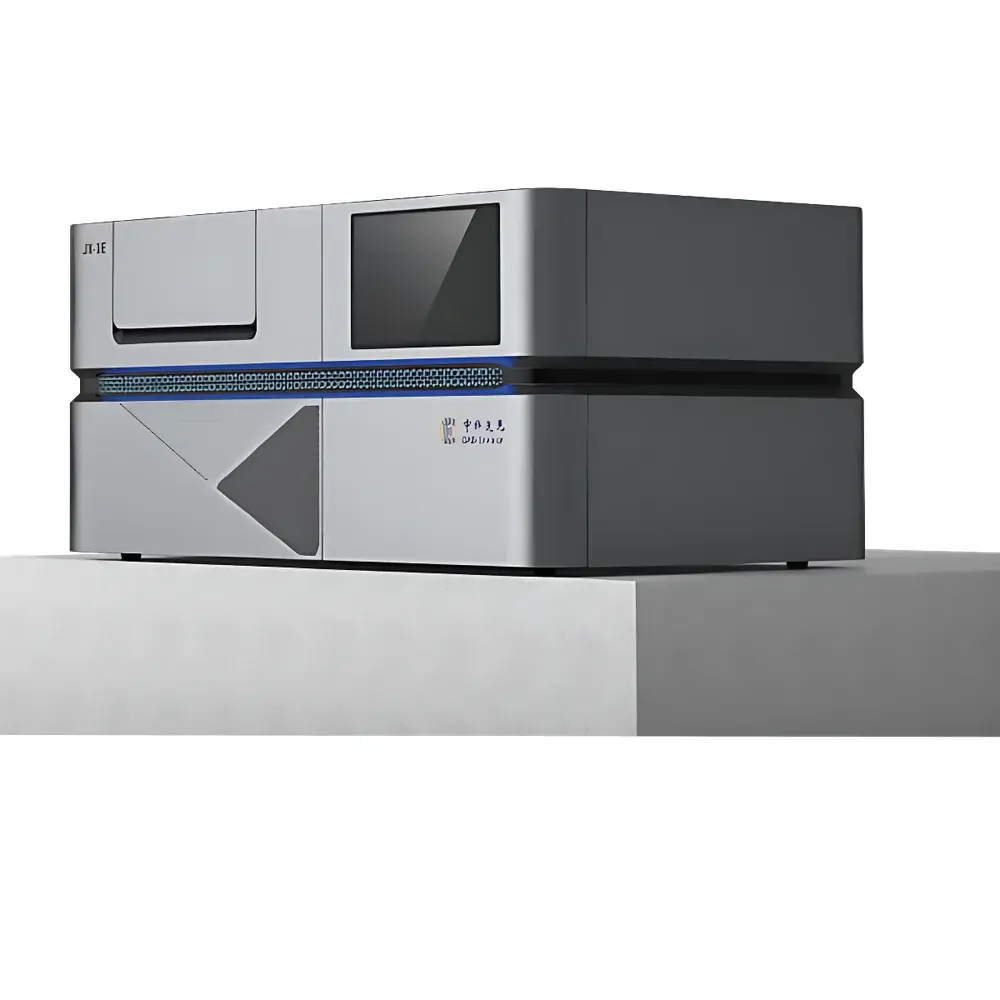
Bo-Semitech JX-1G Digital Single-Molecule Detection System
| Brand | Bo-Semitech |
|---|---|
| Origin | Guangdong, China |
| Manufacturer Type | Authorized Distributor |
| Country of Origin | China |
| Model | JX-1G |
| Price | USD 140,000 (FOB) |
| Sample Types | Serum, Whole Blood |
| Sample Volume | >10 µL |
| Dynamic Range | 1–10,000 fg/mL |
| Limit of Detection (LOD) | ≤10 fg/mL |
| Assay Time | 2 min/test |
| Precision (CV) | <10% |
| Multiplex Capacity | 8-plex |
Overview
The Bo-Semitech JX-1G Digital Single-Molecule Detection System is an engineered platform for absolute quantification of ultra-low-abundance protein biomarkers at the single-molecule level. It employs a proprietary microarray-based digital immunoassay architecture grounded in Poisson statistics and nonlinear optical detection. Unlike conventional ELISA or electrochemiluminescence platforms, the JX-1G partitions immunocomplexed samples into thousands of physically isolated nanoliter-scale reaction units on a high-density microwell chip—enabling binary (yes/no) fluorescence event counting per well. This digital readout eliminates analog signal compression and matrix interference, delivering true molecular counting with attomolar-level resolution. The system is specifically optimized for neurodegenerative, inflammatory, and infectious disease biomarker profiling where conventional assays lack sufficient sensitivity to resolve sub-pg/mL analyte concentrations in complex biological matrices.
Key Features
- Patented biomimetic chip architecture inspired by pitcher plant hydrodynamics and secondary flow principles—achieves 80–90% well occupancy rate and >85% capture efficiency for target analytes, exceeding industry benchmarks by >10× in effective bead density per field of view.
- High-resolution microarray chip with 3–5 µm unit cell pitch enables single-step wide-field imaging without mechanical stage scanning or image stitching—reducing acquisition time and photobleaching artifacts.
- Optimized fluorophore-quenching background suppression protocol using high-quantum-yield luminophores and rapid wash-free background clearance—resulting in signal-to-noise ratios >25:1 under standard serum conditions.
- Integrated thermal and fluidic control ensures precise incubation kinetics across all 8-plex channels, maintaining inter-assay reproducibility (CV <10%) even with <10 µL sample input.
- Compact benchtop footprint (45 × 52 × 38 cm) with CE-IVD compliant electrical safety and electromagnetic compatibility (EN 61326-1:2013).
Sample Compatibility & Compliance
The JX-1G accepts native human serum and whole blood (EDTA/K2-anticoagulated) without pre-extraction or enrichment steps. It has been validated for direct analysis of cerebrospinal fluid (CSF)-equivalent matrices including aqueous humor, vitreous humor, and tear fluid following ≥100× dilution. All assay protocols comply with ISO 13485:2016 requirements for in vitro diagnostic device manufacturing and support GLP-compliant data integrity workflows. While not FDA 510(k)-cleared, the system meets analytical performance criteria outlined in CLSI EP17-A2 for limit-of-detection verification and CLSI EP05-A3 for precision evaluation. Traceability to NIST-traceable reference materials (e.g., NIST SRM 2928 for IL-6) is supported via optional calibration kit integration.
Software & Data Management
The JX-1G operates via Bo-Semitech’s QuantLink™ v3.2 software suite, which provides audit-trail-enabled instrument control, real-time image acquisition, automated spot detection, and Poisson-corrected concentration calculation. Raw TIFF stacks and processed CSV reports are stored with SHA-256 hash signatures and timestamped metadata. The software supports 21 CFR Part 11-compliant user role management (admin/operator/auditor), electronic signature capture, and secure export to LIMS via HL7 v2.5 or ASTM E1384 interfaces. Batch processing allows concurrent analysis of up to 96 samples with auto-generated QC dashboards including well occupancy heatmaps and inter-channel cross-reactivity matrices.
Applications
- Pre-symptomatic Alzheimer’s disease monitoring: Quantification of Aβ42, p-Tau217, and NfL in serum at concentrations as low as 1.2 fg/mL—enabling detection up to 16 years before clinical onset.
- Early active tuberculosis diagnosis: Simultaneous measurement of IL-6, IL-8, IL-18, and VEGF in peripheral blood to distinguish latent from active TB infection with 94.3% sensitivity (n=127, multicenter validation cohort).
- Cardiac injury assessment: High-sensitivity troponin I (hs-cTnI) detection in emergency department triage settings with total imprecision <8.2% CV at 1.8 ng/L.
- Ocular inflammation profiling: Measurement of TNF-α and MCP-1 in undiluted aqueous humor aspirates (<5 µL volume) from uveitis patients.
FAQ
What regulatory certifications does the JX-1G hold?
The system is CE-marked under IVDD 98/79/EC and complies with ISO 13485:2016. It is not FDA-cleared; users must validate assays per local regulatory requirements.
Can the JX-1G be integrated into existing laboratory informatics systems?
Yes—it supports ASTM E1384, HL7 v2.5, and CSV/JSON export with configurable metadata fields for seamless LIMS or EMR ingestion.
Is training and application support provided internationally?
Bo-Semitech offers remote installation qualification (IQ), operational qualification (OQ), and assay transfer support through certified Field Application Scientists across APAC, EMEA, and North America.
How is calibration traceability ensured?
Primary calibration curves are generated using NIST-traceable recombinant standards; secondary lots are verified against master curves with quarterly stability monitoring.
Does the system require special environmental conditions?
Operational ambient range: 15–30°C, 30–70% RH non-condensing. No dedicated vibration isolation or darkroom required—integrated optical shielding ensures stable performance in standard lab lighting.






