
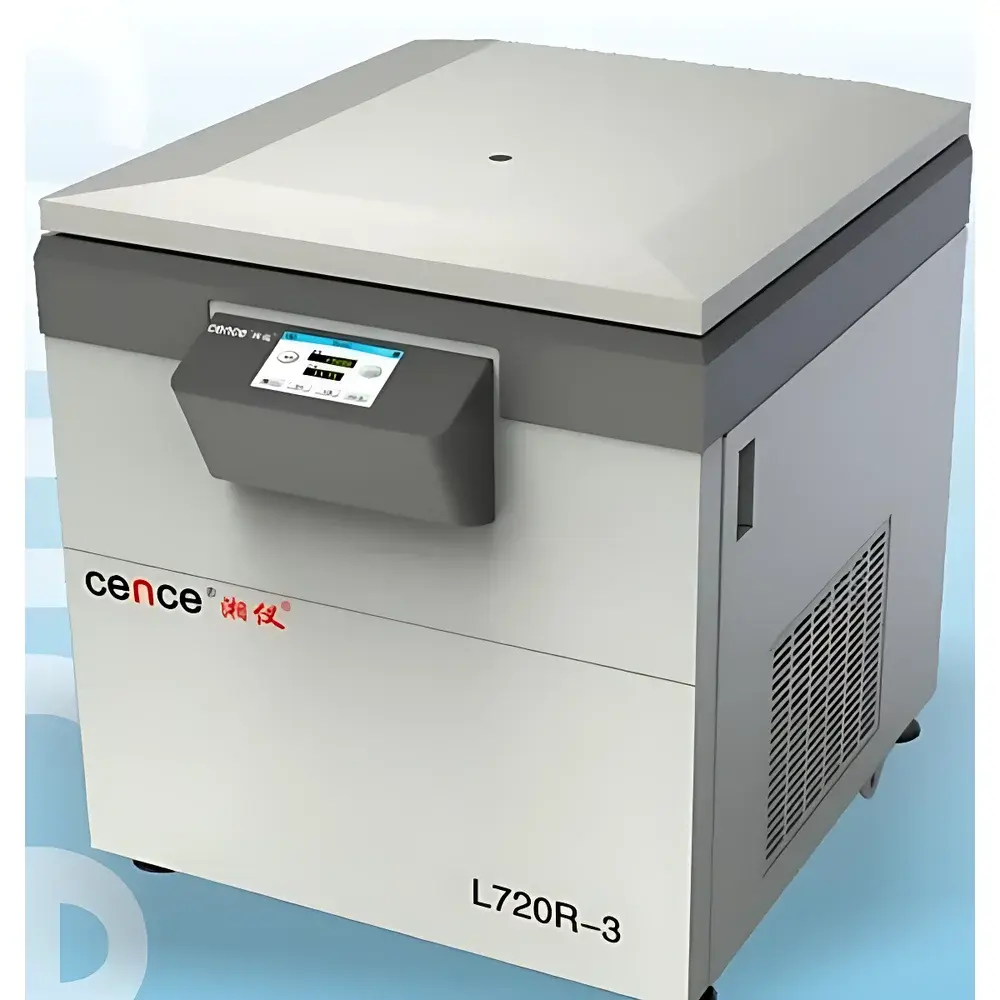
Xiangyi L720R-3 Ultra-High-Capacity Refrigerated Floor-Standing Centrifuge
| Brand | Xiangyi |
|---|---|
| Origin | Hunan, China |
| Manufacturer Type | Direct Manufacturer |
| Product Category | Domestic |
| Model | L720R-3 |
| Instrument Type | Floor-standing Centrifuge |
| Speed Classification | Low-Speed Centrifuge (≤10,000 rpm) |
| Function | Refrigerated Centrifuge |
| Configuration | Horizontal Rotor Centrifuge |
| Separation Target | Large Organelles & Viruses |
| Maximum Capacity | 6 × 2400 mL |
| Maximum Speed | 7200 rpm |
| Maximum RCF | 12,166 × g |
| Dimensions (W×D×H) | 870 × 1020 × 970 mm |
Overview
The Xiangyi L720R-3 is an ultra-high-capacity, refrigerated floor-standing centrifuge engineered for robust, high-throughput separation of biological and industrial suspensions under controlled thermal conditions. Designed according to ISO 15195:2019 (laboratory centrifuge performance requirements) and aligned with IEC 61010-1 safety standards for electrical equipment, the L720R-3 employs horizontal rotor architecture to deliver precise sedimentation of large organelles, viral particles, cell aggregates, and precipitated polymers. Its operational envelope—spanning temperatures from –20 °C to +40 °C and rotational speeds up to 7200 rpm—ensures consistent density-gradient and differential centrifugation outcomes across batch sizes up to 14.4 L per run. The system integrates a brushless DC motor with closed-loop speed regulation, coupled with a dual-stage refrigeration circuit utilizing environmentally compliant R449A refrigerant, enabling rapid temperature stabilization (<15 min from 25 °C to 4 °C at full load) and minimal thermal drift during extended runs.
Key Features
- Ultra-high capacity configuration supporting six 2400 mL bottles (e.g., Nalgene™ Wide-Mouth HDPE or Corning® Cell Culture Bottles), enabling single-run processing of up to 14.4 L—ideal for upstream bioprocessing, vaccine manufacturing, and bulk plasma fractionation.
- Mechanical integrity validated via Maximum Credible Accident (MCA) testing per EN 61010-2-020 Annex BB: post-failure containment ensures no solid fragment >0.5 mm escapes the chamber; door remains locked; total displacement <30 cm.
- Corrosion-resistant 316L stainless-steel centrifuge chamber (2 mm thickness, material certification available); structural frame fabricated from 3 mm Q235 carbon steel; protective outer casing and door baffle constructed from 22 mm and 2.5 mm Q235 steel respectively.
- Intelligent thermal management: dynamic compressor control activates only during active cooling phases; compressor automatically disengages upon lid opening or enters configurable sleep mode (1–120 min) to reduce standby energy consumption by up to 38%.
- Comprehensive safety architecture including automatic rotor identification (RFID-based), real-time imbalance detection (±0.5 g mass asymmetry), overspeed cutoff (105% setpoint), overtemperature lockout (±2 °C deviation), motor winding overheat protection, and interlocked lid actuation.
- Modular communication interface: standard Ethernet (10/100BASE-TX) compliant with Modbus TCP protocol; provides access to 64 configurable process data points—including actual RCF, chamber temperature, rotor ID, elapsed time, and fault codes—for integration into MES, SCADA, or LIMS environments.
Sample Compatibility & Compliance
The L720R-3 accommodates industry-standard horizontal rotors compatible with 500–2400 mL bottles, conical tubes, and sealed canisters meeting ASTM D4169 and ISO 8573-1 purity classifications. Its design supports GMP-aligned workflows: all firmware logs (including parameter changes, start/stop events, alarms, and user authentication) are timestamped and non-erasable, satisfying FDA 21 CFR Part 11 audit-trail requirements when operated in administrator mode. The system conforms to GLP documentation standards through optional CSV export of run records and event logs. Chamber surface finish (Ra ≤ 0.8 µm) and seamless weld construction meet ISO 13485:2016 criteria for medical device manufacturing support.
Software & Data Management
The 7-inch capacitive touchscreen interface runs embedded Linux-based firmware with dual-language support (English/Chinese) and role-based access control (Operator, Technician, Administrator). Up to 2000 centrifugation protocols may be stored with alphanumeric (Pinyin-enabled) naming for rapid recall. Each protocol supports multi-step gradient runs: up to five sequential stages defined by independent RCF/time/temperature sets, executed with programmable acceleration/deceleration profiles (10 ramp-up and 11 ramp-down curves). Real-time graphical monitoring displays concurrent RCF and temperature trends with ±0.3 °C and ±10 rpm resolution. System logs retain ≥10,000 entries with automatic rollover; external backup via USB 2.0 or network share is supported.
Applications
- Biopharmaceutical manufacturing: clarification of mammalian cell culture harvests, recovery of viral vectors (AAV, lentivirus), and large-volume plasma fractionation prior to chromatography.
- Vaccine production: pelleting of whole-inactivated virus (WIV) or bacterial antigen preparations from bioreactor effluents.
- Industrial enzymology: isolation of extracellular enzyme complexes from fungal or bacterial fermentation broths.
- Environmental analysis: concentration of microplastics (>10 µm) and algal biomass from wastewater samples per EPA Method 1611.
- Academic core facilities: high-yield preparation of mitochondria, lysosomes, and exosome-enriched fractions from tissue homogenates using iodixanol or sucrose gradients.
FAQ
What is the minimum operating temperature and how quickly does the chamber reach it?
The refrigeration system achieves –20 °C nominal setpoint; cooling from ambient (25 °C) to 4 °C at maximum load (14.4 L water) requires ≤14 minutes.
Is rotor calibration traceable to national standards?
Yes—each supplied horizontal rotor includes a factory calibration certificate traceable to CNAS-accredited metrology laboratories (certificate number provided per unit).
Can the L720R-3 be integrated into a 21 CFR Part 11-compliant environment?
When deployed with enabled audit-trail logging, electronic signatures, and password-protected user roles, the system meets foundational technical controls for Part 11 compliance; validation documentation packages are available upon request.
What maintenance intervals are recommended for the refrigeration system?
Compressor oil and filter replacement every 24 months; annual verification of refrigerant charge and heat exchanger cleanliness per ISO 8573-8.
Does the system support third-party rotor compatibility?
Only Xiangyi-certified rotors with embedded RFID tags are recognized and permitted to operate; non-OEM rotors trigger immediate interlock and error code E207.



