
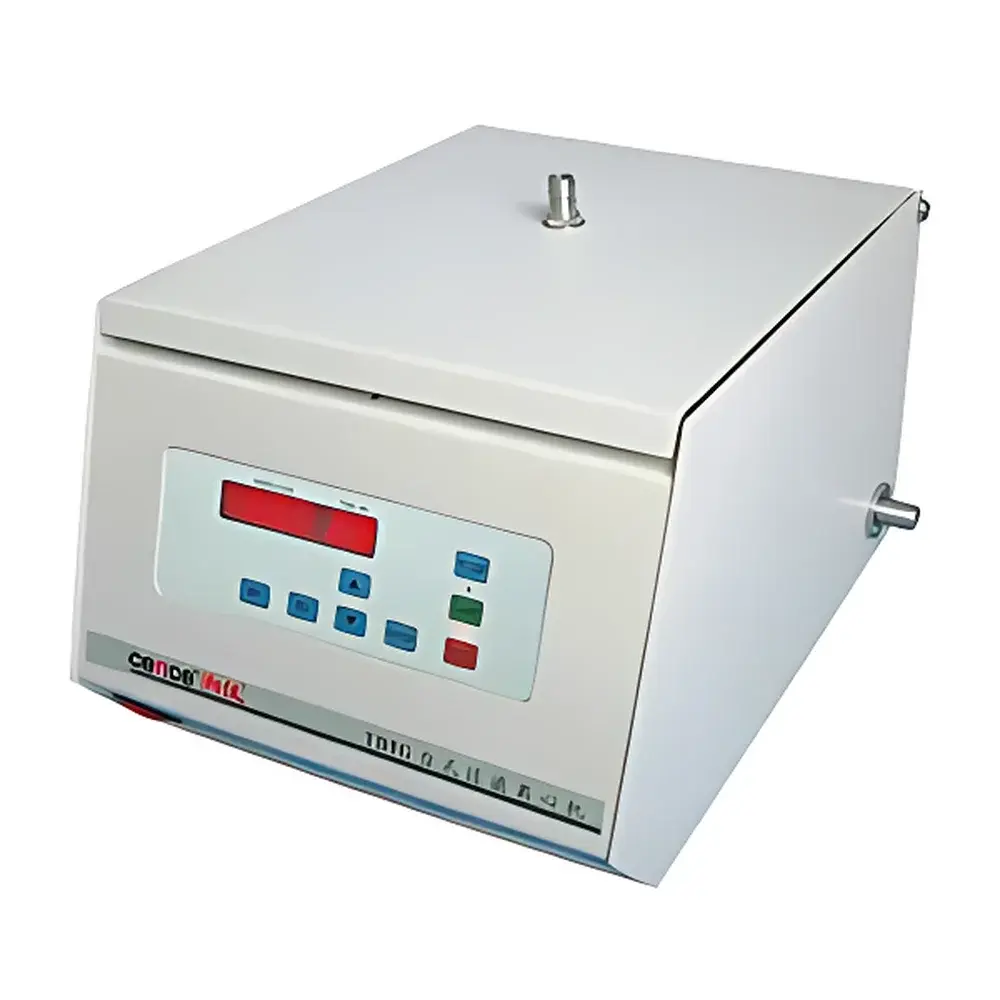
Xiangyi TD5G Benchtop Filtration Centrifuge
| Brand | Xiangyi |
|---|---|
| Origin | Hunan, China |
| Manufacturer Type | Direct Manufacturer |
| Product Category | Domestic |
| Model | TD5G |
| Instrument Type | Benchtop Centrifuge |
| Speed Class | Low-Speed Centrifuge (≤ 5000 rpm) |
| Function | General-Purpose Filtration Centrifuge |
| Configuration | Horizontal Rotor Design |
| Maximum Capacity | 8 L/min (filtration throughput) |
| Maximum Speed | 5000 rpm |
| Maximum RCF | 4100 × g |
| Dimensions | 320 × 380 × 350 mm |
| Drive System | Brushless DC Motor |
| Control System | Microprocessor-Based |
| Rotor & Chamber Material | Stainless Steel (AISI 304) |
| Lid Seal | Silicone Rubber Gasket |
| Sterilization Compatibility | Autoclavable, Chemical Disinfection (e.g., 70% ethanol, 0.5% sodium hypochlorite), UV Exposure |
Overview
The Xiangyi TD5G Benchtop Filtration Centrifuge is an engineered solution for solid–liquid separation via centrifugal filtration—a process in which differential sedimentation and mechanical straining occur simultaneously under controlled rotational force. Unlike conventional sedimentation centrifuges, the TD5G integrates a horizontal rotor configuration with integrated filter support structures, enabling continuous or semi-continuous operation when coupled with external feed and filtrate collection systems. Designed specifically for low-speed, high-capacity applications, it operates at up to 5000 rpm with a maximum relative centrifugal force (RCF) of 4100 × g—optimized for gentle yet efficient separation of coarse particulates, cell aggregates, precipitated proteins, or crystalline suspensions without shear-induced degradation. Its robust stainless-steel construction (AISI 304), silicone-sealed lid, and brushless DC motor ensure long-term reliability, low acoustic emission (< 62 dB(A)), and zero carbon dust generation—critical for GLP-compliant laboratories and cleanroom-adjacent environments.
Key Features
- Brushless DC motor drive system ensures stable speed control, extended service life (> 20,000 hr MTBF), and electromagnetic compatibility compliant with IEC 61000-4 standards.
- Microprocessor-based control interface with real-time rpm/RCF display, programmable time settings (1 s – 99 min 59 s), and automatic rotor identification logic for safety interlock validation.
- Horizontal swing-out rotor design accommodates standard filtration bags (included) and supports customizable filter media (e.g., nylon mesh, polypropylene pleated cartridges, or stainless-steel sintered discs).
- Full stainless-steel centrifuge chamber and rotor housing provide corrosion resistance to organic solvents, mild acids/bases, and aqueous salt solutions—validated per ASTM B117 salt-spray testing (72 hr exposure, no pitting).
- Silicone rubber door gasket maintains positive sealing integrity under dynamic load; compatible with autoclaving (121 °C, 15 psi, 20 min) and validated for repeated chemical disinfection cycles per ISO 15883-1.
- Integrated vibration damping and precision-balanced rotor assembly deliver < 0.15 mm/s RMS vibration amplitude at full speed—minimizing structural fatigue and cross-contamination risk.
Sample Compatibility & Compliance
The TD5G is suitable for processing suspension volumes up to 8 L/min in continuous-feed mode (when interfaced with peristaltic pumps and buffer reservoirs) or discrete batch loads in standard conical-bottom centrifuge tubes (up to 500 mL) and custom filtration housings. It complies with essential electrical safety requirements per IEC 61010-1:2010 (Class I, Pollution Degree 2) and meets CE marking directives for laboratory equipment. While not certified for ATEX or IECEx hazardous-area use, its non-sparking motor and grounded chassis make it appropriate for general-purpose pharmaceutical QC labs operating under cGMP Annex 1 environmental controls. The stainless-steel wetted surfaces conform to USP material classification for Class VI plastics-equivalent inertness in contact with biopharmaceutical intermediates.
Software & Data Management
The TD5G operates as a standalone instrument with embedded firmware—no external PC dependency required for routine operation. All run parameters (speed, time, acceleration/deceleration profiles) are stored in non-volatile memory with timestamped logs retained for ≥1000 cycles. Optional RS-232/USB serial output enables integration into LabVantage or Thermo Fisher SampleManager LIMS platforms for audit-trail generation aligned with FDA 21 CFR Part 11 requirements (electronic signatures, data integrity verification). Raw log files export in CSV format for traceability during internal quality audits or regulatory inspections.
Applications
- Clarification of fermentation broths in bioprocessing pilot lines prior to depth filtration or chromatography.
- Recovery of microcrystalline cellulose or calcium carbonate precipitates in fine chemical synthesis.
- Separation of plant tissue homogenates in phytochemical extraction workflows (e.g., curcuminoid isolation from turmeric).
- Preparative cleaning of polymer emulsions in coatings R&D laboratories.
- Field-deployable sediment analysis in environmental monitoring programs using portable filtration kits.
- QC testing of excipient particle distribution in oral solid dosage form development (aligned with USP light obscuration methodology).
FAQ
What types of filtration media are compatible with the TD5G?
Standard polyester or polypropylene filter bags (included) are supplied; users may substitute with any 100–500 µm pore-size media rated for ≤ 4100 × g and compatible with AISI 304 contact surfaces.
Can the TD5G be used for sterile processing?
Yes—the entire rotor chamber and lid assembly can be autoclaved; however, filtration bags must be pre-sterilized separately (gamma irradiation or EO sterilization recommended).
Is rotor imbalance detection built-in?
Yes. The microprocessor continuously monitors current draw and phase variance; operation halts automatically if imbalance exceeds ±2.5% mass asymmetry at set speed.
Does the TD5G meet ISO 22870 requirements for point-of-care centrifugation?
While not classified as a POCT device, its performance envelope satisfies ISO 22870 Annex B criteria for “low-risk” centrifugal separation in near-patient settings when operated within validated speed/time parameters.
How is calibration verified?
Speed accuracy is factory-verified using NIST-traceable tachometer standards (±0.5% tolerance); users may perform periodic checks using an optical stroboscope or handheld laser tachometer per ISO/IEC 17025 guidelines.
Related Products



