
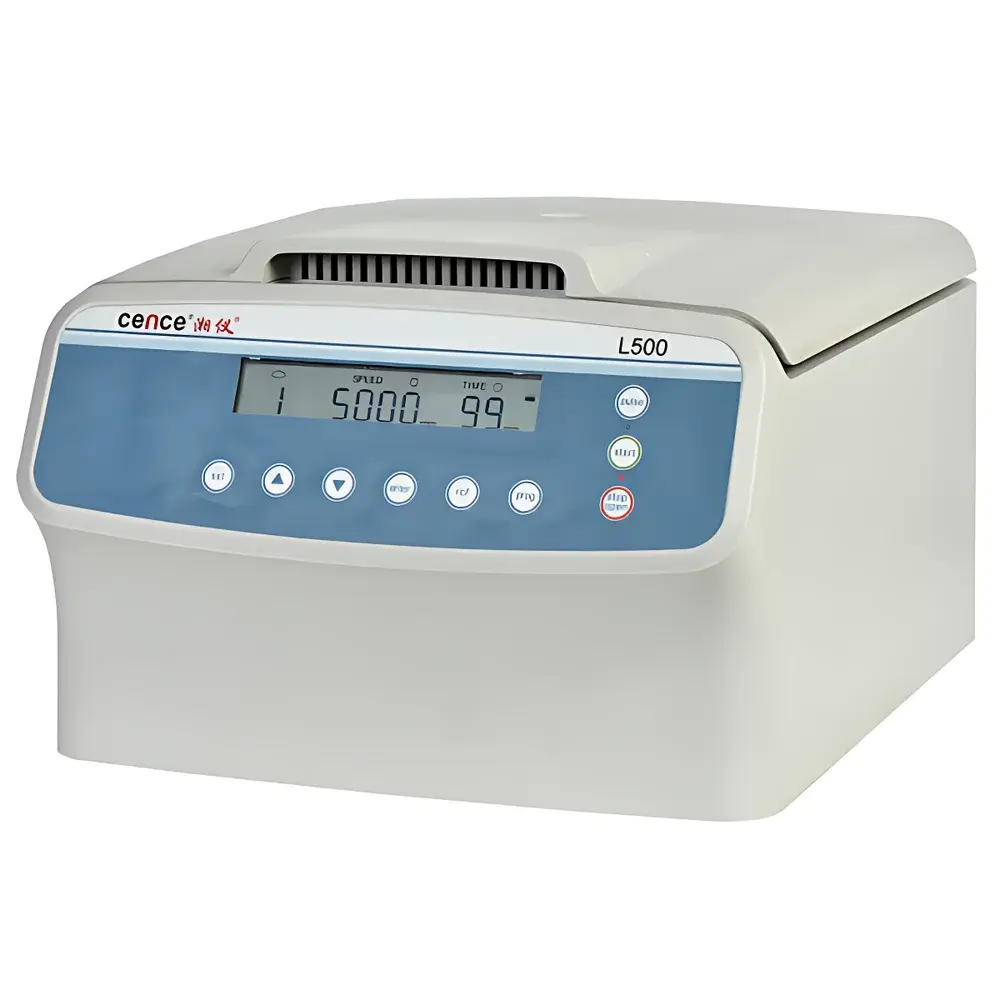
Xiangyi L500-A Benchtop Low-Speed Centrifuge
| Brand | Xiangyi |
|---|---|
| Origin | Hunan, China |
| Manufacturer Type | Direct Manufacturer |
| Product Category | Domestic |
| Model | L500-A |
| Instrument Type | Benchtop Centrifuge |
| Speed Range | Up to 5000 rpm |
| Max RCF | 4030 × g |
| Max Capacity | 24 × 15 mL |
| Rotor Type | Horizontal Swing-Out Rotor |
| Application Scope | Cell & Bacterial Separation |
| Dimensions (W×D×H) | 370 × 432 × 250 mm |
| Drive System | Brushless DC Motor |
| Control Interface | Touchscreen LCD with RCF Auto-Calculation |
| Memory | 50 User-Defined Rotor Profiles |
| Safety Features | Electronic Lid Lock, Automatic Imbalance Detection & Shutdown, Soft-Closing Lid Mechanism |
| Vibration Damping | Integrated Passive Damping System |
| Compliance | Designed per IEC 61010-1 (Safety Requirements for Electrical Equipment for Measurement, Control, and Laboratory Use) |
Overview
The Xiangyi L500-A Benchtop Low-Speed Centrifuge is an engineered solution for routine separation tasks in clinical laboratories, blood banks, and academic research settings where reproducible, low-force sedimentation of biological suspensions is required. Operating on the principle of centrifugal sedimentation—where differential density and particle size drive phase separation under controlled rotational acceleration—the L500-A delivers stable, repeatable performance at speeds up to 5000 rpm and a maximum relative centrifugal force (RCF) of 4030 × g. Its horizontal swing-out rotor design ensures uniform sample distribution during acceleration and deceleration, minimizing shear stress on delicate cellular components such as erythrocytes, leukocytes, and bacterial pellets. Unlike high-speed or ultracentrifugation systems, the L500-A is optimized for applications requiring gentle pelleting without denaturation or lysis—making it particularly suitable for serum/plasma preparation, urine sediment analysis, and microbiological culture harvesting.
Key Features
- Brushless DC motor drive system: Eliminates carbon brush wear, reduces electromagnetic interference, and ensures long-term torque stability across the full speed range (200–5000 rpm).
- Microprocessor-based control architecture: Enables precise speed regulation (±10 rpm accuracy), real-time RCF calculation based on selected rotor radius, and automatic deceleration profiling to prevent resuspension.
- Horizontal swing-out rotor with stainless-steel construction: Accommodates up to 24 × 15 mL conical tubes; compatible with standard polypropylene and glass centrifuge tubes; rotor identification supports memory recall of user-defined configurations.
- Integrated passive damping system: Absorbs mechanical vibration during operation, maintaining operational stability even under partial load imbalance conditions.
- Electromechanical lid interlock: Prevents rotor acceleration unless lid is fully closed and locked; automatically initiates emergency stop if lid is opened mid-run or if imbalance exceeds safe thresholds (>5 mm displacement detected).
- Ergonomic soft-closing lid mechanism: Requires minimal actuation force (<15 N); seals positively with tactile feedback and visual LED confirmation.
Sample Compatibility & Compliance
The L500-A is validated for use with common laboratory consumables including 5–15 mL conical centrifuge tubes (polypropylene, polycarbonate, and borosilicate glass), hematocrit capillaries, and microhematocrit tubes. It meets the essential safety requirements of IEC 61010-1:2010 for electrical equipment used in laboratory environments, including protection against electric shock, mechanical hazards, and abnormal temperature rise. While not certified to ISO 13485 or FDA 21 CFR Part 11 out-of-the-box, its firmware architecture supports audit-ready operation when integrated into GLP/GMP workflows—particularly through traceable parameter logging, user-defined rotor profiles, and non-volatile memory retention of run history (accessible via USB export). The unit complies with CE marking directives for electromagnetic compatibility (EMC) and low-voltage equipment.
Software & Data Management
The L500-A operates via an embedded real-time operating system with a 4.3-inch capacitive touchscreen interface. All operational parameters—including time, speed, RCF, acceleration/deceleration ramp rates, and rotor ID—are displayed simultaneously. Users may store up to 50 rotor-specific protocols, each preserving tube geometry, maximum load, and recommended run conditions. The system logs timestamped run records (start/stop time, final speed, total runtime, error codes) internally for ≥1000 cycles. Data export is supported via USB 2.0 port in CSV format for integration with LIMS or electronic lab notebooks. No proprietary software installation is required; exported files are natively readable in Excel, LabArchives, or OpenLab CDS.
Applications
- Clinical diagnostics: Serum and plasma separation from whole blood (EDTA, heparin, citrate anticoagulated samples); urine sediment concentration prior to microscopic examination.
- Microbiology: Harvesting bacterial cultures (e.g., E. coli, S. aureus) for downstream DNA extraction or antibiotic susceptibility testing.
- Cell biology: Gentle pelleting of mammalian suspension cells (e.g., hybridomas, CHO lines) prior to washing or cryopreservation.
- Pharmaceutical QC: Clarification of low-viscosity aqueous formulations and excipient suspensions during stability studies.
- Education: Teaching core principles of sedimentation velocity, Stokes’ law validation, and centrifugal force calculations in undergraduate biophysics and biochemistry labs.
FAQ
What is the maximum permissible imbalance tolerance for safe operation?
The L500-A detects imbalances exceeding ±5 g between opposing positions and halts acceleration before reaching set speed. Load symmetry must be maintained within ±0.5 g for optimal rotor longevity.
Can the centrifuge accommodate 50 mL conical tubes?
No—the L500-A’s horizontal rotor is mechanically configured for 15 mL tubes only. Adapters for smaller volumes (5–10 mL) are available as optional accessories.
Is rotor calibration required before first use?
No factory calibration is needed; however, users must input the effective rotor radius (142 mm for standard configuration) into the system to ensure accurate RCF display.
Does the device support timed runs with automatic restart after power interruption?
No—it lacks uninterruptible power supply (UPS) integration or resume-on-power restoration functionality. All active runs terminate upon loss of mains power.
What maintenance intervals are recommended for long-term reliability?
Brushless motor requires no scheduled maintenance. Annual inspection of lid lock actuator, damping mounts, and rotor threads is advised per manufacturer guidelines. Rotors should be cleaned with 70% ethanol after each use and inspected for pitting or thread damage before reuse.



