
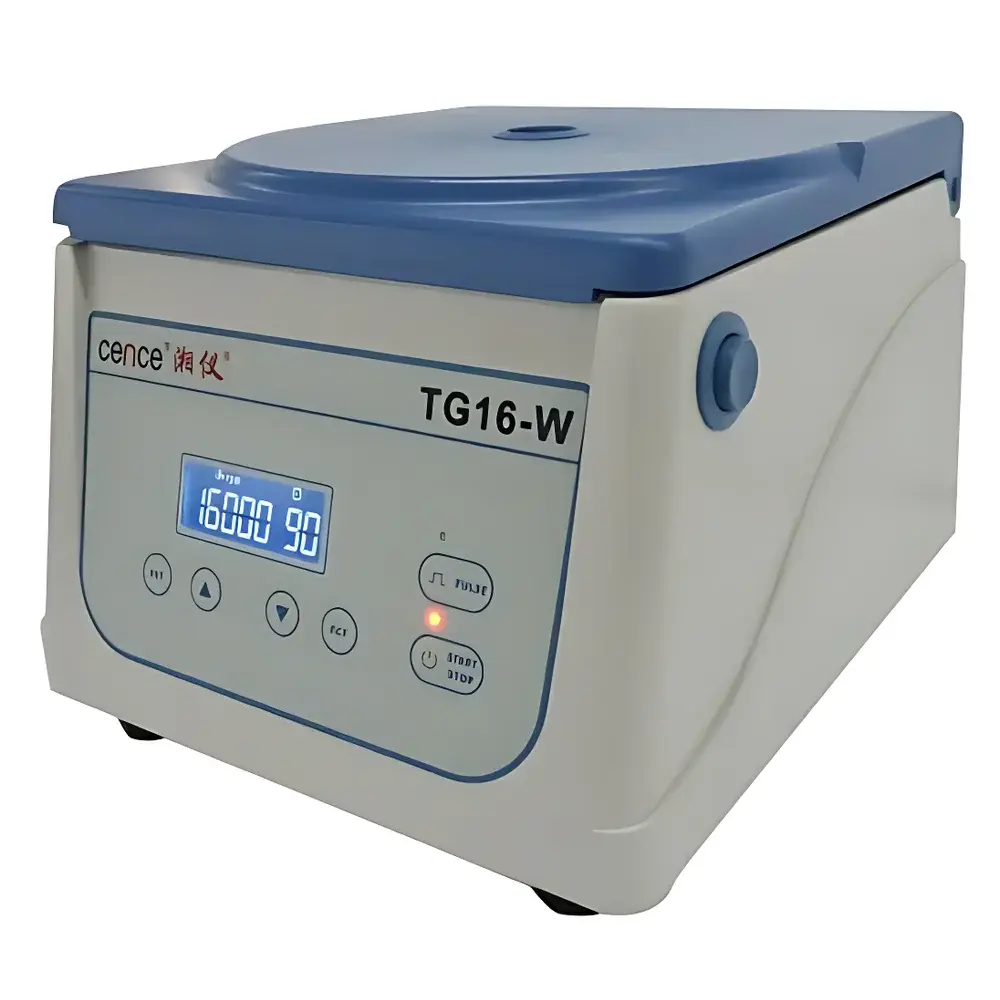
Xiangyi TG16-W Benchtop High-Speed Centrifuge
| Brand | Xiangyi |
|---|---|
| Origin | Hunan, China |
| Manufacturer Type | Direct Manufacturer |
| Product Category | Domestic |
| Model | TG16-W |
| Instrument Type | Benchtop Centrifuge |
| Speed Range | High-Speed (10,000–30,000 rpm) |
| Max. Speed | 16,500 rpm |
| Max. RCF | 17,800 × g |
| Max. Capacity | 8 × 5 mL |
| Dimensions | 265 × 305 × 205 mm |
| Drive System | Microprocessor-Controlled Brushless DC Motor |
| Control Interface | Touch Panel with LCD Display |
| Acceleration/Deceleration | 10 Programmable Steps |
| Safety Features | Electronic Lid Lock, Full Steel Inner Chamber, Real-Time Fault Diagnostics (Overspeed, Rotor Imbalance, Lid Open Detection) |
| Special Functions | RCF Direct Calculation & Display (RCF Key), Instant Spin (Pulse Mode), Countdown Timer with Second Resolution (<60 s) |
Overview
The Xiangyi TG16-W is a microprocessor-controlled benchtop high-speed centrifuge engineered for precision separation of biological and chemical samples in routine laboratory environments. It operates on the principle of sedimentation under controlled centrifugal force (RCF), where rotational motion generates radial acceleration to separate components based on density, size, and shape. Designed for consistent performance at speeds up to 16,500 rpm and maximum relative centrifugal force of 17,800 × g, the TG16-W supports standard microcentrifuge tube formats—specifically optimized for 8 × 5 mL angular rotor configurations. Its brushless DC motor ensures low-vibration, low-noise operation with extended service life and minimal maintenance requirements. The instrument complies with IEC 61010-1 safety standards for laboratory electrical equipment and incorporates mechanical and electronic safeguards aligned with GLP-aligned operational workflows.
Key Features
- Microprocessor-based control system with real-time monitoring of speed, time, and RCF
- Brushless DC motor drive delivering stable torque across full speed range and eliminating carbon brush wear
- Intuitive touch-panel interface with backlit LCD display for parameter entry, status feedback, and error logging
- Programmable acceleration and deceleration profiles (10-step selection) to minimize sample disturbance during spin-up/spin-down
- Dedicated RCF key enabling instantaneous conversion between rpm and ×g values without interrupting operation
- Pulse mode (short-time centrifugation) for rapid pelleting or quick wash steps without presetting full run duration
- Dynamic countdown timer displaying remaining time in seconds when less than 60 seconds remain
- Electronic lid interlock system preventing operation unless door is fully closed and locked; automatic rotor deceleration upon unauthorized opening
- Integrated fault diagnostics detecting overspeed conditions, rotor imbalance, abnormal lid status, and motor anomalies—triggering immediate safe shutdown
- Full stainless-steel inner chamber housing and reinforced structural frame for long-term corrosion resistance and mechanical integrity
Sample Compatibility & Compliance
The TG16-W accommodates common 5 mL conical-bottom tubes used in molecular biology, clinical diagnostics, and pharmaceutical QC labs—including polypropylene and polycarbonate variants rated for high-RCF applications. It is compatible with fixed-angle rotors only (no swing-bucket or vertical rotor options). While not certified to ISO 13485 or FDA 21 CFR Part 11 out-of-the-box, its operational logs (accessible via display history) support basic audit trail requirements for internal GLP documentation. Routine calibration verification can be performed using NIST-traceable tachometers and RCF reference standards. The device meets CE marking requirements under the Low Voltage Directive (2014/35/EU) and EMC Directive (2014/30/EU), and conforms to RoHS 2011/65/EU restrictions on hazardous substances.
Software & Data Management
The TG16-W operates as a standalone instrument without external PC connectivity or proprietary software. All operational parameters—including speed, time, RCF, acceleration/deceleration profile, and run history—are stored locally in non-volatile memory and accessible via the LCD menu. Event logs retain timestamped records of the last 20 runs and any triggered fault conditions (e.g., “Lid Open Detected”, “RCF Limit Exceeded”). No data export functionality (USB, Ethernet, or Bluetooth) is provided; however, manual transcription of displayed values supports integration into LIMS or ELN systems via operator input. For regulated environments requiring electronic records, users may supplement with external video recording or digital logbook entries aligned with ALCOA+ principles.
Applications
- Clarification of cell lysates and bacterial supernatants prior to chromatography or electrophoresis
- Isolation of plasmid DNA, RNA, and protein complexes from small-volume samples
- Preparation of membrane fractions and organelle subpopulations in basic cell biology workflows
- Routine pelleting of precipitated proteins or synthetic nanoparticles in formulation development
- Centrifugal concentration of dilute analytes in environmental or food safety testing protocols
- Quality control of reagent stability and particulate contamination in diagnostic kit manufacturing
FAQ
What rotor types are supported by the TG16-W?
The TG16-W is configured exclusively for fixed-angle rotors; the standard configuration includes an 8-place 5 mL angular rotor. Swing-bucket or horizontal rotors are not compatible.
Does the TG16-W support temperature control?
No. This is a non-refrigerated centrifuge intended for ambient-temperature operation only.
Can RCF values be calibrated or validated independently?
Yes. Users may verify RCF accuracy using a calibrated handheld tachometer and the manufacturer’s published rotor radius value (provided in the user manual) to cross-check displayed RCF against theoretical calculation.
Is the instrument suitable for use in ISO Class 5 cleanrooms?
While the unit emits no volatile organic compounds and features sealed electronics, it lacks HEPA filtration or static-dissipative casing; therefore, it is not classified for direct cleanroom installation without additional environmental controls.
What maintenance intervals are recommended?
Annual visual inspection of rotor integrity, lubrication of lid hinge mechanism, and verification of electronic lock engagement are advised. Brushless motor maintenance is not required; however, dust filters (if equipped) should be cleaned quarterly.



