
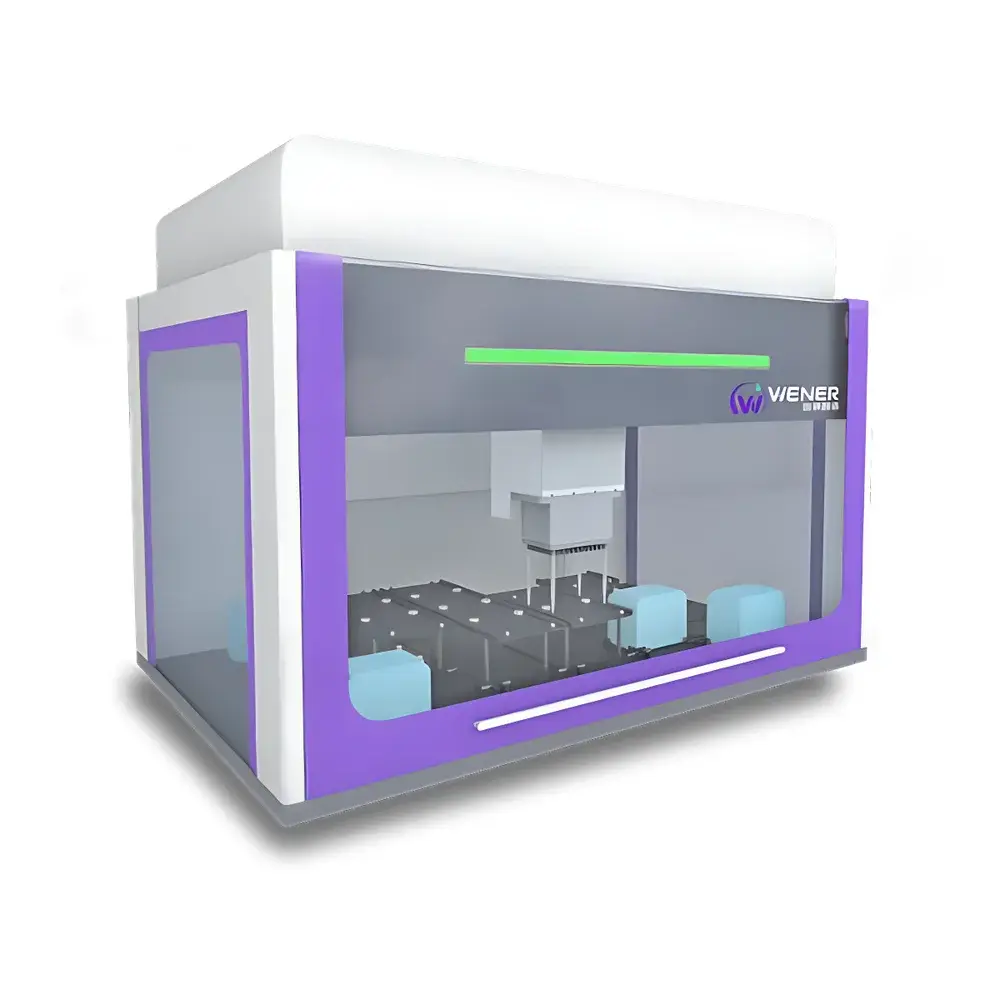
WenerLab V30 High-Throughput Liquid Handling Workstation
| Brand | Wener |
|---|---|
| Origin | Shanghai, China |
| Manufacturer Type | Original Equipment Manufacturer (OEM) |
| Country of Origin | China |
| Model | WenerLab V30 |
| Plate Positions | 30 |
| Pipetting Accuracy | CV ≤5% at 1 µL |
| Pipetting Range | 0.5–1000 µL |
| Sample Throughput | 96 samples per run |
| Dimensions | 1200 × 780 × 930 mm |
| Weight | 168 kg |
| Control System | External PC with Open API |
| Standard Tips | 96-channel (10 µL / 200 µL / 1000 µL) |
| Integrated Modules | Shaker, magnetic stand, PCR module, temperature controller, barcode scanner |
| Safety Features | Emergency stop button, optional UV lamp + HEPA filtration |
| Connectivity | Ethernet |
| Software Interface | Drag-and-drop graphical programming, real-time data logging, LIMS integration capability |
Overview
The WenerLab V30 High-Throughput Liquid Handling Workstation is an OEM-engineered automation platform designed for precision liquid transfer in mid- to high-volume laboratory environments. Built on a robust, open-architecture framework, it employs positive-displacement and air-displacement pipetting principles—configurable per application—to deliver reproducible fluid handling across volumes from 0.5 µL to 1000 µL. Its core architecture supports standardized SBS-format consumables and integrates seamlessly into regulated workflows requiring traceability, audit readiness, and modular scalability. The system is intended for use in academic research laboratories, clinical diagnostics support units, pharmaceutical QC labs, and contract research organizations (CROs) performing assay development, sample normalization, plate replication, serial dilution, and reagent dispensing.
Key Features
- 30-position universal deck layout with modular grid-based mounting system—enables flexible placement of SBS-standard plates, reservoirs, accessories, and third-party modules without mechanical recalibration
- Dual contamination mitigation: factory-integrated HEPA filtration (ISO Class 5 compliant airflow) and optional ultraviolet germicidal irradiation (254 nm) for laminar hood-style workspace decontamination between runs
- Multi-channel pipetting capability supporting 48-, 96-, and 384-channel configurations; interchangeable tip types (10 µL, 200 µL, 1000 µL) calibrated per ISO 8655-6 for volumetric accuracy verification
- Graphical, drag-and-drop protocol builder with real-time execution monitoring—no coding required; supports conditional logic, loop structures, and multi-step pipetting sequences
- Open API architecture (RESTful interface over Ethernet) enabling bidirectional communication with LIMS, ELN, or MES platforms; full support for ASTM E1578-compliant instrument control messaging
- Emergency stop circuitry compliant with IEC 60204-1; physical hardware interlocks prevent motion during lid-open conditions or tip collision events
Sample Compatibility & Compliance
The WenerLab V30 accommodates standard ANSI/SBS-formatted microplates (24-, 96-, 384-well), deep-well plates, tube racks, and linear reservoirs. All pipetting operations are compatible with low-retention, filtered, and sterilized automation-grade tips meeting ISO 8655-7 specifications. The workstation meets CE marking requirements under the Machinery Directive 2006/42/EC and Electromagnetic Compatibility Directive 2014/30/EU. For GLP/GMP-aligned deployments, the system supports 21 CFR Part 11-compliant electronic signatures when paired with validated software extensions and audit-trail-enabled LIMS interfaces. It is routinely deployed in workflows aligned with CLSI EP15-A3, ISO/IEC 17025, and USP <1058> Analytical Instrument Qualification protocols.
Software & Data Management
Control is executed via a Windows-based host application featuring intuitive visual workflow design. Protocols generate timestamped log files containing step-by-step execution metadata—including aspirate/dispense volumes, tip IDs, plate coordinates, error flags, and environmental sensor readings (if optional temp/humidity sensors installed). All logs are exportable in CSV and XML formats. The open API allows custom Python or LabVIEW scripts to initiate runs, retrieve status, or inject dynamic parameters—facilitating integration into automated QA/QC pipelines. Optional validation packages include IQ/OQ documentation templates and performance qualification test scripts aligned with ISO/IEC 17025 clause 6.4.
Applications
- High-throughput screening (HTS) assay setup for drug discovery pipelines
- Genomic library preparation—including PCR master mix dispensing, NGS normalization, and bead-based cleanups
- Clinical sample batching and aliquoting for ELISA, immunoassay, and molecular diagnostics platforms
- Automated calibration curve generation and internal standard spiking in analytical chemistry workflows
- Cell culture support tasks: media exchange, passaging reagent dispensing, and viability assay setup
- Regulatory-compliant stability study sample preparation per ICH Q5C guidelines
FAQ
What pipetting technologies does the WenerLab V30 support?
It supports both air-displacement and positive-displacement pipetting modes, selectable per channel group and optimized for viscosity, volatility, and surface tension characteristics of target liquids.
Is the system compatible with third-party consumables?
Yes—it accepts any SBS-standard plate, reservoir, or tip certified for robotic automation, including non-Wener branded products meeting ISO 8655-7 dimensional tolerances.
Can the workstation operate unattended overnight?
Yes, provided environmental conditions remain within specified operating ranges (15–30°C, 30–70% RH non-condensing) and safety interlocks are enabled; all runs generate complete execution logs for retrospective review.
Does the system support 21 CFR Part 11 compliance out-of-the-box?
The base configuration provides foundational controls (audit trail, user roles, electronic signature prompts); full Part 11 compliance requires deployment with validated software extensions and documented procedural controls per organizational SOPs.
What is the typical validation timeline for installation qualification (IQ)?
With pre-submitted facility drawings and utility specifications, IQ can be completed in one on-site day; OQ/PQ timelines depend on scope but generally require 2–5 additional days for full performance verification across volume ranges and tip types.



