
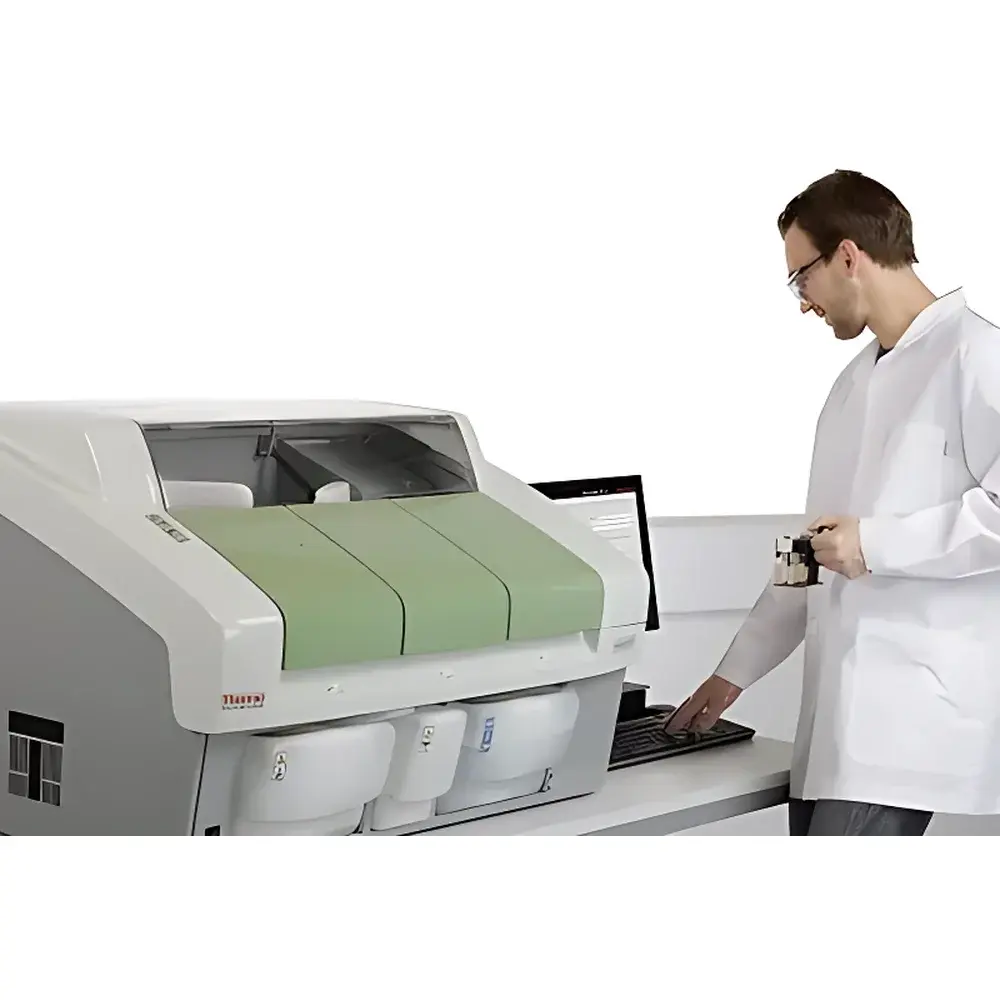
Thermo Fisher Scientific AutoAnalyzer Series
| Origin | Finland |
|---|---|
| Manufacturer Type | Authorized Distributor |
| Origin Category | Imported |
| Model | Thermo Fisher AutoAnalyzer Series |
| Pricing | Available Upon Request |
Overview
The Thermo Fisher AutoAnalyzer Series is a family of fully automated discrete and segmented-flow (FIA/SFA/CFA) wet-chemistry analyzers engineered for high-throughput, reproducible quantification of inorganic and organic analytes in liquid matrices. Based on classical colorimetric, enzymatic, and ion-selective electrode (ISE) detection principles, these instruments implement precise fluidic segmentation, controlled reagent mixing, thermal incubation, and photometric or electrochemical endpoint measurement. Designed for routine laboratory environments—including environmental monitoring labs, beverage quality control facilities, clinical chemistry departments, and industrial process support centers—the AutoAnalyzer Series delivers standardized, traceable results compliant with internationally recognized analytical protocols such as ISO 15586, ASTM D3764, and EPA Methods 365.3 and 4500-NH₃.
Key Features
- Modular architecture supporting both continuous flow (CFA) and sequential flow (SFA) configurations, enabling method flexibility across water, wastewater, food, and fermentation applications.
- Integrated peristaltic pump system with precision tubing calibration and real-time flow rate monitoring to ensure volumetric accuracy within ±1.5% CV over extended operation cycles.
- Onboard temperature-controlled reaction coils and incubation zones (37 °C to 100 °C adjustable), critical for enzyme kinetics and color development stability.
- High-sensitivity dual-beam photometer with selectable wavelengths (340–900 nm), auto-zeroing capability, and dynamic range spanning 0.001–3.0 AU for low-concentration trace analysis.
- Automated calibration and QC checks using built-in standard solutions; supports multi-point calibration curves with polynomial or linear regression fitting.
- Rugged stainless-steel and chemically resistant PTFE/PFA fluid path construction, minimizing carryover (<0.05%) and enabling compatibility with aggressive reagents including strong acids, bases, and oxidizers.
Sample Compatibility & Compliance
The AutoAnalyzer Series accommodates aqueous samples ranging from clarified drinking water and municipal wastewater to turbid beer wort, fruit juice concentrates, and fermentation broths. Sample introduction is supported via rack-based autosampler (up to 120 positions) or direct loop injection for continuous feed systems. All methods are validated per ISO/IEC 17025 requirements and support GLP/GMP documentation workflows. Instrument firmware and data handling comply with FDA 21 CFR Part 11 for electronic records and signatures, including full audit trail logging, user access controls, and electronic signature capture for report approval.
Software & Data Management
Operation is managed through Thermo Fisher’s proprietary AutoAnalysis Suite—a Windows-based application offering method editor, real-time instrument control, raw signal visualization, and integrated data reduction. The software supports customizable reporting templates aligned with LIMS export formats (ASTM E1384, HL7, CSV), automatic flagging of out-of-spec results, and statistical process control (SPC) charting. Data integrity safeguards include encrypted local storage, periodic database backups, and optional integration with enterprise-level LIMS or ELN platforms via ODBC or RESTful API interfaces.
Applications
- Environmental: Nitrate, nitrite, phosphate, ammonia, silica, and total Kjeldahl nitrogen (TKN) in surface water and effluent streams.
- Beverage & Food: Total acidity, alcohol content (via enzymatic oxidation), sugar profiles (glucose, fructose), sulfite, and volatile acidity in wine, beer, soft drinks, and dairy products.
- Clinical & Biotech: Urea, creatinine, uric acid, glucose, and cholesterol in serum and urine using standardized enzymatic assays.
- Industrial Process: Alkalinity, hardness, chloride, and residual chlorine in boiler feedwater, cooling tower fluids, and semiconductor rinse water.
FAQ
What types of analytical methods can be implemented on the AutoAnalyzer platform?
Standardized wet-chemistry methods based on colorimetry, fluorometry, ISE, and enzymatic reactions—many pre-validated against ISO, ASTM, and EPA reference procedures.
Is the system compatible with existing laboratory information management systems (LIMS)?
Yes—via configurable ASCII/CSV export, ODBC drivers, or REST API integration for bidirectional data exchange and workflow automation.
Does the instrument support regulatory compliance for pharmaceutical or clinical use?
Fully compliant with 21 CFR Part 11, ISO/IEC 17025, and GxP-aligned validation documentation packages available upon request.
What maintenance is required for long-term operational reliability?
Scheduled preventive maintenance includes tubing replacement every 6–12 months, photometer lamp calibration quarterly, and full fluidic path cleaning after high-solids or viscous sample batches.
Can the AutoAnalyzer be used for research method development?
Yes—the modular design and open method editor allow custom protocol definition, parameter tuning, and kinetic profiling beyond standard batch analysis modes.





