
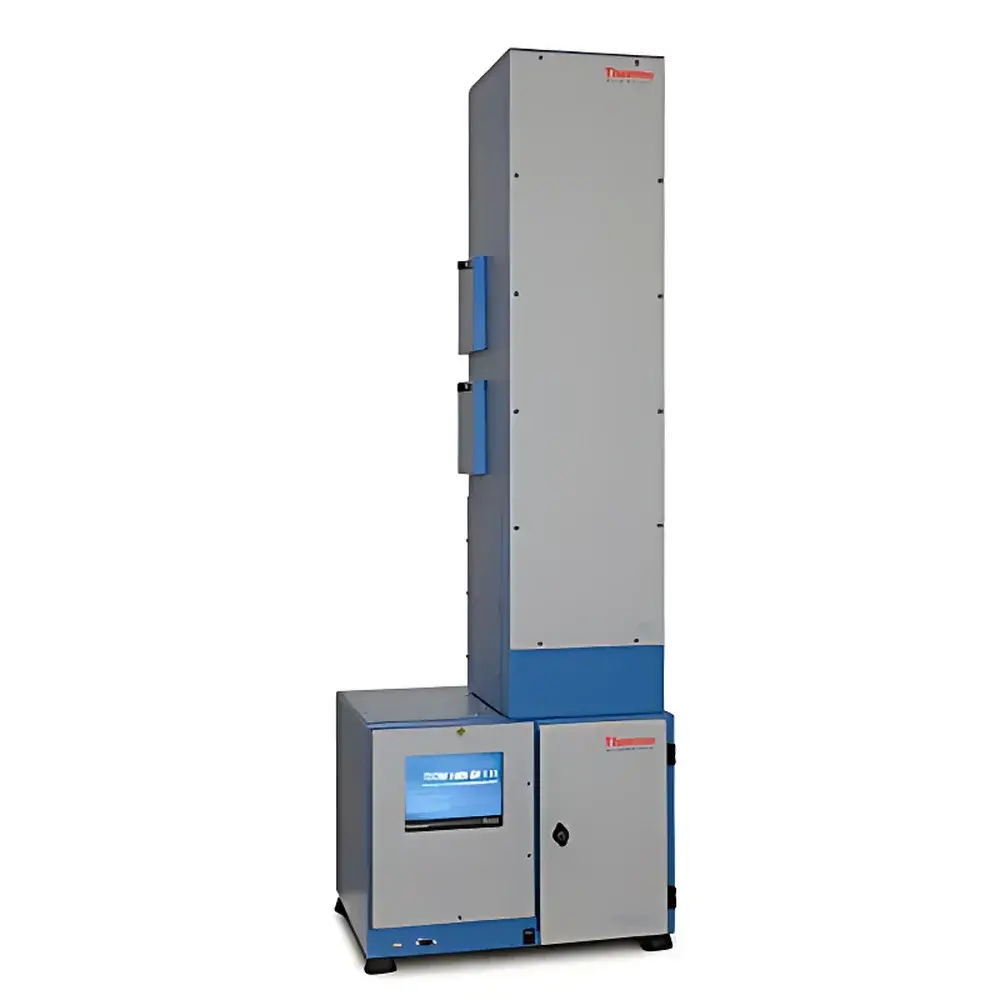
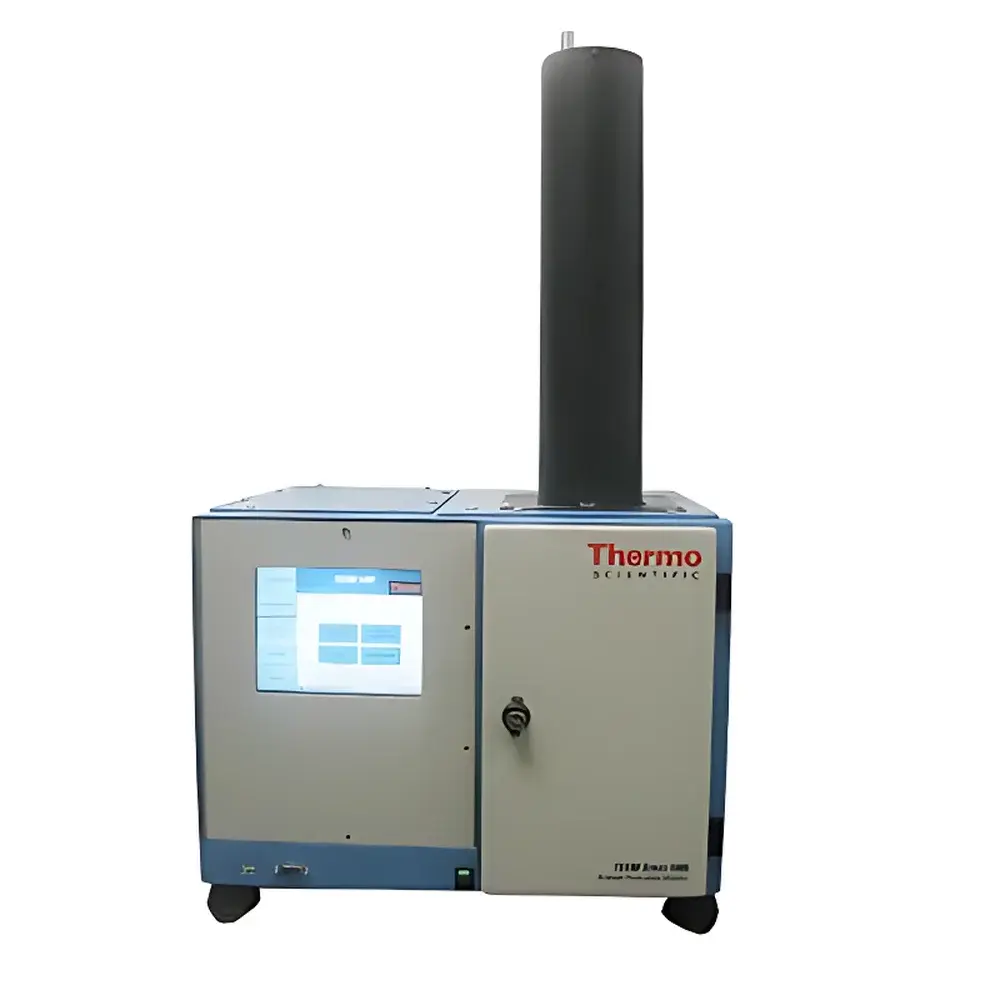
Thermo Scientific TEOM 1405DF/1405F Tapered Element Oscillating Microbalance Particulate Monitor
| Brand | Thermo Fisher |
|---|---|
| Origin | USA |
| Model | Thermo Scientific TEOM 1405DF / 1405F |
| Measurement Principle | Tapered Element Oscillating Microbalance (TEOM) |
| Measured Parameters | PM₁₀, PM₂.₅, TSP, PM₁.₀ |
| Measurement Range | 0–1,000,000 µg/m³ |
| Detection Limit | 0.1 µg/m³ |
| Sampling Flow Rate | 3 L/min (main), 12–13.67 L/min (bypass) |
| Flow Stability | ±75% for mass measurement |
| Data Storage Capacity | 5,000,000 records |
| Reporting Interval | 6-minute updates with 1-hour rolling averages |
| Accuracy | ±2.0 µg/m³ (1-hr avg), ±1.0 µg/m³ (24-hr avg) |
| Resolution | 0.1 µg/m³ |
| Calibration Traceability | NIST-traceable mass and flow standards |
| Compliance | Designed to meet U.S. EPA Reference Method EQPM-0899-007 (PM₂.₅), EQPM-0899-008 (PM₁₀), ISO 20581, and applicable EN 12341 requirements |
Overview
The Thermo Scientific TEOM 1405DF and 1405F are high-precision, continuous ambient particulate matter monitors engineered for regulatory-grade compliance and long-term operational reliability. These instruments implement the patented Tapered Element Oscillating Microbalance (TEOM) principle—a real-time gravimetric measurement technique in which a precision-machined tapered quartz crystal sensor oscillates at its natural resonant frequency. As airborne particles deposit onto a filter membrane mounted on the sensor tip, the increasing mass causes a measurable shift in oscillation frequency—directly proportional to accumulated particle mass. This physical relationship enables true mass-based quantification without reliance on optical proxies or empirical correction factors. Unlike beta attenuation or light scattering methods, TEOM delivers inherently stable, humidity-insensitive mass concentration data across wide dynamic ranges—from background urban air (sub-µg/m³) to industrial stack emissions (up to 1,000,000 µg/m³). The 1405DF model supports dual-channel sequential measurement of PM₁₀ and PM₂.₅ using integrated size-selective inlets and dynamic filter exchange; the 1405F provides single-channel PM₂.₅ or PM₁₀ monitoring with enhanced thermal management for improved low-concentration stability.
Key Features
- Real-time gravimetric measurement via NIST-traceable TEOM sensor technology
- Dual-stage size-selective sampling (1405DF): simultaneous PM₁₀ and PM₂.₅ quantification with automated filter switching
- Active mass-flow control using a high-stability thermal mass flow controller (±1% full-scale repeatability)
- Dynamic Filter Measurement (DFM) system minimizes artifact errors from volatilization and adsorption/desorption hysteresis
- Integrated NIST-traceable calibration ports for periodic mass and volumetric flow verification
- Robust environmental enclosure rated IP55 with internal temperature and pressure compensation (−30°C to +50°C operating range)
- Onboard diagnostics including sensor resonance amplitude monitoring, flow deviation alerts, and filter saturation detection
Sample Compatibility & Compliance
The TEOM 1405DF/1405F is validated for continuous operation in diverse ambient and occupational settings—including urban background stations, roadside networks, industrial fence-line monitoring, indoor air quality assessments, and cleanroom process environments. It accepts standard 47-mm diameter PTFE or quartz fiber filters compliant with EPA Method IO-3.1 and ISO 20581. Instrument design conforms to U.S. EPA Equivalent Method designations EQPM-0899-007 (PM₂.₅) and EQPM-0899-008 (PM₁₀), and supports GLP/GMP-aligned audit trails when paired with Thermo’s Environmental Data Management Software (EDMS). All firmware and data handling routines comply with 21 CFR Part 11 requirements for electronic records and signatures where configured with user authentication and event logging.
Software & Data Management
Data acquisition and instrument control are managed through Thermo Scientific’s proprietary Instrument Manager software, supporting remote configuration, real-time telemetry, and scheduled maintenance alerts via Ethernet or optional cellular modem. Raw sensor outputs—including oscillation frequency, temperature-compensated mass, volumetric flow, and pressure—are timestamped with microsecond resolution and stored internally in non-volatile memory (5 million records capacity). Export formats include CSV, XML, and EPA-compliant AQS-2100 schema. Optional EDMS integration enables automated QA/QC flagging, multi-instrument synchronization, and regulatory reporting packages aligned with EEA, EPA, and national air quality directives. All data streams support secure TLS 1.2 encryption and role-based access control.
Applications
- Regulatory ambient air quality monitoring networks (e.g., national AQMS deployments)
- Source apportionment studies requiring high-temporal-resolution mass profiles
- Indoor air quality assessment in schools, hospitals, and office buildings
- Industrial hygiene monitoring for respirable dust exposure compliance (OSHA PEL, ACGIH TLV)
- Calibration reference for optical particle counters and beta attenuation monitors
- Research applications in aerosol science, atmospheric chemistry, and health effects epidemiology
FAQ
How does TEOM differ from beta attenuation or optical scattering methods?
TEOM provides direct gravimetric measurement based on physical mass accumulation, eliminating assumptions about particle density, refractive index, or hygroscopic growth that affect optical and radiometric techniques.
Is the TEOM 1405DF suitable for unattended year-round operation?
Yes—the instrument features heated inlet lines, condensation-controlled sample conditioning, and wide-temperature electronics certified for continuous deployment in climates ranging from Arctic tundra to desert environments.
Can the system be integrated into an existing air monitoring network?
Absolutely. Standard Modbus TCP, SDI-12, and analog 4–20 mA outputs enable seamless integration with SCADA systems, third-party DAQ platforms, and legacy environmental data loggers.
What maintenance intervals are recommended for routine operation?
Filter changes every 7–14 days depending on loading; annual NIST-traceable flow and mass calibration; biannual sensor resonance verification using certified test masses.
Does the TEOM require zero/span gas calibration?
No—TEOM is a primary gravimetric method and does not rely on gas-phase calibration standards. Mass accuracy is maintained through mechanical calibration artifacts and flow metrology traceable to NIST.







