
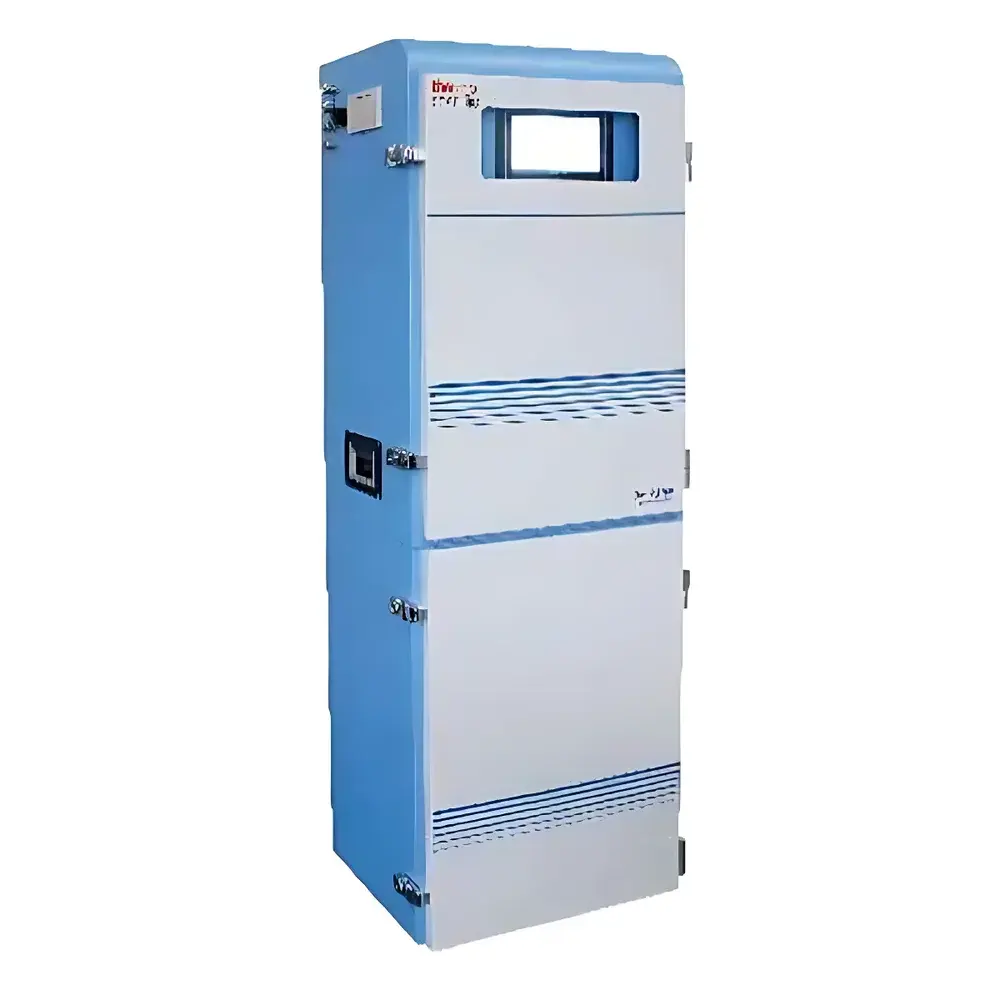
Thermo Scientific Orion 3150 Total Phosphorus and Total Nitrogen Online Analyzer
| Brand | Thermo Fisher Scientific |
|---|---|
| Origin | USA |
| Model | Orion 3150 |
| Instrument Type | Online Analyzer |
| Measurement Principle | Spectrophotometry (UV-Vis) |
| Measuring Parameters | Total Phosphorus (TP) and Total Nitrogen (TN) |
| Range | 0–2 / 0–10 / 0–50 mg/L (user-selectable ranges per parameter) |
| Accuracy | ±5% of reading |
| Detection Limit | 0.005 mg/L |
| Resolution | 0.01 mg/L |
| Light Source (TN module) | Xenon flash lamp (rated for >10⁸ flashes) |
| Sample Handling | Integrated digestion-colorimetric cell with automated reagent dosing and thermal digestion |
Overview
The Thermo Scientific Orion 3150 Total Phosphorus and Total Nitrogen Online Analyzer is an industrial-grade, fully automated water quality monitoring system engineered for continuous, unattended measurement of total phosphorus (TP) and total nitrogen (TN) in aqueous matrices. It employs standardized spectrophotometric detection following high-efficiency chemical digestion—acid persulfate oxidation under controlled temperature and pressure—to convert all phosphorus- and nitrogen-containing species—including orthophosphate, polyphosphates, organophosphates, organic nitrogen, ammonia, nitrite, and nitrate—into measurable orthophosphate and nitrate ions, respectively. The instrument conforms to core methodological principles aligned with EPA Method 365.4 (for TP) and EPA Method 353.2/351.2 (for TN), and supports compliance with ISO 15681-1, ISO 11908, and DIN EN ISO 11908 for routine environmental and wastewater applications.
Key Features
- Multi-range auto-ranging capability: dynamically selects optimal measurement range (0–2, 0–10, or 0–50 mg/L) based on real-time sample concentration to maintain analytical precision across low- and high-load conditions.
- Modular architecture: supports independent installation of TP-only, TN-only, or dual-parameter configurations—enabling field-upgradable deployment without hardware replacement.
- Dual-digestion, single-cell design: integrates high-temperature acid digestion and colorimetric reaction within a shared quartz flow cell, minimizing carryover, reducing cycle time (<25 min per full TP/TN analysis), and enhancing repeatability (RSD <3% at mid-range).
- Interference-resistant optical detection: utilizes wavelength-specific photometric algorithms and dual-beam referencing to compensate for inherent sample turbidity and color—eliminating the need for manual blank correction or auxiliary turbidity sensors.
- Long-life xenon flash lamp (TN channel): rated for ≥100 million flashes, ensuring stable spectral output over extended operational periods (>2 years at typical 1-hr sampling intervals) with no warm-up drift.
- Automated quality control: performs scheduled standard verification using onboard certified reference materials; configurable QC frequency (e.g., every 6/12/24 hours) with pass/fail flagging and audit-trail logging.
- Remote operation and diagnostics: supports Modbus TCP, OPC UA, and optional 4G/LTE telemetry; enables full bidirectional control—including method start/stop, calibration initiation, and fault reset—via secure web interface or SCADA integration.
Sample Compatibility & Compliance
The Orion 3150 is validated for use with raw influent, secondary effluent, surface water, groundwater, and treated discharge streams (pH 5–9, suspended solids ≤100 mg/L, temperature 5–40 °C). Its digestion protocol meets the oxidative completeness requirements specified in US EPA NPDES permit monitoring guidelines and EU Water Framework Directive (WFD) Annex V reporting standards. Data integrity is maintained through GLP-compliant electronic records—including timestamped calibration logs, alarm events, reagent consumption tracking, and user action history—all stored locally with optional cloud backup. The system supports 21 CFR Part 11–compliant audit trails when deployed with Thermo Fisher’s optional SecureLink software package.
Software & Data Management
The analyzer operates with embedded firmware v4.2+ and interfaces with Thermo Fisher’s AquaManager™ 2.0 platform—a browser-based supervisory application supporting multi-instrument fleet monitoring, customizable dashboards, trend analytics, and automated report generation (PDF/CSV/Excel). All measurement data are time-stamped with NTP-synchronized UTC clocks and tagged with metadata including digestion temperature, reagent batch ID, and optical path integrity status. Raw absorbance spectra (340–800 nm, 1 nm resolution) are retained for retrospective method validation. Data export supports FTP/SFTP, MQTT, and RESTful API endpoints for integration into LIMS, EMS, or municipal SCADA systems.
Applications
- Municipal wastewater treatment plants: real-time monitoring of TP/TN removal efficiency across primary, secondary, and tertiary treatment stages; feed-forward control of coagulant dosing and denitrification processes.
- Industrial pretreatment facilities: compliance verification for textile, food processing, chemical manufacturing, and semiconductor rinse water discharges subject to local POTW limits.
- Surface water surveillance networks: early warning detection of agricultural runoff events and eutrophication risk assessment in lakes, reservoirs, and estuaries.
- Regulatory compliance reporting: generation of auditable datasets for NPDES permits, ISO 14001 environmental management systems, and national discharge monitoring programs.
FAQ
What digestion method does the Orion 3150 use for total nitrogen determination?
It applies alkaline potassium persulfate digestion at 120 °C and 0.1 MPa, converting all nitrogen species quantitatively to nitrate prior to cadmium reduction and diazotization-based spectrophotometric detection.
Can the instrument operate without external lab support for calibration verification?
Yes—the built-in QC checker performs automated standard addition and recovery verification using preloaded traceable standards; calibration validity is assessed against user-defined acceptance criteria (e.g., ±10% recovery).
Is the system compatible with existing plant SCADA infrastructure?
Yes—it provides native Modbus TCP and OPC UA server functionality with configurable polling intervals, register mapping, and alarm event triggering via discrete digital outputs or embedded SNMP traps.
How is reagent consumption monitored and managed?
Onboard level sensors track reagent volumes in real time; low-level alerts trigger maintenance notifications, and usage history is logged with timestamps and volume delta per analysis cycle.
Does the analyzer meet requirements for unattended operation in remote locations?
Yes—designed for IP65-rated outdoor enclosures, it supports wide-temperature operation (−10 to 50 °C ambient), uninterruptible power input (24 VDC ±15%), and failsafe mode activation upon communication loss or critical fault detection.
Related Products







