
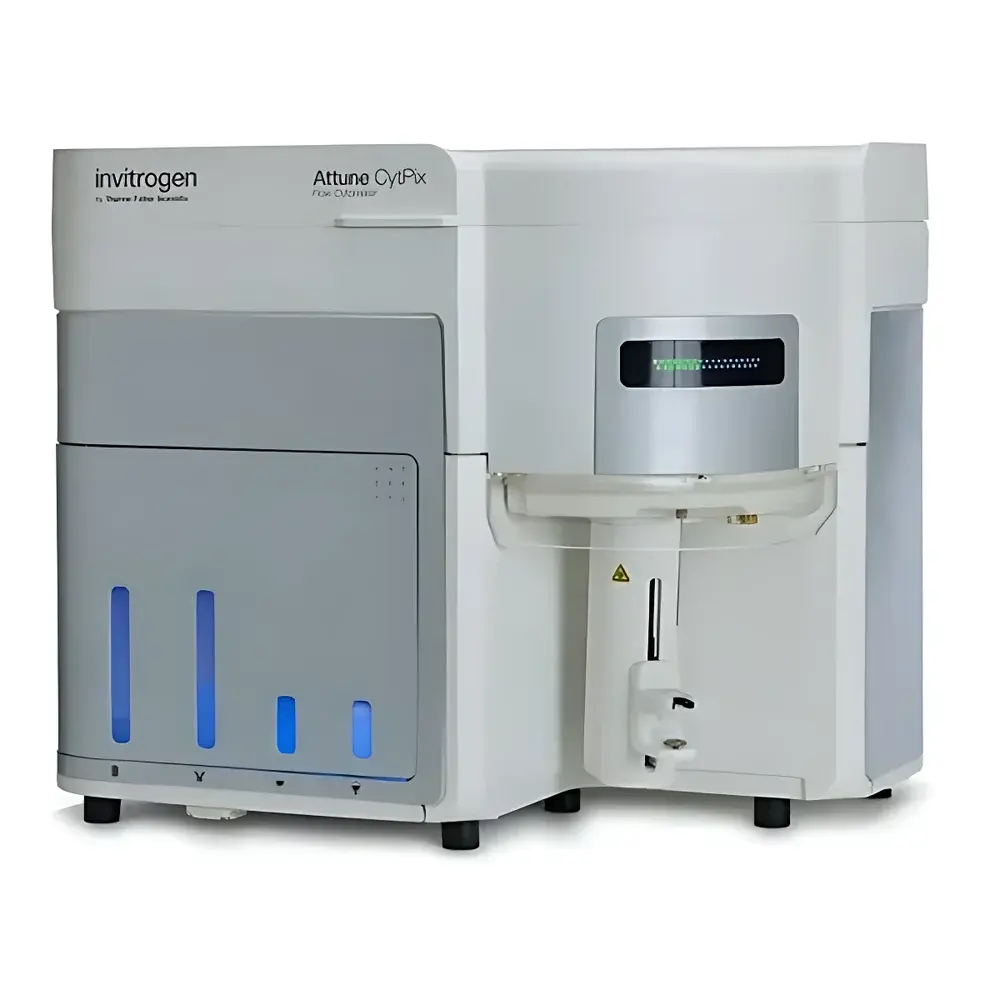
Thermo Fisher Attune CytPix Imaging Flow Cytometer
| Brand | Thermo Fisher |
|---|---|
| Origin | Shanghai, China |
| Manufacturer Type | Authorized Distributor |
| Product Origin | Domestic (China) |
| Model | Attune CytPix |
| Pricing | Available Upon Request |
Overview
The Thermo Fisher Attune CytPix Imaging Flow Cytometer is an integrated benchtop platform that combines high-speed hydrodynamic focusing, multi-laser excitation, and real-time brightfield imaging within a single analytical workflow. Engineered for precision in heterogeneous cell population analysis, the system operates on the principle of imaging flow cytometry—where each cell traverses a precisely aligned interrogation zone while being simultaneously illuminated by up to four spatially separated lasers (e.g., 405 nm, 488 nm, 561 nm, and 640 nm) and imaged at high frame rates using a dedicated sCMOS-based brightfield camera. Unlike conventional flow cytometers that infer morphology indirectly from light scatter profiles, the Attune CytPix captures actual pixel-resolved cellular images (up to 10,000 cells/sec), enabling direct morphometric quantification—including cell size, aspect ratio, nuclear texture, and cytoplasmic granularity—fully co-registered with standard fluorescence intensity parameters (FITC, PE, APC, etc.). This dual-modality architecture supports rigorous phenotypic validation, rare-event detection, and context-aware gating strategies essential for immunology, oncology, and stem cell research.
Key Features
- Acoustic-assisted hydrodynamic focusing enabling sample throughput up to 1,000 µL/min—approximately 10× faster than conventional sheath-flow systems—without compromising coefficient of variation (CV) or signal resolution.
- Modular optical configuration supporting up to four independent lasers and 14 fluorescence detection channels, with customizable filter sets and PMT voltage optimization per detector.
- Dedicated high-speed brightfield imaging module (sCMOS sensor, ≥30 fps at full resolution) synchronized with fluorescence acquisition; image capture triggered per event with sub-millisecond latency.
- Integrated morphological analysis engine delivering >20 quantitative image-derived features (e.g., perimeter, convex hull area, intensity gradient variance, nucleolar segmentation) directly exportable alongside FCS 3.1-compliant fluorescence data.
- Benchtop footprint (≤50 cm × 45 cm × 40 cm) with passive cooling and low power consumption (<300 W), suitable for shared core facilities and BSL-2 laboratories.
- Compliance-ready software architecture supporting optional 21 CFR Part 11 modules—including electronic signatures, audit trails, role-based access control, and data integrity logging—for regulated environments (GLP/GMP, clinical trial support).
Sample Compatibility & Compliance
The Attune CytPix accepts suspension-based biological samples including peripheral blood mononuclear cells (PBMCs), dissociated tumor digests, primary hematopoietic cultures, and microbeads for calibration. Sample volumes as low as 20 µL are sufficient for robust acquisition due to efficient acoustic focusing and minimal carryover (<0.1%). The system accommodates standard 12×75 mm polystyrene tubes, 96-well plates (via optional autosampler), and custom microfluidic cartridges. All fluidic pathways are constructed from biocompatible, non-binding polymers certified to ISO 10993-5 standards. Instrument qualification documentation—including IQ/OQ protocols, laser alignment reports, and photomultiplier gain stability verification—is provided to support laboratory accreditation under ISO/IEC 17025 and CLIA requirements.
Software & Data Management
Instrument control, acquisition, and analysis are unified within Attune CytPix Software v3.x (Windows 10/11 64-bit), built on a .NET framework with native HDF5 file handling. Raw data is stored in hierarchical format (FCS + TIFF + JSON metadata bundles), ensuring long-term readability and interoperability with third-party tools such as FlowJo, FCS Express, and open-source Python libraries (e.g., cytopy, scikit-image). The software includes batch processing pipelines for automated image segmentation, feature extraction, and machine learning–assisted classification (support vector machines, random forest models). Audit trail logs record every parameter change, gate modification, and export action with timestamp, user ID, and IP address—fully traceable for FDA inspection readiness.
Applications
- Immunophenotyping with morphological validation: distinguishing blast vs. mature lymphocytes in acute leukemia diagnostics.
- Cell cycle analysis incorporating nuclear morphology metrics to resolve S-phase heterogeneity in drug-treated populations.
- Exosome and microparticle characterization via combined light scatter imaging and antibody-conjugated fluorescent labeling.
- High-content screening of CRISPR-edited clones where phenotypic outliers (e.g., multinucleation, membrane blebbing) correlate with off-target effects.
- Microbiological analysis of yeast or bacterial aggregates in fermentation monitoring, leveraging brightfield texture features absent in conventional scatter plots.
FAQ
Does the Attune CytPix require external cooling or compressed air?
No—the system uses passive thermal management and integrated pressure regulation; no external chillers or air compressors are needed.
Can I import existing FCS files into the image analysis module?
Yes—legacy FCS 3.0/3.1 files can be re-analyzed with newly acquired brightfield imagery when paired with compatible sample IDs and metadata tags.
Is the imaging module compatible with fluorescent microscopy filters?
The brightfield camera operates independently of fluorescence detection; however, optional LED-based epi-illumination kits (not included) enable basic phase contrast or DAPI-stained nuclear visualization.
What regulatory documentation is supplied for installation qualification?
Thermo Fisher provides comprehensive IQ/OQ test scripts, laser safety certificates (IEC 60825-1 Class 1), and PMT linearity verification reports upon delivery.
How is data backup and version control managed across multi-user labs?
The software supports network-mounted storage with Windows ACL permissions; all analysis sessions generate immutable checksummed archives compliant with ALCOA+ principles.





