
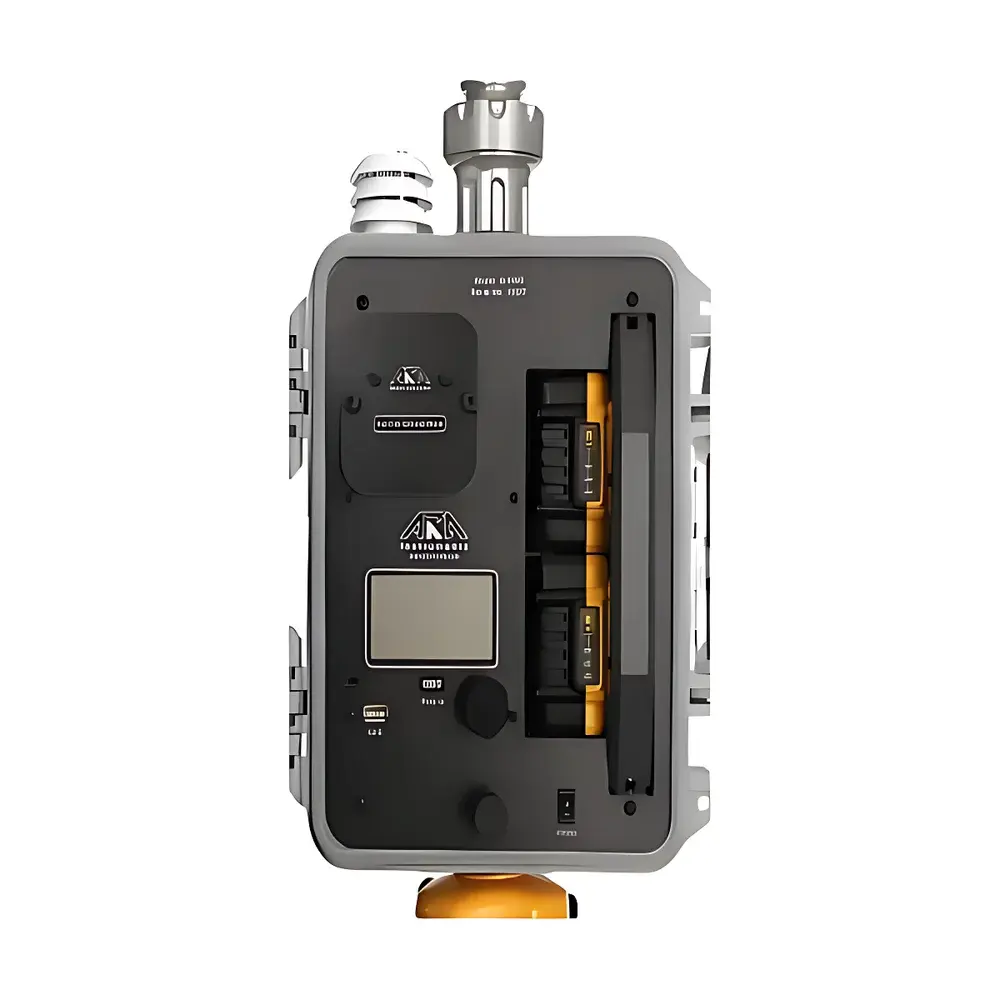
ARA N-FRM Intelligent Air Sampler
| Brand | ARA |
|---|---|
| Origin | USA |
| Model | N-FRM |
| Flow Rate | 10–20 LPM (nominal 16.7 LPM) |
| Flow Accuracy | ±2% (±1% with calibration) |
| Operating Time | >30 hours on rechargeable 18 V lithium battery |
| Charging Time | 1 hour |
| Data Output | USB flash drive interface |
| Dimensions | 25.4 × 30.48 × 17.78 cm |
| Sampling Weight | 15 lbs |
| Shipping Weight | 25 lbs |
| Filter Holder | Standard FRM-compliant 47 mm cassette mount |
| Particle Separation | Low-maintenance, oil-free cyclonic inlet for PM₂.₅ and PM₁₀ |
Overview
The ARA N-FRM Intelligent Air Sampler is a U.S.-engineered, portable ambient air monitoring system designed to meet the stringent performance criteria of the U.S. Environmental Protection Agency’s Federal Reference Method (FRM) for total suspended particulates (TSP), PM₁₀, and PM₂.₅. It operates on the principle of constant-flow gravimetric sampling—drawing ambient air through a standardized 47 mm filter substrate at a precisely regulated nominal flow rate of 16.7 LPM, with real-time pressure, temperature, and flow monitoring to ensure regulatory compliance and data traceability. Unlike legacy FRM samplers, the N-FRM integrates embedded environmental sensing, programmable sampling logic, and field-deployable power architecture—enabling unattended, long-term operation in remote or infrastructure-limited locations without AC mains dependency.
Key Features
- FRM-compliant constant-flow sampling at 16.7 LPM (±2% flow accuracy; ±1% with optional flow calibrator)
- Integrated environmental sensor suite recording barometric pressure, ambient temperature, and relative humidity—loggable to USB flash memory
- Modular real-time particle detection capability via optional optical scattering sensor (e.g., for PM₂.₅/PM₁₀ mass concentration trending)
- Oil-free, low-maintenance cyclonic particle separator compliant with EPA Method IO-3.2 and ISO 7708 for size-selective sampling
- Intuitive graphical user interface with programmable start/stop times, multi-stage sampling profiles, and status diagnostics
- Rechargeable 18 V lithium battery system delivering >30 hours of continuous operation; full charge achieved in ≤60 minutes
- Compact, ruggedized chassis (25.4 × 30.48 × 17.78 cm) weighing 15 lbs—optimized for tripod mounting, vehicle integration, or handheld transport
Sample Compatibility & Compliance
The N-FRM supports standard 47 mm quartz fiber, Teflon®, or cellulose ester filters per EPA Methods IO-1, IO-2, and IO-3.2. Its inlet configuration and flow control architecture are validated against 40 CFR Part 53 Appendix L (PM₂.₅ FRM) and Appendix O (PM₁₀ FRM). All recorded metadata—including timestamped flow, temperature, pressure, and battery voltage—is stored in comma-separated values (CSV) format compatible with EPA AirData ingestion protocols. The system supports audit-ready data logging aligned with GLP principles, including immutable event timestamps and user-accessible calibration history. Optional accessories—including wind speed sensors (Model 600-000), real-time optical particle counters (Model 620-000), and solar charging kits—extend its utility across mobile monitoring networks and temporary deployment scenarios requiring meteorological co-location.
Software & Data Management
Data acquisition and configuration are managed via an embedded firmware platform accessible through a local LCD interface or remote serial/USB connection. Sample metadata and environmental logs export directly to FAT32-formatted USB flash drives without proprietary software dependencies. Field technicians may review real-time flow stability, battery health, and sensor status on-device; historical datasets support post-processing in common analytical environments (e.g., R, Python pandas, Excel). Firmware updates are delivered via signed binary packages to maintain integrity under FDA 21 CFR Part 11-aligned change control practices. No cloud connectivity or vendor-hosted platforms are required—ensuring data sovereignty and operational continuity in sensitive or offline environments.
Applications
- Regulatory-grade ambient air quality monitoring networks (urban, rural, and roadside)
- Industrial fence-line and perimeter monitoring for fugitive emissions verification
- Short-term source attribution studies and emergency response deployments (e.g., wildfire smoke, industrial incidents)
- Long-term epidemiological exposure assessment requiring synchronized PM and meteorological time-series
- Research-grade validation of low-cost sensor networks using FRM-traceable reference measurements
- Occupational hygiene assessments where portability, battery autonomy, and FRM equivalence are critical
FAQ
Does the N-FRM meet U.S. EPA FRM requirements for PM₂.₅ and PM₁₀?
Yes—the N-FRM is engineered and tested to satisfy all physical, operational, and data logging criteria specified in 40 CFR Part 53 Appendices L and O for FRM designation.
Can the unit operate unattended for extended periods?
Yes—its >30-hour battery life, weather-resistant enclosure, and internal data logging enable fully autonomous deployments up to five days when paired with optional solar charging.
Is external calibration required prior to use?
An initial flow calibration using a NIST-traceable primary standard (e.g., electronic bubble meter or rotameter) is recommended before first deployment; the onboard flow sensor maintains stability between calibrations.
What filter media are compatible with the 47 mm holder?
Standard EPA-approved substrates including Pallflex® EFA-0600-207 (TSP), Zefluor™ (PM₂.₅), and Gelman Type A/E (PM₁₀), as specified in Methods IO-1, IO-2, and IO-3.2.
How is data integrity ensured during field operation?
All logged parameters include hardware-timestamped records with CRC-32 checksums; USB exports are write-once by default, and firmware enforces sequential file naming to prevent overwrites.
Related Products







