
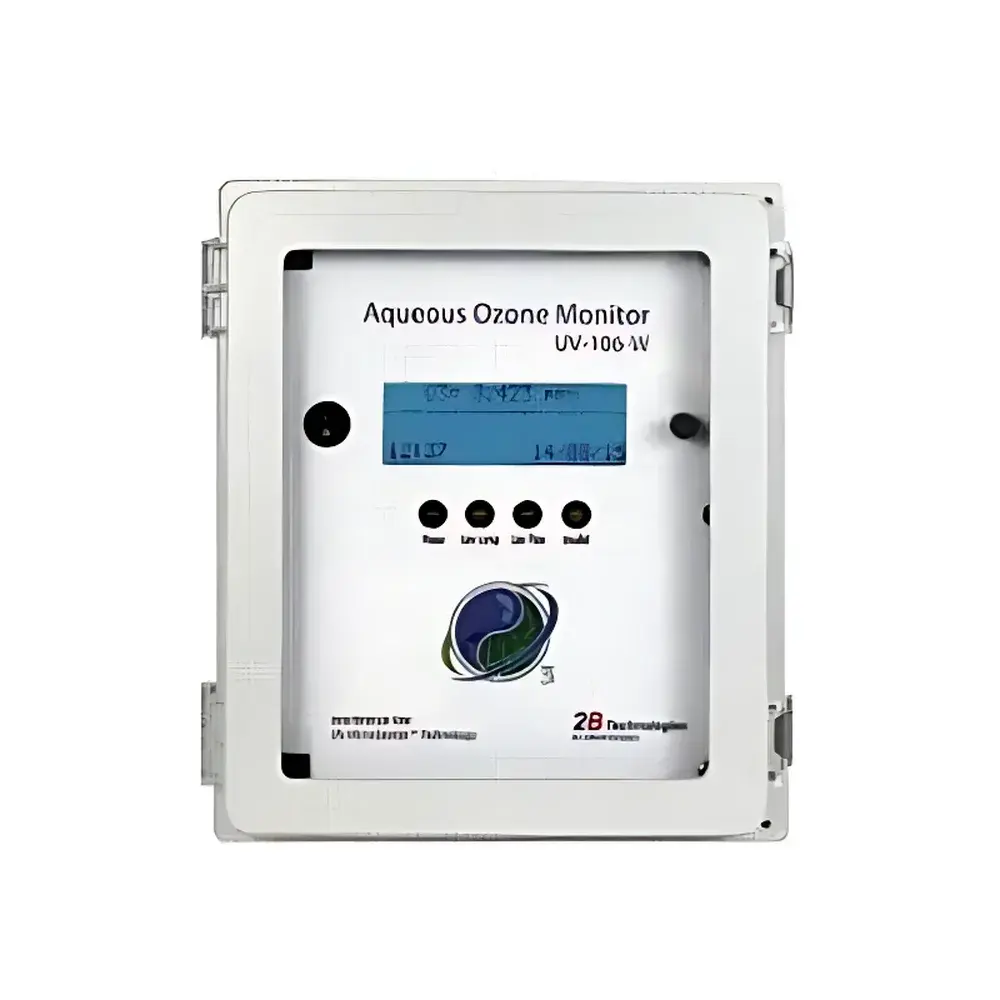
2B Technologies Model 106W Dissolved Ozone Analyzer
| Brand | 2B Technologies |
|---|---|
| Origin | USA |
| Model | Model 106W |
| Instrument Type | Portable |
| Measurement Range | 0–100 ppm |
| Detection Limit | 0.05 ppm (or ±1% of reading) |
| Response Time | <10 seconds (t₉₀) |
| Zero Drift | <0.02 ppm/24 h |
| Resolution | 0.01 ppm |
| Flow Rate | ~12 mL/min |
| Data Storage | 16,368 records |
| Sampling Interval Options | 10 s, 1 min, 5 min, 1 h |
| Output Interfaces | RS-232 serial, 0–2.5 V analog, LCD display, LED alarm |
| Power Supply | 12 V DC or 100–240 V AC, 5.0 W (3.9 W in low-power mode) |
| Dimensions | 33.8 × 30.5 × 18.5 cm |
| Weight | 6.6 kg |
Overview
The 2B Technologies Model 106W Dissolved Ozone Analyzer is a field-deployable, UV-absorption-based instrument engineered for precise, interference-free quantification of dissolved ozone (O₃) in aqueous matrices. Unlike conventional membrane-based electrochemical or amperometric sensors—whose performance degrades with fouling, biofilm formation, or particulate loading—the Model 106W employs 2B’s proprietary MicroSparge™ sample introduction technology. This method physically transfers a discrete 2 mL water sample into a gas-phase reaction chamber, where controlled sparging induces rapid thermal decomposition of dissolved ozone into gaseous ozone. The liberated O₃ vapor is then swept through a temperature-stabilized, dual-beam UV photometer operating at 254 nm, enabling highly reproducible absorbance measurement per the Beer–Lambert law. The absence of consumable membranes, electrodes, or catalytic surfaces eliminates calibration drift associated with sensor aging and ensures long-term stability across heterogeneous water types—including potable water, wastewater effluent, cooling tower make-up, swimming pool recirculation streams, and ultrapure process water.
Key Features
- Membrane-free, maintenance-light design: No replaceable filters, electrolytes, or sensing elements—reducing total cost of ownership and operational downtime
- MicroSparge™ sample introduction: Enables direct analysis of turbid, high-TSS, or organically complex waters without pre-filtration
- High temporal resolution: <10-second response time (t₉₀) supports real-time process monitoring and dynamic ozone dosing control
- Onboard data logging: Stores up to 16,368 timestamped measurements with user-selectable averaging intervals (10 s, 1 min, 5 min, or 1 h)
- NEMA-4X-rated enclosure: IP66-equivalent ingress protection ensures reliable operation in humid, outdoor, or industrial environments
- Dual-output capability: Simultaneous RS-232 digital output and 0–2.5 V analog signal for integration with SCADA, DCS, or PLC systems
- Low-power architecture: Operates at 3.9 W in energy-conservation mode—suitable for solar-battery deployments or remote monitoring stations
Sample Compatibility & Compliance
The Model 106W is validated for use across diverse water quality regimes without signal suppression or false positives from common interferents. It exhibits no measurable cross-sensitivity to chlorine, chloramines, hydrogen peroxide, nitrate, or dissolved organic carbon (DOC) at concentrations typical in municipal and industrial water treatment. Its measurement principle complies with the fundamental spectroscopic basis outlined in EPA Method 4500-O₃ B (UV absorption) and aligns with ISO 13837:2001 (Water quality — Determination of ozone — UV spectrometric method). While not certified under FDA 21 CFR Part 11, its audit-ready data log includes embedded timestamps, operator ID fields (via optional keypad), and immutable record structure—supporting GLP-aligned documentation practices in regulated water quality laboratories.
Software & Data Management
Data retrieval is facilitated via 2B’s free, Windows-compatible OzLog software, which enables configuration, real-time telemetry, firmware updates, and export to CSV or Excel formats. All logged entries include UTC timestamps, measurement values, internal temperature/humidity diagnostics, and battery voltage status. The instrument supports configurable alarm thresholds with visual (LED) and optional relay-triggered outputs for automated shutdown or notification events. Raw absorbance data and background-corrected ozone concentration values are stored separately—enabling retrospective recalibration or method validation traceability per ISO/IEC 17025 requirements.
Applications
- Real-time monitoring of ozone contact chambers in drinking water treatment plants
- Validation of CT (concentration × time) values for pathogen inactivation per US EPA Guidance Manual for Disinfection By-Products
- Process control in bottled water and beverage production lines
- Swimming pool and spa disinfection system optimization
- Cooling water system corrosion mitigation and biofouling prevention
- Research-grade kinetics studies of ozone decay in natural organic matter (NOM)-rich waters
- Calibration verification of online ozone analyzers using grab-sample reference methodology
FAQ
Does the Model 106W require routine calibration with ozone gas standards?
No—calibration is performed using aqueous ozone standards generated by a traceable ozone generator or iodometric titration. Field verification against NIST-traceable primary standards is recommended quarterly.
Can it measure ozone in seawater or high-salinity brines?
Yes—salinity up to 35 g/L (seawater strength) has been empirically verified without signal attenuation or chloride interference.
Is sample filtration necessary prior to analysis?
Not required. The MicroSparge™ mechanism inherently excludes suspended solids; however, gross debris (>100 µm) should be removed to prevent clogging of the sample inlet tubing.
What is the expected service life of the UV lamp and photodetector?
The mercury-vapor UV lamp maintains stable output for ≥12,000 hours; the silicon photodiode detector exhibits negligible drift over 5+ years under normal operating conditions.
How is temperature compensation handled during measurement?
An integrated Pt100 RTD monitors chamber temperature in real time; ozone solubility and UV absorbance coefficients are dynamically corrected using the IUPAC-recommended Henry’s law constants and spectral extinction coefficients.
Related Products







