
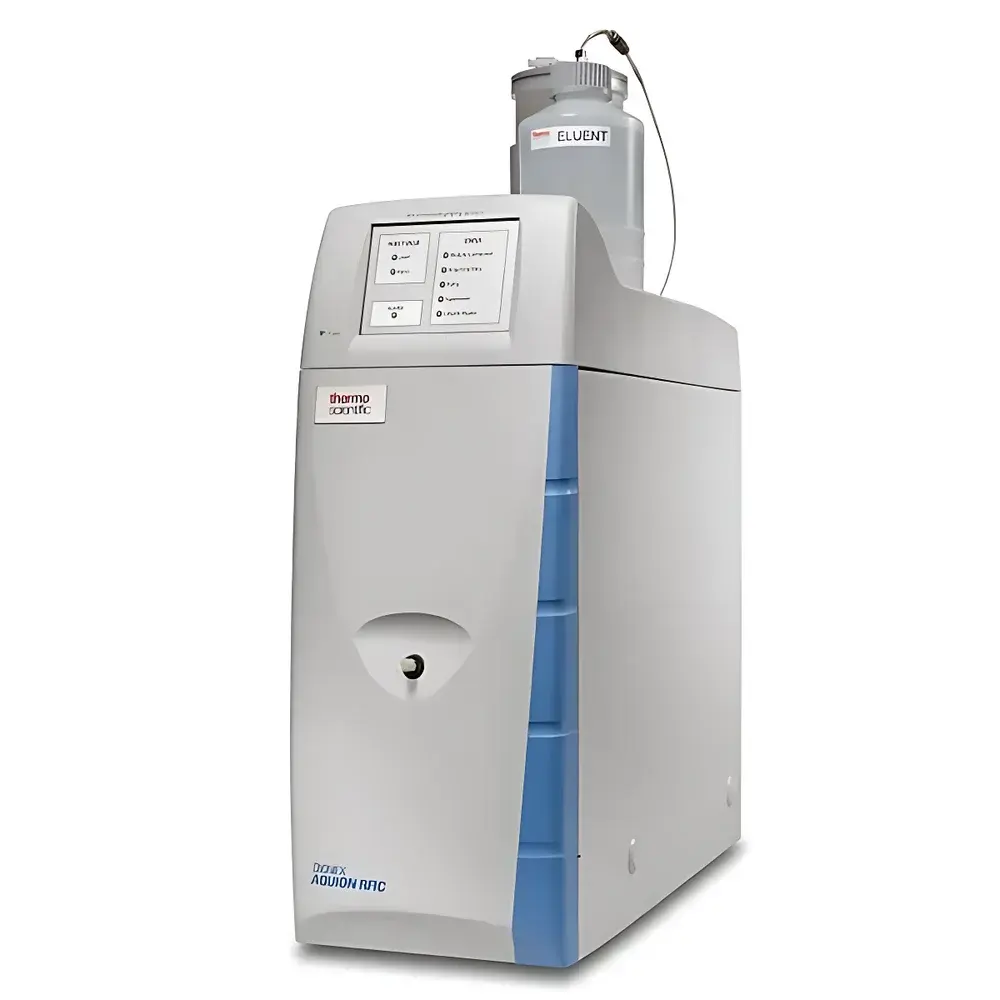
Thermo Scientific Aquion RFIC Ion Chromatograph
| Brand | Thermo Scientific |
|---|---|
| Origin | Mexico |
| Manufacturer Type | Original Equipment Manufacturer (OEM) |
| Origin Category | Imported |
| Model | Aquion RFIC |
| Instrument Type | Laboratory Benchtop Ion Chromatograph |
| Reagent-Free Eluent Generation | Integrated RFIC-EG Technology |
| Software Control | Chromeleon CDS v7.3 or later |
| Compliance | Designed for GLP/GMP environments |
Overview
The Thermo Scientific Aquion RFIC Ion Chromatograph is a compact, reagent-free benchtop ion chromatography system engineered for precision, operational simplicity, and long-term analytical reliability in routine and regulated laboratory environments. Built upon the foundational principles of suppressed conductivity detection and electrolytic eluent generation, the Aquion RFIC employs a dual-piston high-pressure pump, electrochemical suppression, and integrated Reagent-Free Ion Chromatography–Eluent Generation (RFIC-EG) technology to deliver stable, reproducible separations of anions and cations without manual eluent preparation. Unlike conventional IC systems requiring daily preparation and degassing of chemical eluents, the Aquion RFIC generates high-purity KOH, NaOH, or methanesulfonic acid (MSA) eluents on-demand from deionized water—eliminating variability introduced by human handling, ambient contamination, or batch-to-batch inconsistencies. Its modular architecture supports isocratic and gradient elution methods, making it suitable for applications ranging from environmental anion monitoring (e.g., nitrate, sulfate, fluoride) to food safety cation analysis (e.g., sodium, ammonium, lithium) and pharmaceutical counterion profiling.
Key Features
- Dual-piston, pulse-free high-pressure pump delivering flow rates from 0.01 to 3.00 mL/min with ≤0.1% RSD for superior retention time stability
- Integrated RFIC-EG module enabling on-line, programmable generation of hydroxide (KOH/NaOH) or MSA eluents at concentrations from 1 to 100 mM—no external eluent reservoirs or mixing valves required
- CR-TC (Continuous Regeneration Trap Column) technology for real-time removal of trace cations and anions from the eluent stream, reducing baseline noise and improving signal-to-noise ratio
- Electrolytic suppressor (ASRS™ 300 or CSRS™ 300) with automatic water regeneration, eliminating need for chemical regenerants and minimizing maintenance downtime
- Temperature-controlled column compartment (ambient to 60 °C) with ±0.5 °C stability for method robustness across seasonal lab conditions
- Modular detector options including conductivity detector with digital signal processing and optional UV/Vis or mass spectrometry interfaces for hybrid workflows
Sample Compatibility & Compliance
The Aquion RFIC accommodates aqueous samples with total dissolved solids (TDS) ≤100 ppm and particulate content <0.45 µm (pre-filtering recommended). It supports direct injection of drinking water, wastewater extracts, food digestates, pharmaceutical formulations, and biological fluids following appropriate dilution and filtration. The system complies with key international standards including ASTM D4327 (anion analysis in water), ISO 10304-1 (determination of dissolved anions), and USP for analytical instrument qualification. When operated under Chromeleon CDS with enabled audit trail, electronic signatures, and user role management, the platform meets FDA 21 CFR Part 11 requirements for data integrity in regulated environments. Full IQ/OQ documentation packages are available for GxP validation.
Software & Data Management
Controlled exclusively via Thermo Scientific Chromeleon Chromatography Data System (CDS) v7.3 or later, the Aquion RFIC provides intuitive method setup, real-time system status visualization, automated diagnostics, and comprehensive reporting. Chromeleon supports sequence scheduling, peak integration with customizable baselines, calibration curve generation (linear, quadratic, or weighted), and export to LIMS-compatible formats (e.g., .csv, .pdf, .cdf). All instrument events—including pump pressure, suppressor current, column temperature, and RFIC-EG voltage—are timestamped and logged with full traceability. Audit trail functionality records every user action, parameter change, and report modification, satisfying ALCOA+ data governance principles (Attributable, Legible, Contemporaneous, Original, Accurate, Complete, Consistent, Enduring, Available).
Applications
- Environmental monitoring: Quantification of F⁻, Cl⁻, NO₂⁻, Br⁻, NO₃⁻, PO₄³⁻, SO₄²⁻, and AsO₄³⁻ in surface water, groundwater, and effluent per EPA Method 300.0 and 300.1
- Food & beverage quality control: Simultaneous determination of organic acids (acetate, lactate, citrate), inorganic anions, and cations (Na⁺, K⁺, Ca²⁺, Mg²⁺) in dairy, beverages, and plant-based products
- Pharmaceutical analysis: Counterion profiling (Cl⁻, Br⁻, acetate) in APIs and excipients; residual catalyst metal ion screening (e.g., Ni²⁺, Co²⁺) in synthesis intermediates
- Electronics-grade water testing: Ultra-trace chloride and sulfate detection down to sub-pptr levels using high-capacity concentrator columns and low-noise detection
- Academic research: Method development for novel ionic liquid characterization, polymer electrolyte membrane analysis, and speciation studies of redox-active ions (e.g., Cr(VI)/Cr(III))
FAQ
Does the Aquion RFIC require external gas sources or chemical regenerants for suppression?
No—the system uses electrolytically regenerated suppressors (ASRS/CSRS 300) powered by the instrument’s internal power supply; no helium, nitrogen, or sulfuric acid regenerant is needed.
Can I run gradient elution with both hydroxide and MSA on the same system?
Yes—via software-selectable RFIC-EG cartridge modules; switching between KOH/NaOH and MSA gradients requires only cartridge replacement and method reconfiguration.
What is the typical time-to-first-analysis after system startup?
Under standard conditions, equilibration to baseline stability takes ≤15 minutes post-pump priming and column thermal stabilization.
Is Chromeleon CDS included with the system purchase?
Yes—each Aquion RFIC ships with a perpetual, single-user license of Chromeleon CDS v7.3+, including remote monitoring and basic compliance configuration tools.
How often does the CR-TC trap column require replacement?
Typical service life exceeds 2,000 injections when used with filtered, low-TDS samples; Chromeleon provides predictive maintenance alerts based on pressure trends and conductivity drift.





