
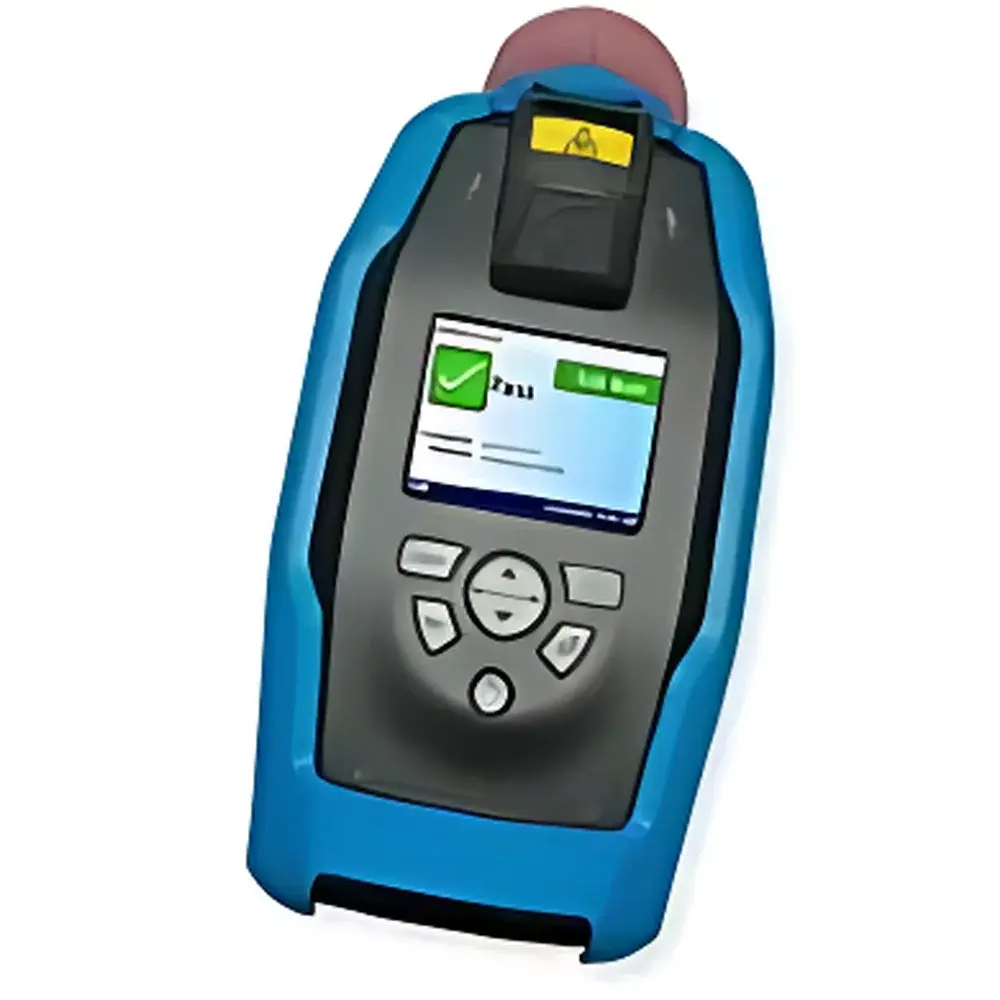
Thermo Scientific Portable Optical Analyzer
| Origin | USA |
|---|---|
| Manufacturer Type | Distributor |
| Origin Category | Imported |
| Model | Thermo Scientific Portable Optical Analyzer |
| Price | Upon Request |
Overview
The Thermo Scientific Portable Optical Analyzer is a field-deployable, multi-modal spectroscopic instrument engineered for rapid, non-destructive elemental and molecular characterization in diverse operational environments. Unlike benchtop systems, this analyzer integrates three complementary optical techniques—Fourier Transform Infrared (FT-IR), Near-Infrared (NIR), and Laser Raman Spectroscopy—within a single ruggedized platform. Its core measurement principle relies on the interaction of incident electromagnetic radiation with molecular vibrational modes: FT-IR detects fundamental absorptions in the mid-infrared range (4000–400 cm⁻¹), NIR captures overtones and combination bands (14000–4000 cm⁻¹), and Raman spectroscopy measures inelastic scattering induced by monochromatic laser excitation (typically 785 nm or 1064 nm). This tri-modal architecture enables cross-validated identification of organic functional groups, inorganic crystalline phases, hydration states, and trace contaminants without sample preparation—critical for time-sensitive applications such as field-based hazardous material screening, pharmaceutical raw material verification, and geological prospecting.
Key Features
- Ruggedized, IP54-rated enclosure with shock-absorbing chassis and MIL-STD-810G compliance for transport and operation in industrial, outdoor, and mobile laboratory settings.
- Integrated battery pack supporting ≥4 hours of continuous spectral acquisition; hot-swappable battery option available for extended deployment.
- Touchscreen interface with glove-compatible operation and preloaded spectral libraries (including ASTM E1421, USP , and Thermo’s proprietary ChemID database).
- Onboard real-time spectral processing engine enabling automatic peak detection, baseline correction, and multivariate classification (PCA, PLS-DA) without external computing resources.
- Modular optical path design accommodating interchangeable sampling accessories: fiber-optic probes (contact and standoff), ATR crystals (ZnSe, diamond), and micro-sampling stages for particulate analysis.
Sample Compatibility & Compliance
The analyzer accepts solid powders, tablets, films, liquids, gels, and heterogeneous surfaces—including coated metals, polymers, soils, and biological tissues—without destructive digestion or dilution. It supports regulatory workflows aligned with FDA 21 CFR Part 11 (electronic records/signatures), ISO/IEC 17025 (testing laboratory competence), and ASTM E1655 (standard practices for NIR quantitative analysis). All spectral acquisition and processing routines maintain full audit trail logging, including operator ID, timestamp, instrument configuration, and raw data checksums—ensuring traceability for GLP and GMP environments.
Software & Data Management
Powered by Thermo Scientific OMNIC Mobile software, the system provides seamless synchronization with enterprise LIMS and ELN platforms via secure HTTPS API endpoints. Raw interferograms, spectra, and processed results are stored in vendor-neutral HDF5 format compliant with NIH/NIST spectral metadata standards. Software features include spectral subtraction, library search with confidence scoring (Spectral Match Index ≥95% threshold), batch quantification using user-defined calibration models, and export to CSV, JCAMP-DX, or ASTM E131-compliant formats. Remote firmware updates and method validation reports are generated automatically upon completion of IQ/OQ protocols.
Applications
- Pharmaceutical: Identification of counterfeit APIs, excipient verification, blend uniformity assessment, and cleaning validation swab analysis.
- Materials Science: Polymer degradation monitoring, catalyst composition mapping, and thin-film thickness estimation via interference fringe analysis.
- Environmental: On-site detection of hydrocarbon spills, heavy metal complexes in soil leachates, and microplastic particle identification in water filtration matrices.
- Forensics: Non-contact analysis of ink, paint chips, and illicit drug mixtures under chain-of-custody documentation protocols.
- Geology & Mining: Real-time mineralogical mapping of drill core samples using Raman + NIR fusion algorithms trained on RRUFF reference datasets.
FAQ
Does the analyzer require external calibration standards for routine operation?
No—factory-installed NIST-traceable wavelength and intensity calibration references are embedded within the optical module. User verification checks can be performed daily using the integrated polystyrene film standard.
Can spectral data be exported for third-party chemometric modeling?
Yes—full-resolution interferograms and processed spectra are exportable in open-format HDF5 and JCAMP-DX, compatible with MATLAB, Python (scikit-learn, h5py), and Unscrambler X.
Is the device certified for use in classified or explosive atmospheres?
It is not intrinsically safe (ATEX/IECEx certified); however, optional explosion-proof enclosures (Class I, Division 2) are available through authorized Thermo Scientific integration partners.
What is the typical spectral resolution achievable across all three modalities?
FT-IR: 4 cm⁻¹ nominal resolution (user-selectable down to 0.5 cm⁻¹); NIR: 8 cm⁻¹; Raman: 8 cm⁻¹ (with 785 nm excitation), optimized for signal-to-noise ratio in field conditions rather than ultra-high resolution.
How is data integrity maintained during wireless transmission?
All Wi-Fi and Bluetooth data transfers employ TLS 1.2 encryption; local storage uses AES-256 full-disk encryption with FIPS 140-2 validated cryptographic modules.



