
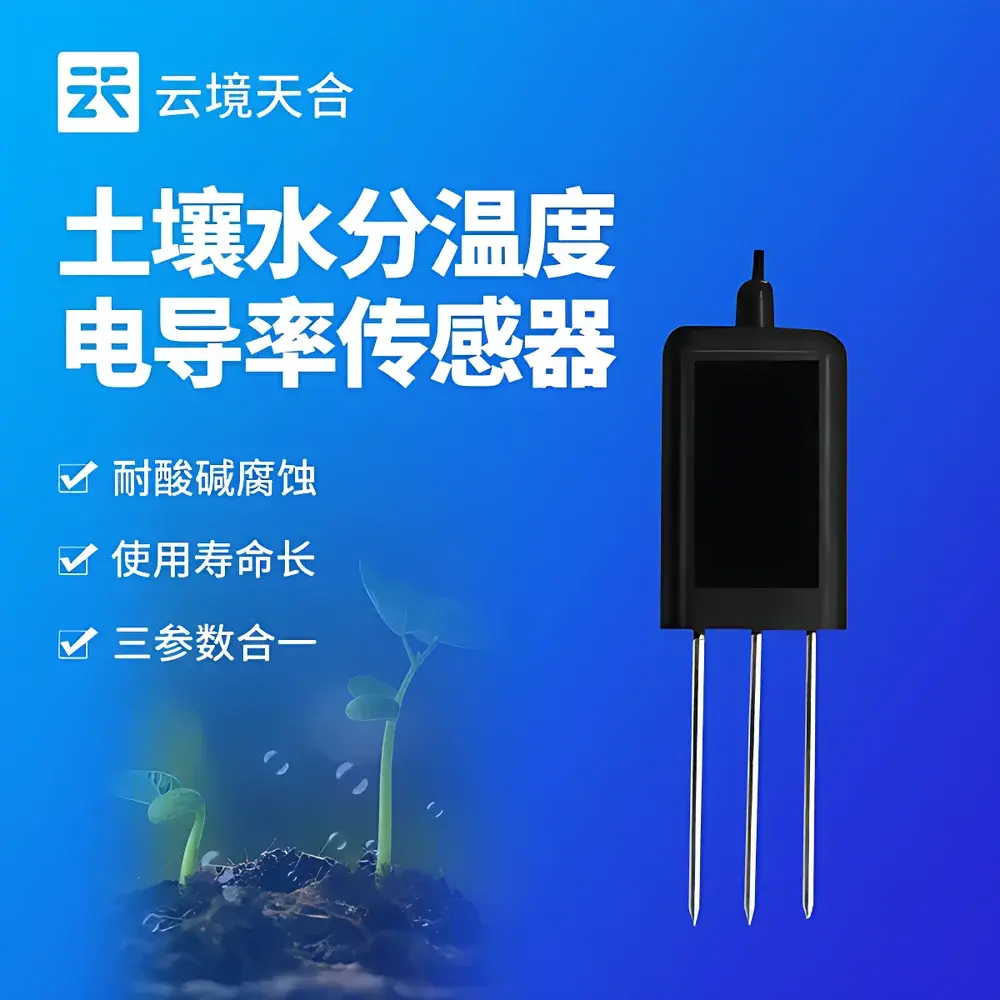
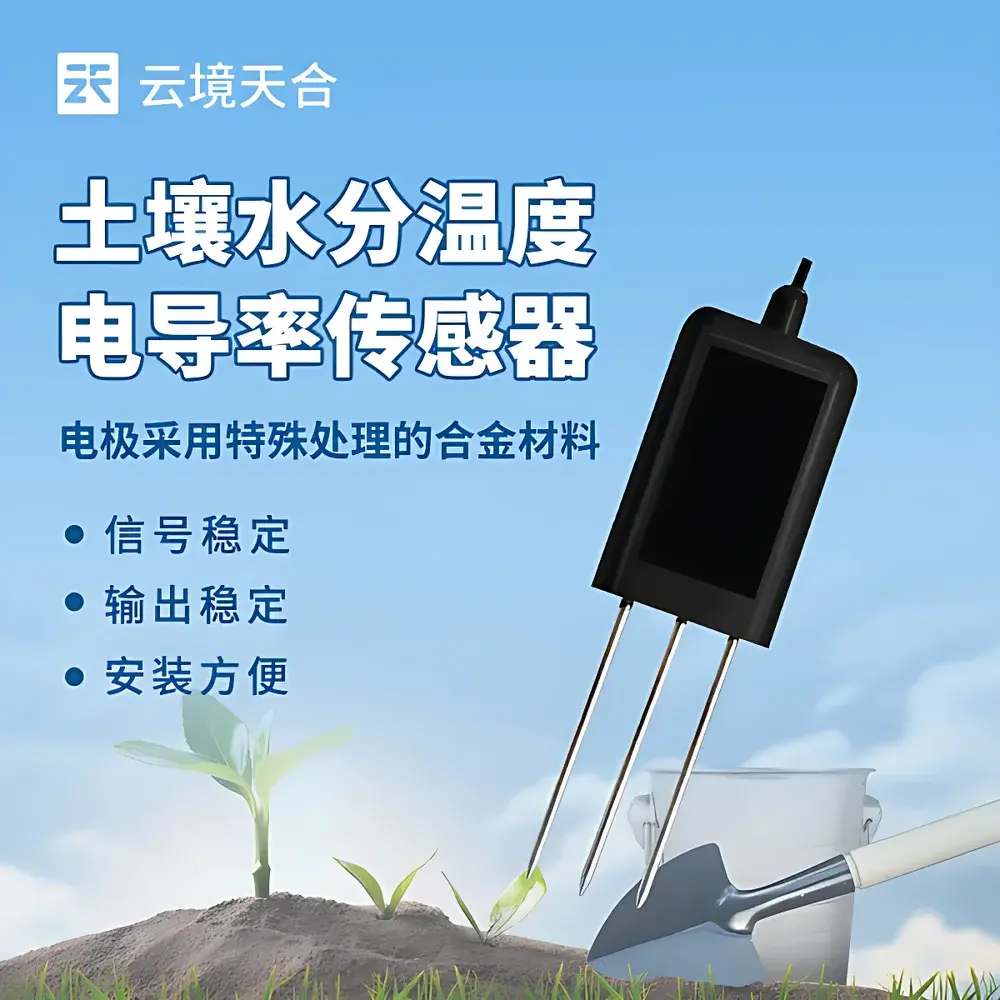
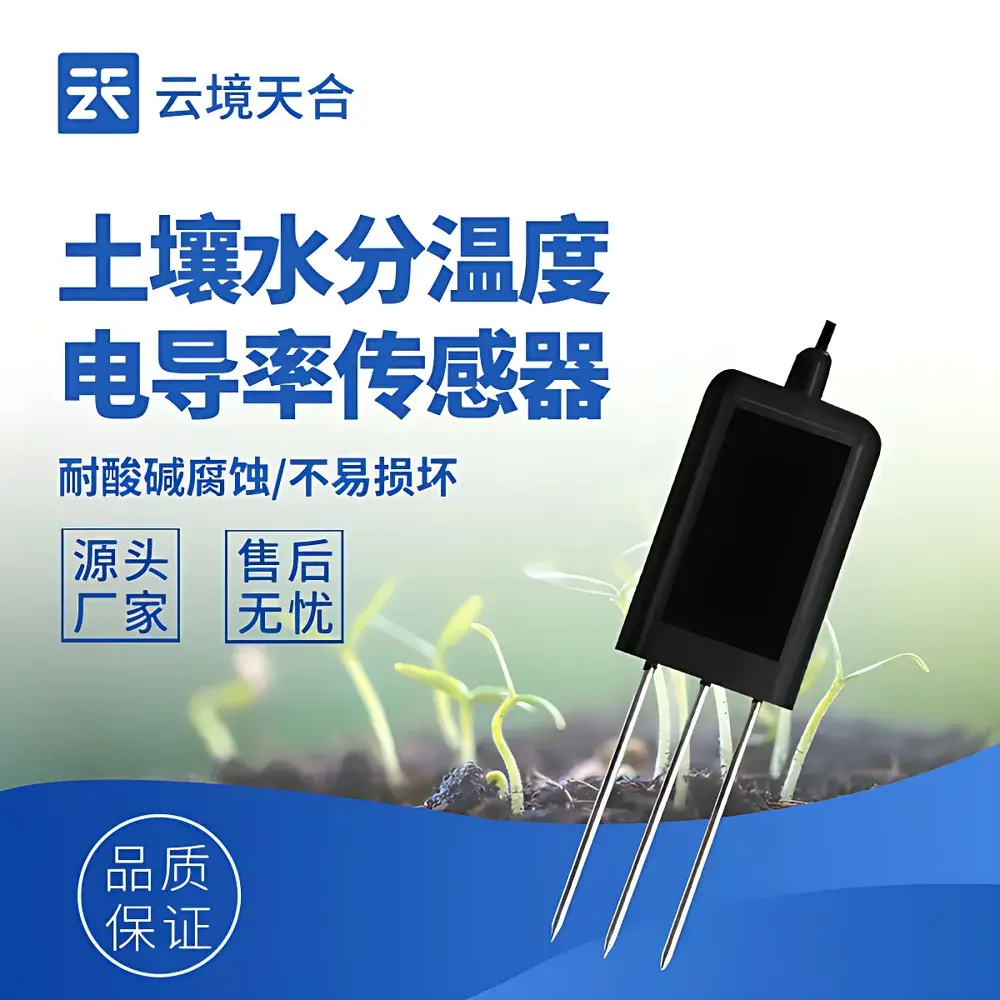
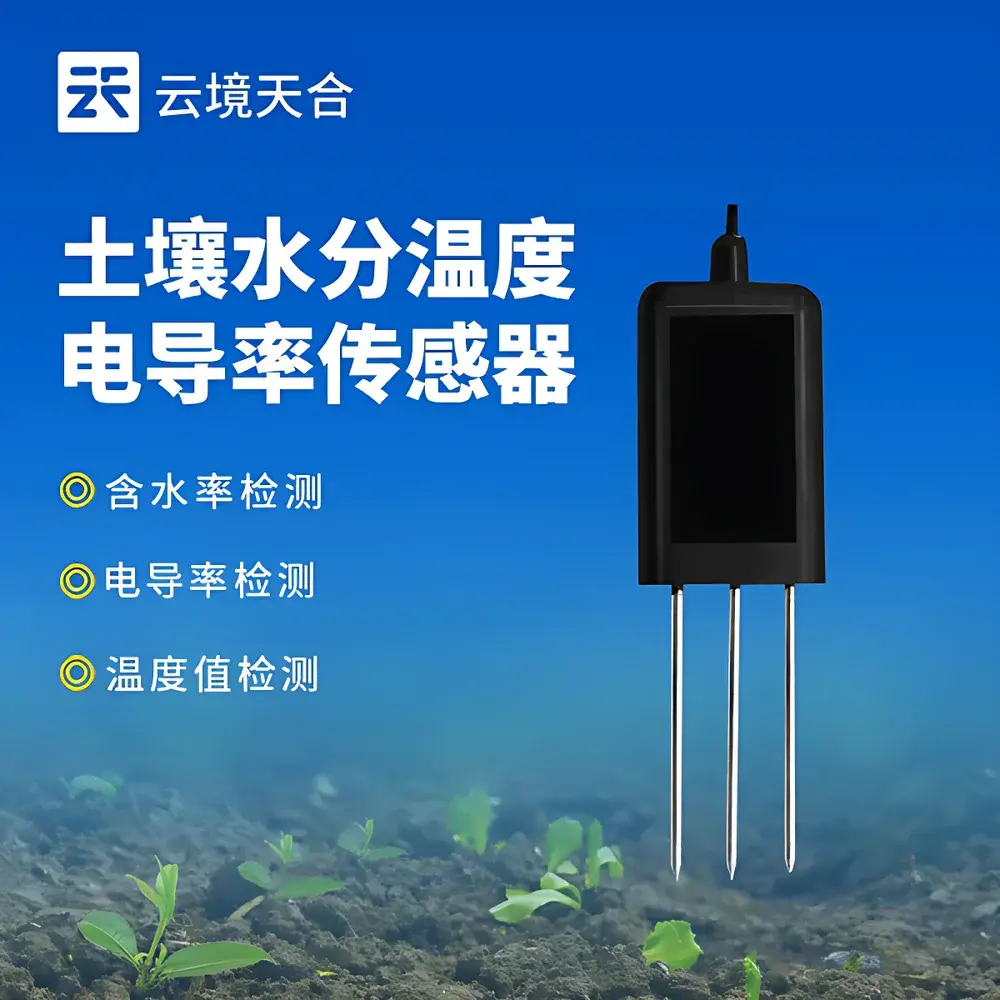
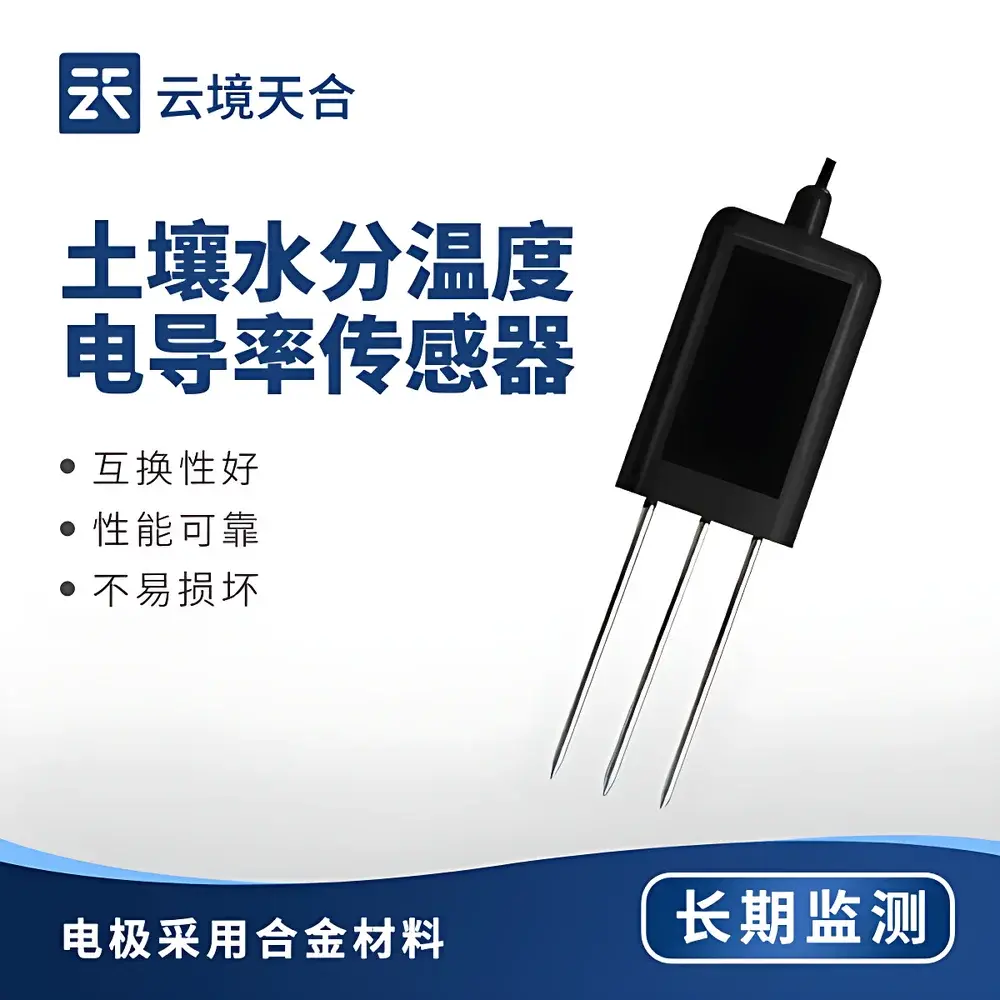
YunJingTianHe TH-WS485 Soil Moisture and Temperature Sensor
| Brand | YunJingTianHe |
|---|---|
| Origin | Shandong, China |
| Manufacturer Type | Direct Manufacturer |
| Country of Origin | China |
| Model | TH-WS485 |
| Power Supply | DC 12 V |
| Power Consumption | < 0.1 W |
| Operating Temperature Range | −30 to +70 °C |
| Communication Interface | RS-485 |
| Operating Current | 8 mA @ 12 V DC |
| Minimum Data Interval | 60 s |
| Soil Temperature Measurement Range | −30 to +70 °C |
| Soil Temperature Accuracy | ±0.3 °C (−10 to +50 °C) |
| Soil Temperature Resolution | 0.01 °C |
| Soil Volumetric Water Content (VWC) Range | 0–100 % |
| VWC Accuracy | ±3 % (for loam soils) |
| VWC Resolution | 0.01 % |
| Calibration Requirement | Site-specific calibration recommended for high-organic-matter soils (>12 % SOC) or high-clay soils (>45 % clay content) |
Overview
The YunJingTianHe TH-WS485 Soil Moisture and Temperature Sensor is an industrial-grade, RS-485–enabled environmental monitoring device engineered for continuous, high-stability measurement of volumetric water content (VWC) and soil temperature in field and greenhouse applications. It employs frequency-domain reflectometry (FDR) as its primary sensing principle—measuring the dielectric permittivity of soil at a fixed operating frequency (typically 50–100 MHz), which correlates strongly with water content due to the large dielectric contrast between water (εr ≈ 80) and dry soil matrix (εr ≈ 3–5). Integrated Pt1000-class thermistor technology enables concurrent, high-resolution soil temperature monitoring—critical for temperature compensation of dielectric readings and for agronomic modeling of root-zone thermal dynamics. Designed for long-term unattended deployment, the sensor features a ruggedized stainless-steel probe housing, IP68-rated enclosure, and wide operational temperature tolerance (−30 to +70 °C), making it suitable for year-round use across temperate, arid, and semi-humid agroecological zones.
Key Features
- RS-485 Modbus RTU communication protocol for reliable multi-node daisy-chaining (up to 32 devices per bus) and noise-immune data transmission over distances up to 1,200 m
- Low-power design (<0.1 W standby, 8 mA @ 12 V DC), compatible with solar-powered telemetry systems and battery-backed edge controllers
- Minute-interval sampling capability (configurable down to 60 s), enabling high-temporal-resolution monitoring of irrigation events, infiltration fronts, and evapotranspiration-driven moisture depletion
- Dual-parameter output: simultaneous VWC (%) and soil temperature (°C), both timestamped and linearized in firmware
- Factory-calibrated for standard loam soils; includes documented calibration coefficients and user-accessible offset registers for on-site soil-specific adjustment
- Probe geometry optimized for minimal soil disturbance during insertion and stable mechanical coupling—reducing air-gap artifacts common in low-density or cracked soils
Sample Compatibility & Compliance
The TH-WS485 is validated for use in mineral soils with texture ranging from sandy loam to silty clay, provided organic carbon content remains below 12 % and clay fraction does not exceed 45 %. In high-organic-matter or high-clay soils, users must perform empirical calibration using gravimetric reference measurements, as dielectric relaxation effects alter the εr–VWC relationship. The sensor complies with IEC 61000-4-2 (ESD immunity), IEC 61000-4-4 (EFT), and IEC 61000-4-5 (surge protection) standards for industrial environments. While not certified for FDA 21 CFR Part 11 or ISO/IEC 17025, its data output structure supports integration into GLP-compliant agricultural research workflows when paired with audit-trail-capable data loggers and cloud platforms.
Software & Data Management
Data from the TH-WS485 is transmitted as raw Modbus registers (holding registers 0x0000–0x0003), containing scaled integer values for VWC and temperature. These are decoded using open Modbus documentation provided in the technical manual. The sensor integrates natively with SCADA systems, MQTT-based IoT gateways (e.g., EdgeX Foundry, ThingsBoard), and commercial farm management platforms via RS-485-to-Ethernet or RS-485-to-LoRaWAN bridges. Firmware supports configurable baud rates (9.6–115.2 kbps), parity modes, and slave ID assignment. No proprietary software is required; configuration and diagnostics can be performed using standard Modbus utilities (e.g., QModMaster, Simply Modbus).
Applications
- Precision irrigation scheduling in orchards, vineyards, and row-crop systems
- Soil hydrological modeling and vadose zone process validation in university and government research stations
- Smart greenhouse climate control—correlating substrate moisture with HVAC and fertigation setpoints
- Long-term ecological monitoring networks (LTER) requiring low-maintenance, multi-year sensor stability
- Validation of satellite-derived soil moisture products (e.g., Sentinel-1 SAR, SMAP L2/L3)
- Urban green infrastructure performance assessment (bioswales, rain gardens, green roofs)
FAQ
What is the recommended installation depth for optimal root-zone monitoring?
For most annual crops and turfgrass, install the sensor at 10–30 cm depth; for deep-rooted perennials (e.g., fruit trees, vines), deploy at 30–60 cm. Avoid placement within 5 cm of irrigation emitters or drainage tiles.
Can the TH-WS485 be used in saline soils?
Yes—but accuracy degrades above 4 dS/m EC. For saline conditions, apply empirical salinity correction using parallel ECa measurements and published pedotransfer functions.
Is factory calibration traceable to NIST or other national standards?
Calibration is performed against gravimetrically verified soil standards prepared per ASTM D2216; full traceability documentation is available upon request for research procurement.
Does the sensor support automatic temperature compensation of VWC readings?
Yes—internal temperature compensation is applied in real time using a second-order polynomial algorithm embedded in firmware.
What is the expected service life under continuous field exposure?
Rated for ≥5 years in non-aggressive soils; probe longevity is extended by avoiding installation in highly acidic (pH < 4.5), alkaline (pH > 9.0), or heavy-metal-contaminated sites.







