
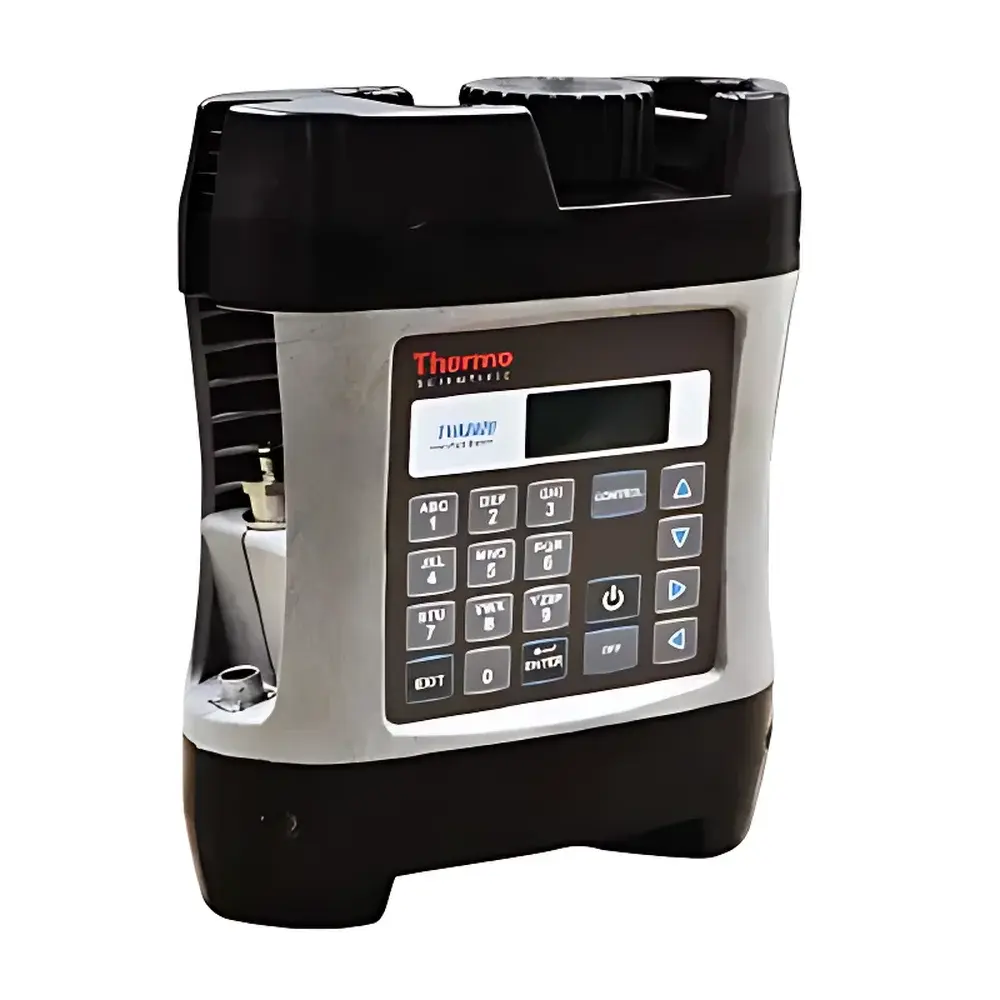
Thermo Scientific TVA2020C Portable FID/PID Dual-Detector Toxic Volatile Organic Compounds Analyzer
| Brand | Thermo Fisher |
|---|---|
| Origin | USA |
| Model | TVA2020C |
| Detector Types | Flame Ionization Detector (FID) & Photoionization Detector (PID) |
| Instrument Type | Intrinsically Safe Portable Analyzer |
| Detection Range | FID 1.0–30,000 ppm methane |
| Resolution | FID 0.5 ppm methane |
| Accuracy | FID ±10% of reading or ±0.1 ppm (whichever is greater) over 1.0–10,000 ppm |
| Response Time | <3.5 s |
| Compliance | ATEX Zone 2, ANSI/CSA Class I & II Division 2 |
| Connectivity | Bluetooth 4.0 LE |
| Data Logging | Internal non-volatile memory with user-configurable sampling intervals and path-based tagging |
Overview
The Thermo Scientific TVA2020C is an intrinsically safe, handheld dual-detector analyzer engineered for real-time, field-deployable detection and quantification of toxic volatile organic compounds (VOCs) and select inorganic gases. It integrates two complementary analytical principles—flame ionization detection (FID) and photoionization detection (PID)—within a single, lightweight platform. FID provides broad-spectrum, carbon-mass-sensitive response to hydrocarbons and most organics with high dynamic range and excellent reproducibility across concentrations from 1.0 to 30,000 ppm (as methane). PID delivers selective, low-level detection of aromatic, heteroatomic, and unsaturated compounds—including chlorinated solvents, amines, and sulfur-containing species—at sub-ppm levels (0.5–2,000 ppm as isobutylene), leveraging 10.6 eV UV lamp ionization. Unlike single-sensor instruments, the TVA2020C enables concurrent, independent signal acquisition from both detectors—allowing simultaneous assessment of total hydrocarbon load (FID) and compound-class-specific reactivity or toxicity potential (PID). This dual-channel architecture supports method-compliant execution of U.S. EPA Method 21 for fugitive emission monitoring, as well as broader environmental site assessments, landfill gas surveys, and industrial hygiene screening.
Key Features
- Intrinsically safe design certified for hazardous locations: ATEX Zone 2 and ANSI/CSA Class I & II Division 2 compliance ensures operational safety in petrochemical, refinery, and waste management environments.
- True dual-detection capability: FID and PID operate simultaneously without cross-interference, enabling parallel data streams for comprehensive gas profiling.
- Optimized ergonomics: 21% lighter than predecessor models and significantly more compact than conventional portable FID analyzers—reducing operator fatigue during extended LDAR (Leak Detection and Repair) surveys.
- Integrated Bluetooth 4.0 Low Energy connectivity: Enables direct wireless transmission of time-stamped, location-tagged concentration data to compatible handheld LDAR software platforms (e.g., Thermo Scientific LDAR Pro), eliminating post-survey manual download steps.
- User-configurable operation: Field-adjustable parameters include alarm thresholds, response factor libraries, internal data logging intervals, and route-based measurement tagging—all accessible via intuitive on-device interface without PC dependency.
- Modular accessory support: Optional configurations include enhanced sampling probes (heated/stainless steel), ruggedized transport cases, and integrated hydrogen charging valves for sustained FID operation in remote settings.
Sample Compatibility & Compliance
The TVA2020C is validated for direct analysis of ambient air, stack effluents, soil vapor, and headspace samples containing saturated/unsaturated aliphatics, aromatics, ketones, esters, aldehydes, amines, and select halogenated compounds. Its FID response is proportional to the number of carbon atoms combusted, while PID sensitivity depends on ionization potential relative to the 10.6 eV photon energy—making it suitable for detecting compounds with IP ≤ 10.6 eV. The instrument meets performance criteria specified in U.S. EPA Method 21 (40 CFR Part 60, Appendix A) for VOC leak detection, and its measurement uncertainty profile aligns with ASTM D6348–22 (Standard Test Method for Determination of Gaseous Compounds by Extractive Direct Interface Fourier Transform Infrared Spectroscopy) for comparative field validation. All firmware and calibration routines are traceable to NIST-certified standards; audit trails comply with GLP/GMP documentation requirements where applicable.
Software & Data Management
Data acquisition and reporting are fully embedded within the device firmware. Internal non-volatile memory stores up to 100,000 measurement records with timestamps, GPS coordinates (when paired with external GNSS), detector-specific concentration values, and user-defined tags (e.g., component ID, valve number, survey route segment). Bluetooth-enabled synchronization supports seamless integration with Thermo Scientific LDAR Pro and third-party regulatory reporting platforms compliant with 21 CFR Part 11 (electronic records and signatures). Firmware updates are delivered via secure USB or OTA (over-the-air) mechanisms, preserving configuration integrity and cryptographic signature verification. Calibration history—including span gas lot numbers, date/time stamps, and drift verification results—is automatically archived and exportable in CSV or XML format for QA/QC review and regulatory submission.
Applications
- Fugitive emission monitoring per U.S. EPA Method 21 and EU IED (Industrial Emissions Directive) Annex VI requirements.
- Landfill gas characterization (CH₄, NMOCs) and biofilter efficiency evaluation.
- Soil vapor intrusion assessment at brownfield sites under ASTM E2600 guidance.
- Process safety audits including flare stack testing, tank vent screening, and pump seal leak verification.
- Emergency response triage for chemical spills or confined-space entry pre-clearance.
- Complementary use with OGI (Optical Gas Imaging) systems such as the OPGAL EyeCGas camera—where TVA2020C provides quantitative concentration data at suspected leak points identified visually via infrared imaging.
FAQ
What certification standards does the TVA2020C meet for use in hazardous areas?
It is certified to ATEX Directive 2014/34/EU for Zone 2, and ANSI/CSA C22.2 No. 157 and UL 121201 for Class I, II, Division 2, Groups A–G and T4 temperature class.
Can the TVA2020C be used for quantitative compliance reporting under EPA regulations?
Yes—its FID accuracy specification (±10% or ±0.1 ppm) and documented linearity over five orders of magnitude satisfy the performance criteria for Method 21 reference analyzers when operated per manufacturer-recommended calibration and verification protocols.
Is hydrogen fuel supply integrated or external?
Hydrogen is supplied via replaceable, disposable cylinders (e.g., 11 g Alkaline Metal Hydride cartridges); optional integrated charging valves enable field refilling using standard H₂ sources.
Does the instrument support custom response factors for compound-specific quantification?
Yes—users can load and assign compound-specific RF libraries via the onboard menu or Bluetooth-synced software; default libraries include >200 VOCs aligned with EPA TO-15 and ASTM D5504 compound lists.
How is data integrity ensured during extended field deployments?
All measurements are timestamped, detector-tagged, and stored with cyclic redundancy check (CRC) validation; internal memory retains data through power loss, and firmware enforces write-protection on calibration logs.







