
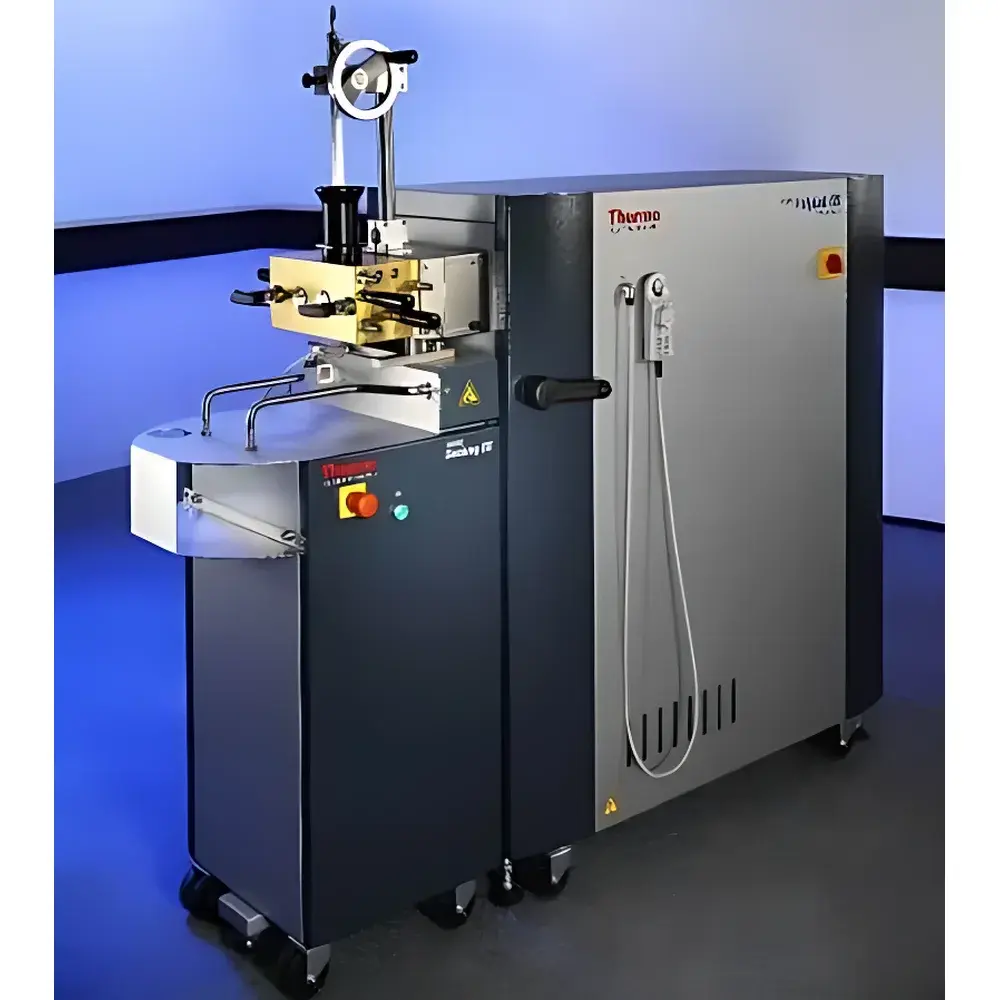
Thermo Scientific Materials Characterization Rheometer
| Origin | Imported |
|---|---|
| Manufacturer Type | Distributor |
| Model | Thermo Scientific Materials Characterization |
| Instrument Type | Torque Rheometer |
| Motor Bearing | Not Applicable |
| Minimum Rotational Speed | Not Specified |
| Maximum Rotational Speed | Not Specified |
| Frequency Range | Not Specified |
| Maximum Torque | Not Specified |
| Torque Resolution | Not Specified |
Overview
The Thermo Scientific Materials Characterization Rheometer is a high-performance torque rheometer engineered for comprehensive viscoelastic and processing behavior analysis of polymeric melts, thermoplastic compounds, elastomers, and pharmaceutical formulations under realistic shear and thermal conditions. Unlike rotational viscometers designed for low-shear Newtonian fluids, this instrument operates on the principle of controlled-stress or controlled-strain torque rheometry—measuring the resistance to deformation (torque) and angular displacement (rotation) of a sample subjected to defined mechanical work input within a closed mixing chamber or between parallel-plate/ cone-plate geometries. Its architecture supports both steady-state and dynamic oscillatory testing protocols, enabling quantification of melt viscosity, elasticity (storage modulus G′), viscous response (loss modulus G″), complex viscosity (η*), and processing-related parameters such as energy consumption, dispersion efficiency, and thermal stability during compounding.
Key Features
- Modular torque rheometry platform compatible with interchangeable mixing heads (e.g., Brabender-type internal mixers, capillary dies, and extrusion modules) for simulating industrial processing steps including kneading, extrusion, and injection molding.
- Integrated temperature control system with PID-regulated heating/cooling zones (typically spanning 20–300 °C) and real-time monitoring via embedded Pt100 sensors in rotor, chamber wall, and die sections.
- Dual-sensor torque measurement system with high-resolution digital encoders and calibrated load cells, ensuring traceable torque data acquisition across wide dynamic ranges.
- Robust mechanical design featuring rigid cast-iron frame, precision-machined stainless-steel components, and sealed drive transmission to minimize maintenance and ensure long-term repeatability.
- Compliance-ready hardware architecture supporting audit trails, electronic signatures, and user-access-level configuration—aligned with GLP, GMP, and FDA 21 CFR Part 11 requirements when deployed with validated software packages.
Sample Compatibility & Compliance
This rheometer accommodates solid granules, powder blends, pellets, and pre-compounded melts—commonly used in polymer development, recycling feedstock evaluation, and solid-dosage formulation optimization. Sample volumes range from 30 mL to 120 mL depending on mixer geometry. The system meets mechanical safety standards per ISO 12100 and electrical safety per IEC 61000-6-2/6-4. When operated with Thermo Scientific RheoWin or third-party compliant software (e.g., TA Instruments TRIOS), it supports data integrity frameworks required by USP , ASTM D3835, ISO 6721-10, and ISO 11443 for melt rheology characterization.
Software & Data Management
RheoWin Control and Analysis Software (v5.x or later) provides full instrument orchestration—including ramped temperature profiles, multi-step shear protocols, time-sweep experiments, and frequency sweeps. Raw torque, temperature, speed, and power data are recorded at ≥10 Hz sampling rate and stored in vendor-neutral .csv or .tdms formats. Built-in reporting templates generate ASTM/ISO-compliant test reports with metadata embedding (operator ID, calibration certificate numbers, environmental conditions). Audit trail functionality logs all parameter changes, method modifications, and data exports—supporting regulatory review and internal quality audits. Optional integration with LIMS platforms via OPC UA or RESTful API enables automated data routing into enterprise QA/QC workflows.
Applications
- Development and scale-up of polymer blends and composites, including carbon-fiber-reinforced thermoplastics and biodegradable matrix systems.
- Evaluation of thermal degradation onset and shear-induced structural breakdown in high-viscosity engineering resins.
- Optimization of plasticizer content and filler dispersion homogeneity in PVC compound formulation.
- In-process characterization of hot-melt extrusion (HME) formulations for amorphous solid dispersions in oral drug delivery.
- Quality-by-Design (QbD) studies supporting ICH Q5E and Q8(R2) guidelines for pharmaceutical excipient functionality assessment.
FAQ
What types of materials can be tested on this torque rheometer?
Polymer melts, thermoplastic compounds, thermoset precursors, rubber compounds, pharmaceutical hot-melt extrusion blends, and filled composites—provided they exhibit sufficient melt cohesion and thermal stability within the operational temperature window.
Is the system suitable for GLP-compliant laboratories?
Yes, when configured with validated software, electronic signature capability, and documented calibration procedures, the system meets core GLP requirements for data integrity, traceability, and personnel accountability.
Does it support oscillatory shear testing?
Oscillatory capabilities depend on the selected modular configuration; certain parallel-plate or cone-plate accessories enable small-amplitude oscillatory shear (SAOS) measurements for linear viscoelastic region (LVR) determination.
Can raw torque and temperature data be exported for third-party analysis?
Yes, all primary sensor outputs are exportable in ASCII-compatible formats (.csv, .txt) and binary formats (.tdms), preserving timestamp, unit metadata, and channel synchronization information.



