
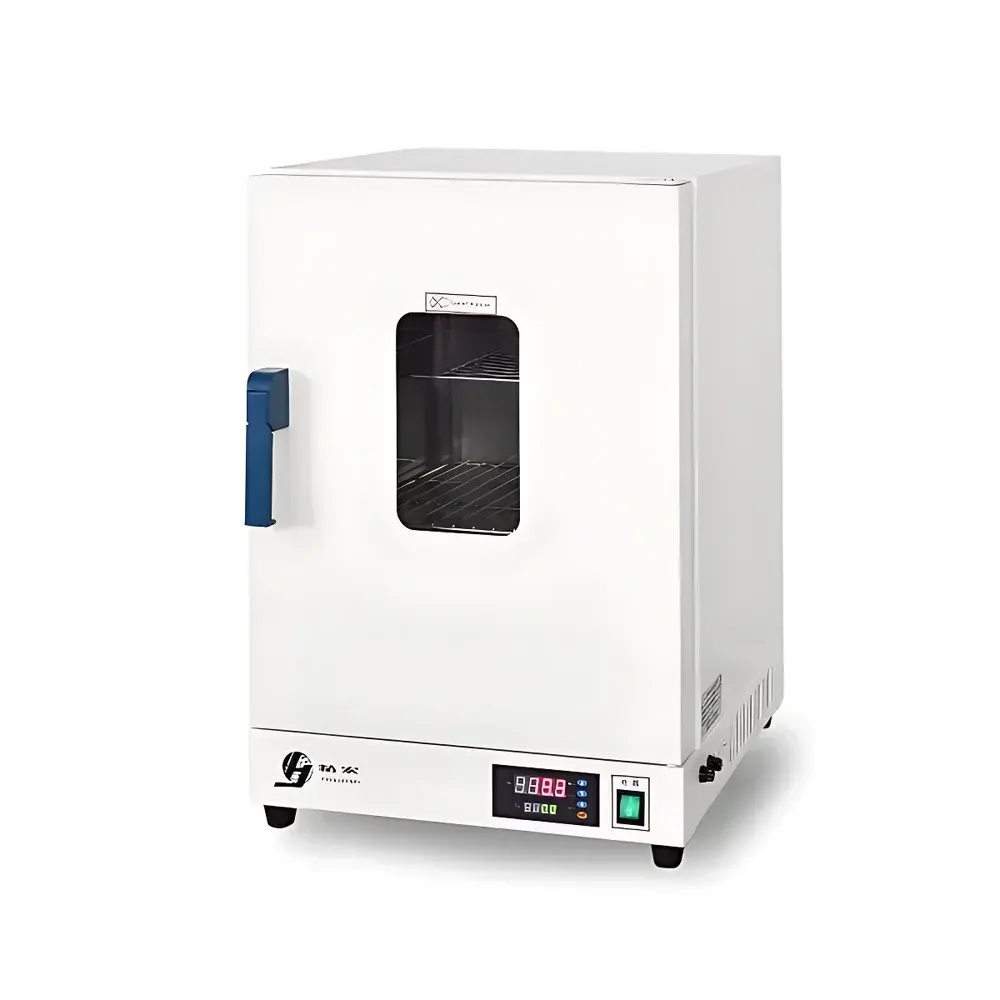
JingHong DHG-9241A Natural Convection Constant Temperature Drying Oven
| Brand | JingHong |
|---|---|
| Origin | Shanghai, China |
| Model | DHG-9241A |
| Temperature Range | Ambient +10°C to 200°C |
| Temperature Uniformity | ±1°C |
| Temperature Resolution | 0.1°C |
| Chamber Dimensions (W×D×H) | 540 × 600 × 750 mm |
| External Dimensions (W×D×H) | 705 × 820 × 1120 mm |
| Working Environment Temperature | 5–40°C |
| Interior Material | Stainless Steel |
| Heating Method | Natural Convection (No Forced Air Circulation) |
| Instrument Type | General-Purpose Laboratory Drying Oven |
Overview
The JingHong DHG-9241A is a precision-engineered natural convection constant temperature drying oven designed for routine thermal processing in laboratories, quality control facilities, and industrial R&D environments. Unlike forced-air (fan-assisted) ovens, the DHG-9241A relies on passive thermal buoyancy-driven air movement—eliminating airflow-induced sample disturbance, dust redistribution, or mechanical vibration. This makes it especially suitable for applications where sample integrity, gentle heat exposure, and minimal cross-contamination are critical—such as drying hygroscopic powders, conditioning reference standards, pre-weighing desiccation of filter papers, or low-temperature sterilization of glassware and non-volatile reagents. Its temperature control system operates via a microprocessor-based PID controller with dual digital display (setpoint and actual chamber temperature), enabling stable thermal regulation within ±1°C across the full operating range (ambient +10°C to 200°C) and resolution down to 0.1°C. The unit complies with fundamental safety and performance expectations outlined in IEC 61010-1 for laboratory electrical equipment and is constructed to support long-term operational reliability under standard ambient conditions (5–40°C).
Key Features
- Stainless steel interior chamber (540 × 600 × 750 mm) resistant to corrosion, oxidation, and repeated thermal cycling
- Natural convection heating architecture—no internal fan or air ducts—ensuring uniform, laminar thermal distribution without turbulent airflow
- Microprocessor-controlled PID temperature regulation with auto-tuning capability, real-time deviation compensation, and power modulation logic
- Dual LED digital display showing both setpoint and measured chamber temperature simultaneously
- Timed operation mode with adjustable duration up to 9999 minutes, supporting unattended batch processing
- Over-temperature protection circuit with independent mechanical backup thermostat (fail-safe cut-off)
- Robust external housing fabricated from cold-rolled steel with powder-coated finish for mechanical durability and chemical resistance
Sample Compatibility & Compliance
The DHG-9241A accommodates a broad spectrum of non-volatile, thermally stable samples including ceramic filters, metal calibration weights, polymer pellets, pharmaceutical excipients, soil aggregates, and analytical crucibles. Its natural convection design avoids convective displacement of fine particulates or lightweight materials—a key advantage over fan-circulated ovens when handling open petri dishes, weighing boats, or desiccation trays. The stainless steel chamber meets ISO 8573-1 purity class requirements for non-oiled, low-particulate thermal environments. While not certified for GMP manufacturing use out-of-the-box, the oven supports GLP-compliant documentation when integrated into validated lab workflows—including traceable temperature logging (via optional external data logger interface) and periodic verification per ASTM E2203 (Standard Practice for Calibration of Laboratory Ovens). It is not intended for flammable solvent evaporation, biological decontamination (e.g., autoclaving), or Class II biosafety applications.
Software & Data Management
The DHG-9241A operates as a standalone instrument with embedded firmware; no proprietary software or driver installation is required. All operational parameters—including setpoint, timer value, and status indicators—are managed directly via the front-panel keypad and dual-line LED display. For regulatory traceability, users may connect a calibrated external temperature data logger (e.g., compliant with ISO/IEC 17025-accredited thermistors or Pt100 probes) to the optional analog output port (0–5 V DC proportional to chamber temperature). Such configurations enable generation of audit-ready temperature profiles compatible with FDA 21 CFR Part 11–aligned electronic records when paired with validated third-party acquisition software. Firmware revision history and calibration logs can be maintained manually in accordance with internal SOPs for ISO 17025 or CAP-accredited laboratories.
Applications
- Drying of moisture-sensitive analytical samples prior to gravimetric analysis (e.g., ASTM D2231, ISO 787-2)
- Conditioning of reference materials and certified calibration standards per ISO Guide 34 requirements
- Baking of ceramic substrates and metallurgical specimens before SEM mounting or XRD analysis
- Low-temperature sterilization of glassware and stainless-steel tools in non-aseptic preparatory labs
- Pre-heating of test fixtures, load cells, and sensor housings to thermal equilibrium prior to metrological evaluation
- Controlled dehydration of botanical specimens and geological core samples for archival storage
FAQ
Is the DHG-9241A suitable for drying samples containing volatile organic solvents?
No. This oven lacks explosion-proof construction, solvent recovery systems, or inert gas purging capability. Volatile solvent removal requires specialized explosion-proof ovens meeting UL 61010-1 Class I, Division 1 specifications.
Can the temperature uniformity be verified internally without external equipment?
The unit does not include built-in temperature mapping sensors. Uniformity validation must be performed using NIST-traceable multi-point thermocouples or data loggers following ASTM E2203 or ISO 17025 procedures.
Does the oven support RS232 or USB connectivity for remote monitoring?
No. Communication interfaces are not integrated. Remote data capture requires an external analog-to-digital converter connected to the 0–5 V output signal.
What maintenance is recommended for long-term accuracy?
Annual verification of temperature sensor drift and PID controller response using a calibrated reference thermometer is advised. Clean stainless steel chamber surfaces with non-chlorinated isopropyl alcohol; avoid abrasive cleaners that may compromise surface passivation.



