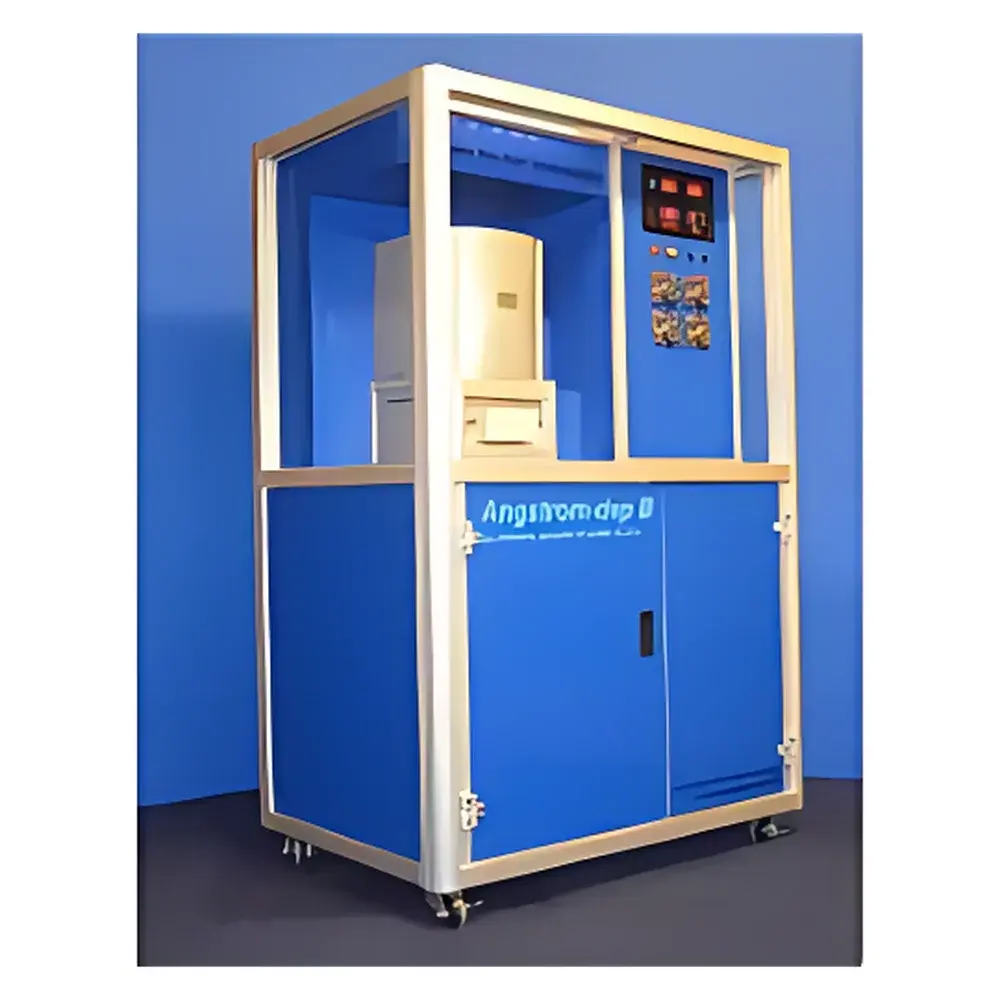
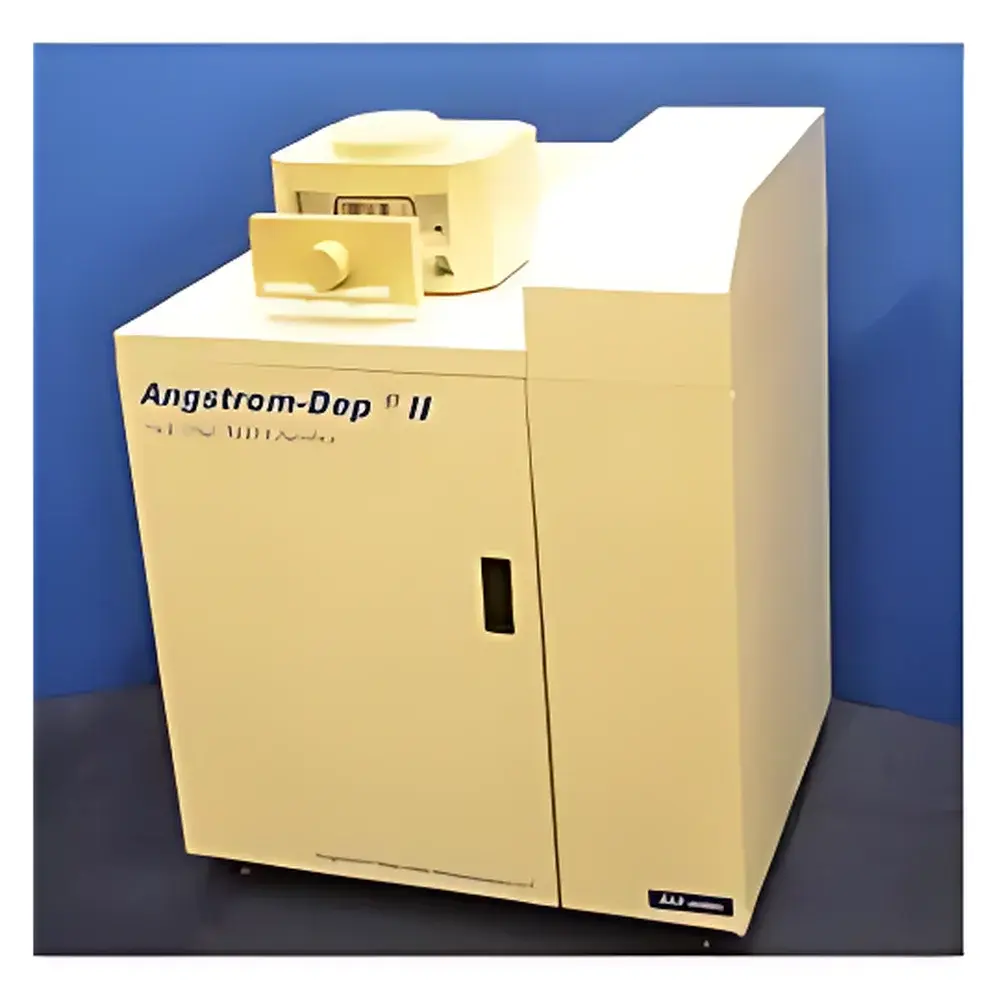
Angstrom Dep I Powder Atomic Layer Deposition System
| Brand | Angstrom (USA) |
|---|---|
| Origin | USA |
| Model | Angstrom Dep I |
| Substrate Size | 4–12 inch wafers |
| Process Temperature | Up to 650 °C (optional) |
| Precursor Channels | 4–10 |
| Weight | 200 kg |
| Dimensions (W × H × D) | 85 × 65 × 180 cm |
| Uniformity | ≤1.5% (typical for AL₂O₃ on 4″ Si wafers) |
Overview
The Angstrom Dep I Powder Atomic Layer Deposition System is a purpose-engineered thin-film synthesis platform designed specifically for high-precision, conformal coating of particulate and powdered substrates—including nanoparticles, metal-organic frameworks (MOFs), battery cathode/anode powders, catalyst supports, and porous ceramics. Unlike conventional wafer-based ALD tools, the Angstrom Dep I integrates a fluidized-bed or rotating-drum powder reactor module with industry-standard thermal ALD process architecture, enabling atomic-scale control over film thickness (sub-Å resolution), composition, and interface chemistry across high-surface-area, non-planar geometries. The system operates on the self-limiting surface reaction principle: sequential, saturating pulses of gaseous precursors react chemisorptively with active surface sites, ensuring monolayer-by-monolayer growth independent of line-of-sight constraints. This makes it indispensable for applications demanding uniform functionalization of complex 3D morphologies—particularly in next-generation energy storage, heterogeneous catalysis, and advanced packaging where traditional CVD or sputtering fail to achieve sufficient step coverage or stoichiometric fidelity.
Key Features
- Modular powder reactor design: configurable fluidized-bed or tumbling drum chamber optimized for particle sizes from 10 nm to 500 µm, with real-time agitation control to prevent agglomeration and ensure homogeneous precursor exposure
- Thermal ALD architecture with up to 10 independently controlled precursor delivery lines, each equipped with Swagelok high-temperature ALD valves rated to 250 °C and integrated mass flow controllers (MFCs)
- Substrate heating range: ambient to 650 °C (optional high-temp upgrade), with ±0.5 °C stability and programmable ramp/soak profiles for thermally sensitive materials
- Base vacuum system: Alcatel dry mechanical pump (≤1 × 10⁻³ mbar); optional integration with Pfeiffer HiPace turbomolecular pump (<5 × 10⁻⁷ mbar) or Edwards nXDS dry scroll pump for ultra-high-purity processing
- Integrated ozone generator (up to 200 g/h) and RF plasma source (13.56 MHz, 300 W) available for hybrid PE-ALD/thermal ALD co-processing
- Full load-lock compatibility with inert-atmosphere glovebox interfaces (O₂/H₂O < 0.1 ppm), enabling air-sensitive powder handling and transfer under N₂ or Ar
Sample Compatibility & Compliance
The Angstrom Dep I accommodates diverse powder classes: oxide and nitride battery active materials (e.g., NMC, LFP, Si anodes), supported noble-metal catalysts (Pt/C, Ru/TiO₂), MOF crystals (UiO-66, MIL-101), silica and alumina aerogels, and polymer microspheres. All wetted surfaces are electropolished 316L stainless steel or quartz-lined; gas lines comply with SEMI F57 standards for high-purity semiconductor tooling. The system meets ISO 9001-certified manufacturing protocols and supports full GLP/GMP documentation workflows—including electronic audit trails, user access levels, and instrument calibration logs traceable to NIST standards. Optional 21 CFR Part 11-compliant software modules enable FDA-regulated R&D environments requiring electronic signatures and data integrity assurance.
Software & Data Management
Control is executed via Angstrom’s proprietary ALDStudio™ v4.2 software suite, running on a Windows 10 IoT Enterprise platform with deterministic real-time scheduling. The GUI provides synchronized waveform visualization of precursor pulses, pressure transients, temperature ramps, and MFC setpoints—enabling precise recipe development and cross-lot reproducibility. All process parameters, timestamps, and alarm events are logged in SQLite databases with automated daily backup and optional cloud sync (AWS S3 or on-premise NAS). Export formats include CSV, HDF5, and XML for seamless integration with MATLAB, Python (Pandas/NumPy), and JMP statistical analysis platforms. Remote monitoring and troubleshooting are supported via TLS-encrypted VNC and SNMP traps for facility-wide equipment management systems.
Applications
- Surface passivation of Li-ion battery cathodes (e.g., Al₂O₃ or LiAlO₂ coatings on NMC811) to suppress interfacial side reactions and extend cycle life
- Atomic-scale encapsulation of photocatalysts (e.g., TiO₂-coated g-C₃N₄) to enhance charge separation and photostability
- Conformal dielectric barriers (HfO₂, AlN) on high-aspect-ratio porous electrodes for solid-state batteries
- Functionalization of mesoporous silica carriers with catalytically active metal oxides (e.g., Co₃O₄ on SBA-15) for selective oxidation
- Deposition of biocompatible coatings (TiN, ZnO) on drug-delivery microspheres for controlled release kinetics
- R&D of ALD-derived composite powders for additive manufacturing feedstocks with tailored sintering behavior
FAQ
What powder throughput capacity does the Angstrom Dep I support?
Standard configurations handle 0.5–5 g batches per run; scalable reactor options support up to 50 g with extended deposition time and enhanced fluidization tuning.
Can the system deposit multi-layer heterostructures on powders?
Yes—via sequential ALD cycles with automated chamber purging and in-situ pressure stabilization between layers; interlayer contamination is minimized by <10⁻⁶ mbar base pressure and pulsed purge protocols.
Is remote maintenance and software update capability available?
All units ship with embedded cellular (LTE-M) and Ethernet connectivity; firmware updates and diagnostic sessions are conducted securely through Angstrom’s certified service portal with end-to-end encryption.
What safety certifications does the system carry?
CE marking (EMC Directive 2014/30/EU, Machinery Directive 2006/42/EC), UL 61010-1 (Lab Equipment), and ATEX Zone 2/22 compliance for flammable precursor handling (optional).
How is film thickness uniformity validated on non-planar substrates?
Uniformity is verified using cross-sectional TEM combined with EDS line scans on representative particle ensembles; batch-level validation employs XPS depth profiling and BET surface area change analysis pre/post deposition.