
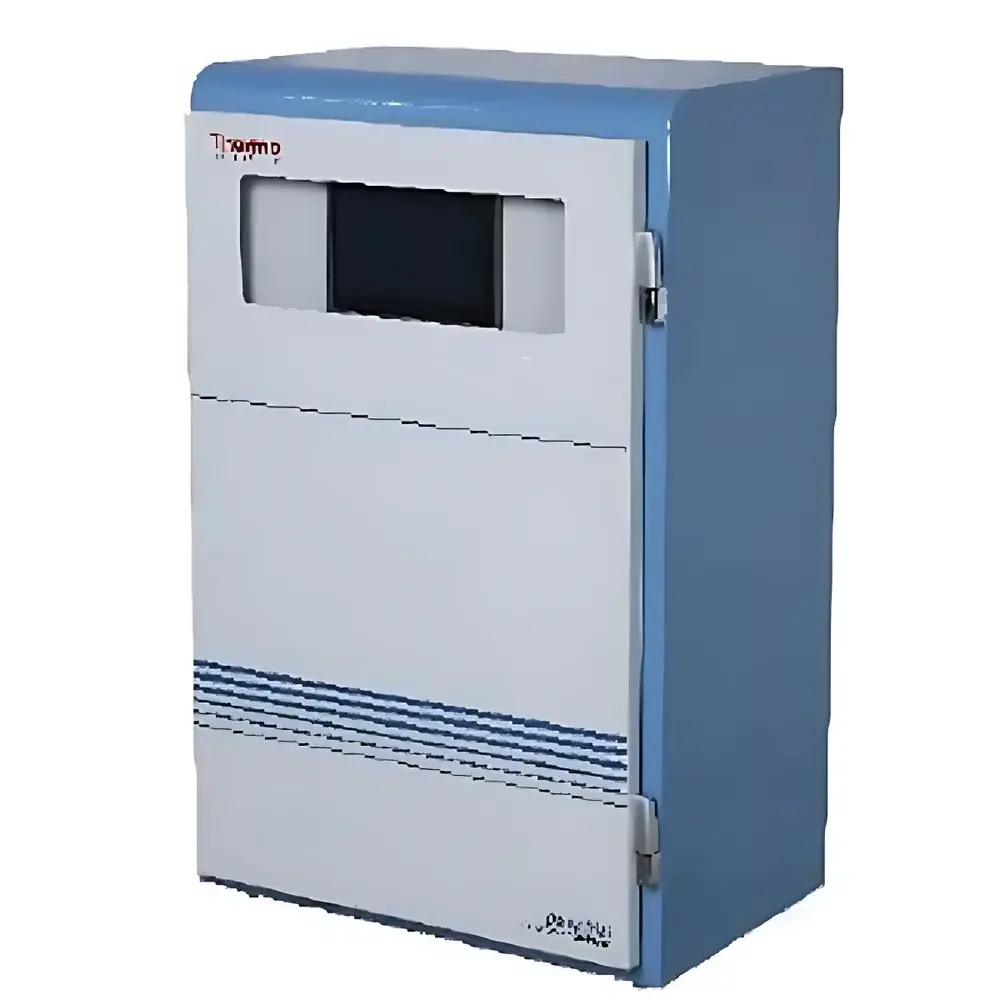
Thermo Scientific 3131 Permanganate Index Analyzer
| Brand | Thermo Fisher Scientific |
|---|---|
| Origin | USA |
| Manufacturer Type | Authorized Distributor |
| Product Category | Imported Instrument |
| Model | Thermo Scientific 3131 |
| Pricing | Available Upon Request |
| Measurement Principle | Potassium Permanganate Oxidation with ORP Endpoint Detection |
| Range | 0–20 / 0–100 / 0–200 mg/L KMnO₄ (customizable extended ranges available) |
| Repeatability | ≤ ±3% RSD |
| Accuracy | ±3% of reading |
| Limit of Detection (LOD) | ≤ 0.2 mg/L |
| Resolution | 0.001 mg/L |
| Analysis Time per Sample | < 60 minutes |
Overview
The Thermo Scientific 3131 Permanganate Index Analyzer is a fully automated, benchtop analytical system engineered for precise and reproducible determination of the permanganate index (also known as oxygen consumption or CODMn) in natural waters, drinking water sources, and treated effluents. Based on the standardized potassium permanganate oxidation method—aligned with ISO 8467:1993, GB/T 5750.7–2006, and APHA Standard Method 5210 B—the instrument employs potentiometric titration with real-time redox potential (ORP) monitoring to identify the stoichiometric endpoint. Unlike colorimetric or spectrophotometric alternatives, this ORP-based detection mechanism eliminates interference from turbidity, suspended solids, and sample chroma, ensuring robust performance across heterogeneous environmental matrices without pre-filtration or decolorization steps.
Key Features
- Oil-bath heating system providing uniform, stable temperature control at 100 °C (±0.5 °C), compliant with regulatory thermal oxidation requirements and minimizing thermal gradient-induced variability.
- High-precision micro-syringe pump with ≤0.01% volumetric accuracy (1/10,000 resolution) for reagent delivery, enabling trace-level dosing consistency and long-term calibration stability.
- Integrated 7-inch true-color capacitive touchscreen interface supporting multi-language operation, intuitive workflow navigation, and real-time visualization of titration curves, temperature profiles, and ORP response kinetics.
- Modular hardware architecture facilitating field-replaceable components—including digestion modules, titration cells, and fluidic manifolds—reducing mean time to repair (MTTR) and extending service life beyond 10 years under routine QC use.
- No electrode calibration required: the ORP sensor operates in a self-referencing mode with built-in drift compensation algorithms, eliminating manual standardization and reducing operator dependency.
- Low reagent consumption—typically ≤1.2 mL KMnO₄ (0.01 mol/L) and ≤2.5 mL H₂SO₄ (1:3 v/v) per analysis—translating to annual operational cost reductions of ≥40% versus conventional manual methods.
- Comprehensive data integrity safeguards: automatic timestamped audit trails, user-level access control (administrator/operator/observer tiers), and non-volatile memory with power-fail recovery preserving all method parameters, calibration logs, and raw titration data.
Sample Compatibility & Compliance
The 3131 analyzer accepts liquid samples with pH 4–9 and total suspended solids (TSS) up to 50 mg/L without pretreatment. It complies with Chinese Environmental Protection Product Certification (CCEP) standards and meets functional equivalency requirements under ISO/IEC 17025:2017 for testing laboratories. Data output conforms to EPA-approved reporting formats and supports 21 CFR Part 11-compliant electronic records when integrated with Thermo Fisher’s optional LIMS-ready software package. All wetted materials (e.g., PTFE tubing, borosilicate glass reaction vessels, and ceramic ORP electrodes) are chemically inert to acidic permanganate solutions and certified for repeated exposure under GLP/GMP-aligned quality assurance protocols.
Software & Data Management
Instrument control and data acquisition are managed via Thermo Scientific’s proprietary Analytical Manager Suite (AMS v4.2+), which provides method editor tools, customizable report templates (PDF/CSV/XLSX), and secure remote access through TLS 1.2-encrypted web interface. The software implements full ALCOA+ principles: attributable, legible, contemporaneous, original, accurate, complete, consistent, enduring, and available. Audit trail entries record every user action—including method modification, result override, and calibration event—with digital signature verification. Data export supports direct ingestion into enterprise LIMS platforms via ASTM E1384-compliant HL7 or ODBC drivers.
Applications
- Monitoring permanganate index in raw surface water intakes to assess organic loading prior to coagulation and disinfection stages.
- Verification of treatment efficacy in municipal drinking water plants, particularly for activated carbon and ozone-biological filtration units.
- Long-term trend analysis of eutrophication indicators in reservoirs, lakes, and river basins under national water quality surveillance programs.
- Regulatory compliance reporting for Class I–III surface water bodies per China’s “Surface Water Environmental Quality Standards” (GB 3838–2002).
- Research-grade characterization of biodegradable organic fractions in wastewater influent/effluent streams for process optimization modeling.
FAQ
What regulatory standards does the 3131 comply with for permanganate index measurement?
It adheres to ISO 8467:1993, GB/T 5750.7–2006, APHA 5210 B, and CCEP certification requirements for automated permanganate index analyzers.
Can the instrument handle highly turbid or colored samples without filtration?
Yes—its ORP endpoint detection is insensitive to optical interferences; no sample clarification is needed for turbidity ≤100 NTU or true color ≤200 Pt-Co units.
Is remote diagnostics and firmware update supported?
Yes—via secure HTTPS connection and authenticated SSH access; updates are digitally signed and validated prior to installation.
How is data integrity ensured during power interruption?
All active measurements and configuration states are written to non-volatile flash memory within 200 ms of detection; recovery resumes from last valid checkpoint without data loss.
What maintenance intervals are recommended for routine operation?
Daily: rinse cycle verification; quarterly: ORP sensor cleaning and oil-bath fluid inspection; annually: pump calibration validation and manifold seal replacement per manufacturer’s service schedule.







