
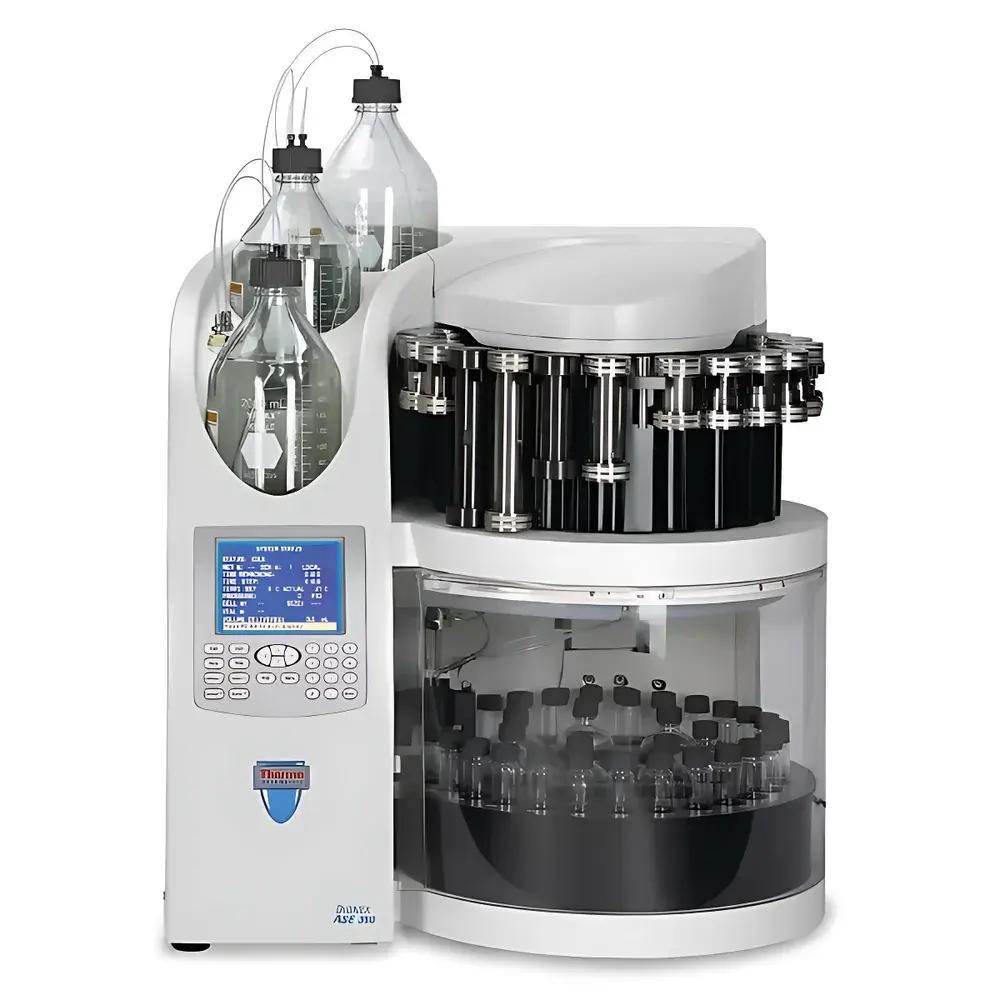
Thermo Fisher Dionex ASE350 Accelerated Solvent Extractor (Domestically Assembled in Shanghai)
| Brand | Thermo Fisher |
|---|---|
| Origin | Shanghai, China |
| Manufacturer Type | Authorized Distributor |
| Origin Category | Domestically Assembled |
| Model | ASE350 Accelerated Solvent Extractor (Domestically Assembled) |
| Pricing | Available Upon Request |
Overview
The Thermo Fisher Dionex ASE350 Accelerated Solvent Extractor (Domestically Assembled in Shanghai) is an automated solid-phase extraction platform engineered for high-efficiency, reproducible recovery of analytes from solid and semi-solid matrices—including soils, sediments, tissues, polymers, and botanical materials. It operates on the principle of accelerated solvent extraction (ASE®), a pressurized liquid extraction technique that combines elevated temperature (up to 200 °C) and pressure (up to 1500 psi) to enhance solvation power, mass transfer kinetics, and analyte desorption—while maintaining chemical integrity of thermolabile compounds. Unlike conventional Soxhlet or ultrasonic extraction, ASE delivers complete extractions in 12–20 minutes per cycle, with solvent consumption reduced by 50–90% relative to traditional methods. The system’s chemically inert fluid path—constructed with Dionium™-coated components and high-purity stainless steel—is compatible with acidic, basic, and oxidative solvent systems (e.g., HCl/methanol, NaOH/acetone, or HF/dichloromethane), supporting method development across diverse regulatory frameworks.
Key Features
- Automated, unattended operation for up to 24 samples per batch, minimizing manual intervention and operator variability
- Seven standardized extraction cell volumes: 1, 5, 10, 22, 34, 66, and 100 mL—enabling scalable method transfer from R&D to routine QC
- Precise thermal control via proprietary furnace architecture, delivering ±1 °C temperature stability across the full 50–200 °C range
- High-flow solvent delivery system (70 mL/min) with integrated three-solvent selection capability for gradient elution or sequential washing
- SmartRun™ cell recognition technology automatically validates cell size and corresponding collection vial geometry, preventing mismatch errors and ensuring consistent solvent-to-sample ratios
- Solvent-saving mode optimizes flush volume and purge duration based on matrix type and cell size—reducing average solvent use to <50 mL per 20 g sample
- On-line filtration and post-extraction cell rinsing via flow-through design, eliminating manual filter changes and reducing carryover risk
Sample Compatibility & Compliance
The ASE350 accommodates heterogeneous and challenging matrices—including activated carbon, sludge, cured resins, and fortified food composites—without clogging or channeling. Its pH-insensitive fluid path enables direct extraction of acid-digested environmental samples (e.g., EPA Method 3545A) and base-hydrolyzed pesticide residues (e.g., AOAC 2007.01). The system supports full traceability and audit readiness: instrument logs record timestamped method parameters, cell ID, solvent lot numbers, and operator credentials. When operated with validated SOPs, it meets data integrity requirements under FDA 21 CFR Part 11 (with optional electronic signature module), ISO/IEC 17025, and GLP-compliant workflows. All wetted parts comply with USP Class VI biocompatibility standards and are certified free of extractables per ASTM D4296.
Software & Data Management
Controlled via Thermo Scientific Chromeleon™ CDS or standalone ASE Console software, the system supports method creation, scheduling, real-time monitoring, and export of structured CSV/Excel reports. Audit trails capture all parameter modifications, run start/stop events, and error notifications—with immutable storage configurable to network drives or NAS. Raw method files include embedded metadata (e.g., calibration dates, maintenance history) for seamless integration into LIMS environments. Optional instrument interconnection with Thermo Scientific Rocket™ Evaporators enables fully automated sample preparation sequences—from extraction through concentration—reducing total turnaround time by >60% in regulated labs.
Applications
- Environmental analysis: PAHs, PCBs, organochlorine pesticides, dioxins/furans in soil and sediment (EPA 3545A, 3546)
- Food safety: Mycotoxins, veterinary drug residues, plasticizers in meat, cereals, and packaging materials (AOAC 2007.01, EN 15662)
- Pharmaceutical QA/QC: Residual solvents, extractables/leachables from polymer containers (USP <467>, <1663>)
- Materials science: Additive migration from composites, flame retardants in textiles, and monomer recovery from cured polymers
- Forensic toxicology: Drug metabolites from hair and tissue homogenates using mixed-mode SPE-compatible extracts
FAQ
Is the ASE350 system compliant with EPA Method 3545A?
Yes—the ASE350 is fully validated for EPA Method 3545A (Pressurized Fluid Extraction) when configured with appropriate cells, solvents, and temperature/pressure profiles.
Can the system handle corrosive solvents such as hydrofluoric acid?
Only with Dionium™-lined cells and dedicated HF-compatible fluid path kits; standard configurations are rated for HCl, HNO₃, and NaOH up to 10% w/w.
What maintenance intervals are recommended for routine operation?
Cell O-rings should be replaced every 200 runs; pump seals annually or after 10,000 cycles; and furnace calibration verified quarterly using NIST-traceable reference materials.
Does the ASE350 support remote monitoring and troubleshooting?
Yes—via Chromeleon CDS web interface or secure VPN connection, enabling real-time status checks, log review, and diagnostic command execution from offsite locations.
How does ASE compare to microwave-assisted extraction (MAE) for thermally labile compounds?
ASE applies controlled conductive heating without dielectric loss, avoiding localized superheating; thus, it demonstrates superior recovery for compounds such as certain antibiotics and prostaglandins where MAE may cause degradation.



