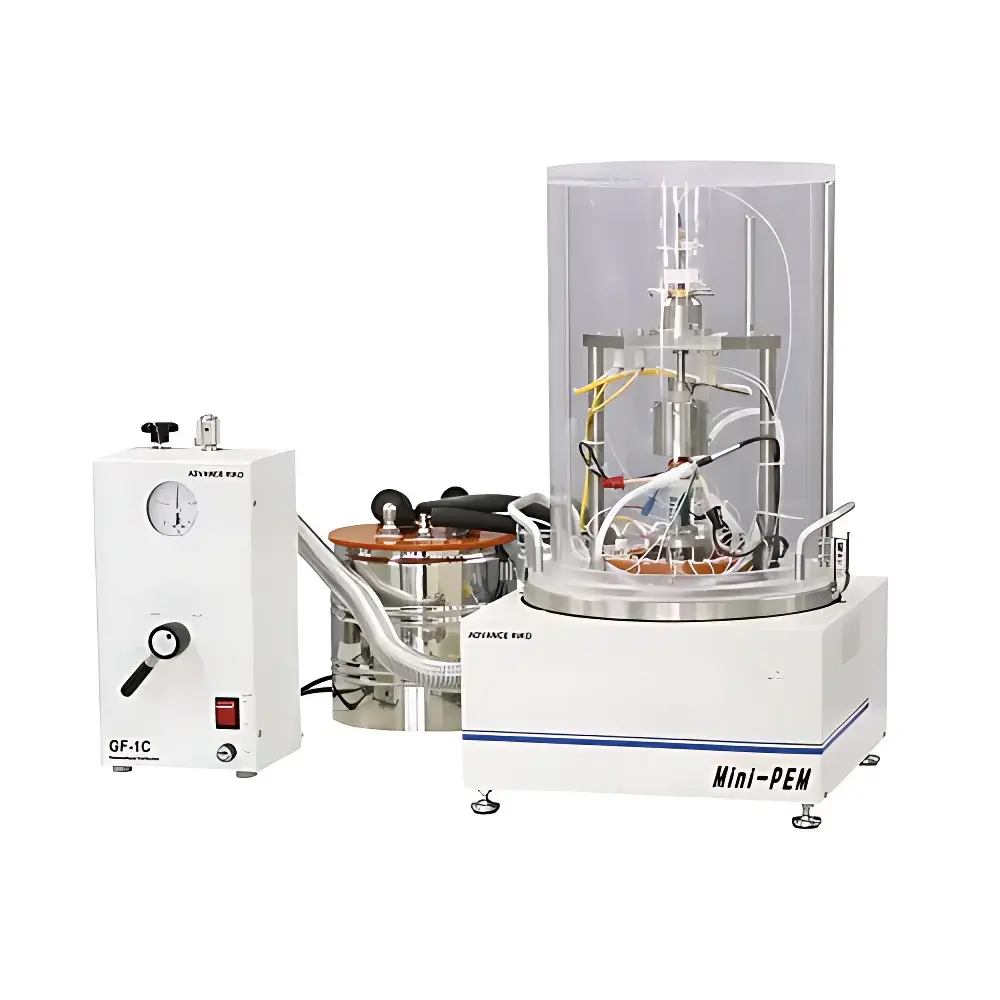
ADVANCE RIKO Mini-PEM Thermoelectric Conversion Efficiency Measurement System
| Brand | ADVANCE RIKO |
|---|---|
| Origin | Japan |
| Model | Mini-PEM |
| Measurement Principle | Simultaneous electrical power output & heat flux quantification for η calculation |
| Compliance | ASTM D8251 (2022), ISO 14405-1, GLP-aligned thermal-electrical co-calibration protocol |
| Price Range | USD 82,000 – 163,000 (FOB Yokohama) |
Overview
The ADVANCE RIKO Mini-PEM Thermoelectric Conversion Efficiency Measurement System is a benchtop-grade instrument engineered for precise, synchronized quantification of electrical power generation and axial heat flux across thermoelectric (TE) materials and modules under controlled thermal gradients. Unlike conventional Seebeck coefficient or resistivity analyzers, the Mini-PEM implements a dual-channel metrology architecture grounded in the fundamental thermodynamic definition of conversion efficiency: η = (Pelec / Qhot) × 100%, where Pelec is net electrical output power (W) and Qhot is heat input rate (W) at the hot-side interface. It achieves this via integrated four-point probe DC current–voltage characterization and calibrated heat-flux sensor (HFS) arrays embedded in actively temperature-controlled copper heat sinks. The system operates within a stable ΔT range of 10–250 °C, supporting both n-type and p-type bulk, thin-film, and segmented TE specimens up to 15 mm × 15 mm in footprint.
Key Features
- Simultaneous real-time acquisition of voltage, current, hot-side and cold-side temperatures, and directional heat flux with <1.5% combined standard uncertainty (k=2) per NIST-traceable calibration certificate
- Dual-zone Peltier-based thermal control with ±0.1 °C stability over 24 h, enabling reproducible gradient establishment without external cryogenic or furnace infrastructure
- Four-terminal electrical measurement circuitry compliant with ASTM F2397 for low-resistance TE material evaluation, minimizing contact resistance artifacts
- Modular sample holder design accommodating standardized 12.7 mm and 15.0 mm square specimens, with replaceable gold-plated Cu electrodes and integrated thermal interface material (TIM) alignment guides
- Onboard data synchronization engine ensuring microsecond-level timestamp alignment between electrical and thermal channels, critical for transient η analysis during thermal ramping
- Rugged aluminum chassis with EMI-shielded enclosure, CE/UKCA marked, and designed for integration into ISO/IEC 17025-accredited materials testing laboratories
Sample Compatibility & Compliance
The Mini-PEM supports a broad spectrum of thermoelectric configurations: single-leg bulk Bi2Te3, PbTe, or Skutterudite samples; monolithic thin-film devices on Si/SiO2 substrates; and commercial TE modules (up to 40 mm × 40 mm with optional adapter kit). All measurements adhere to the methodology outlined in ASTM D8251–22 “Standard Test Method for Determining Thermoelectric Conversion Efficiency of Bulk Materials and Modules” and align with ISO 14405-1 geometric product specification requirements for thermal boundary condition repeatability. Heat-flux sensors are factory-calibrated against NIST SRM 1450c (fibrous glass board) and verified annually per ISO/IEC 17025 clause 6.6. Calibration reports include uncertainty budgets per GUM (JCGM 100:2008). The system meets electromagnetic compatibility requirements per EN 61326-1 and safety standards per IEC 61010-1.
Software & Data Management
The proprietary PEM-Control Suite (v4.2) provides full instrument orchestration, automated η calculation, and traceable data export. It features audit-trail logging compliant with FDA 21 CFR Part 11 (electronic signatures, user access levels, immutable record retention), GLP-compliant metadata tagging (operator ID, ambient conditions, calibration status), and export to CSV, HDF5, or ASTM E1447-compliant XML formats. Real-time η curves, ZT derivation (via simultaneous σ, S, κ estimation), and statistical process control (SPC) charts are generated directly within the software. Raw time-series datasets retain full resolution (100 Hz sampling per channel) and support post-hoc reprocessing using user-defined thermal boundary models.
Applications
- Quantitative benchmarking of novel TE materials (e.g., half-Heuslers, organic-inorganic hybrids) against industry reference standards such as Bi2Te3-based alloys
- Accelerated lifetime assessment under thermal cycling (50–200 °C, 1000+ cycles) with periodic η tracking to identify degradation onset
- Interface resistance analysis via differential heat-flux profiling across multi-layer TE stacks
- Validation of computational thermoelectric transport models (e.g., Boltzmann transport equation solvers) using experimentally derived η(ΔT) curves
- Supporting DOE SunShot and EU Horizon Europe initiatives targeting >15% module-level η for waste-heat recovery systems
FAQ
Does the Mini-PEM measure absolute thermal conductivity (κ) independently?
No — it measures heat flux and temperature gradient simultaneously to derive effective κ only when used with pre-characterized reference samples; standalone κ determination requires complementary laser flash analysis.
Can it evaluate segmented or functionally graded TE legs?
Yes — the modular electrode configuration and localized HFS placement allow spatially resolved efficiency mapping along the leg axis, provided segment boundaries are mechanically accessible.
Is remote operation supported for unattended long-term testing?
Yes — PEM-Control Suite includes secure TLS-encrypted remote desktop access, scheduled shutdown protocols, and email/SNMP alerting for thermal runaway or communication loss.
What documentation accompanies delivery for regulatory audits?
Each unit ships with full calibration certificates (NIST-traceable), ISO 9001 manufacturing records, CE Declaration of Conformity, and a validated installation qualification (IQ) and operational qualification (OQ) protocol package.
How frequently must the heat-flux sensors be recalibrated?
Annual recalibration is recommended per ISO/IEC 17025; however, drift verification using certified reference TE samples (e.g., NIST SRM 3451) is advised before each high-precision campaign.