
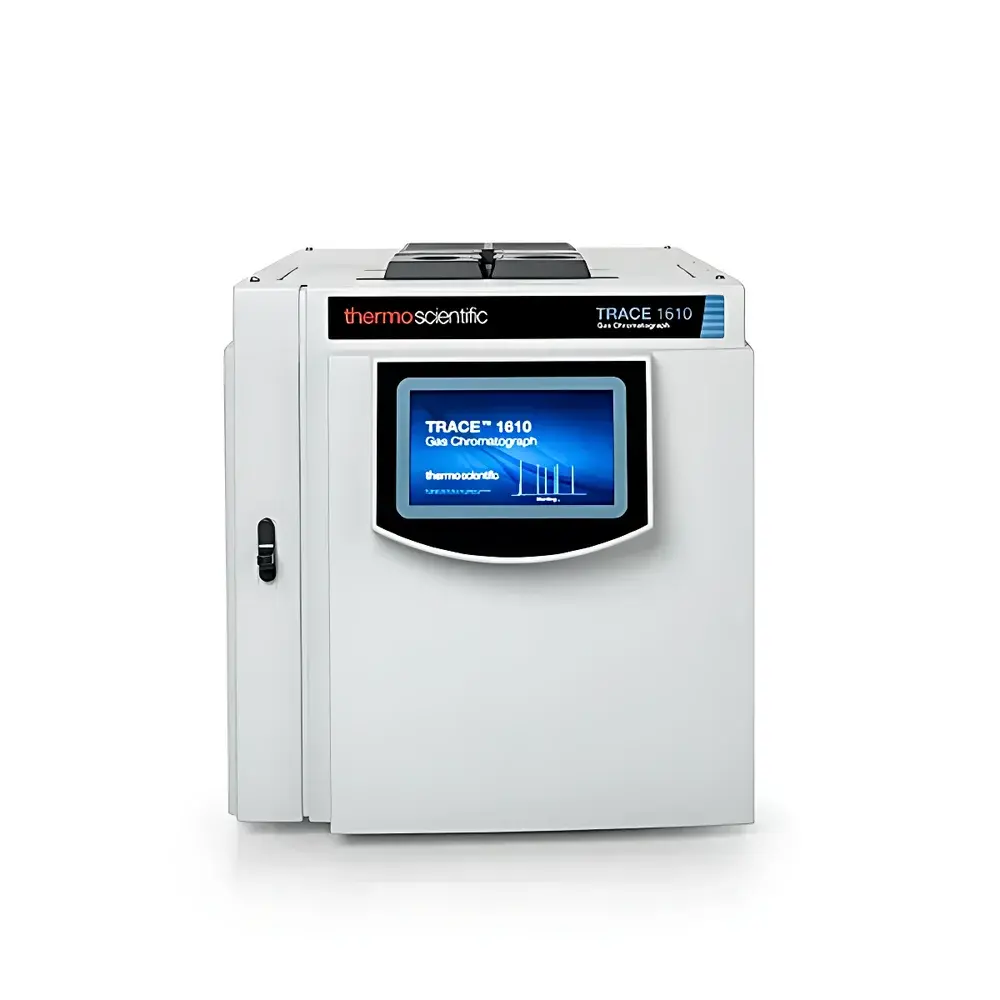
Thermo Fisher Trace 1600 Gas Chromatograph
| Brand | Thermo Fisher |
|---|---|
| Origin | Italy |
| Model | Trace 1600 & 1610 |
| Instrument Type | Laboratory Gas Chromatograph |
| Application Scope | General-Purpose |
| Oven Temperature Range | +3°C to 450°C |
| Maximum Ramp Rate | 125°C/min |
| Cooling Rate | <4 minutes from 450°C to 50°C |
| Module Interchangeability | Yes |
| Helium Conservation Mode | Enabled |
| Power Consumption | Optimized for low operational load |
| Dimensions | Compact benchtop footprint |
| User Interface | 7-inch icon-driven capacitive touchscreen with embedded video-guided maintenance workflows |
| Column Installation | iConnect Column Lock (tool-free), integrated column oven lighting |
Overview
The Thermo Fisher Trace 1600 Gas Chromatograph is a high-performance, modular benchtop GC engineered for precision, reliability, and operational efficiency in regulated and research laboratory environments. Based on proven capillary gas chromatography principles—employing temperature-programmed separation of volatile and semi-volatile compounds in the vapor phase—the Trace 1600 delivers robust analytical performance across diverse sample matrices. Its core architecture centers on modularity: all major functional units—including inlet modules (split/splitless, PTV, cool-on-column), detector modules (FID, TCD, ECD, NPD), and the column oven assembly—are mechanically and electrically standardized for rapid field exchange without system recalibration. This design directly supports ISO/IEC 17025-compliant laboratory practices by minimizing instrument downtime and enabling parallel maintenance activities. The system operates within a precisely controlled thermal envelope, with oven temperature stability ±0.01°C and ramp reproducibility certified per ASTM D3612 Annex A2 protocols.
Key Features
- Modular hardware architecture enabling hot-swap replacement of inlets, detectors, and oven components—reducing mean time to repair (MTTR) by up to 70% compared to monolithic GC platforms.
- iConnect Column Lock mechanism: tool-free column installation with tactile feedback and optical alignment verification, eliminating torque-related column damage and retention time drift.
- Integrated oven illumination and ergonomic column access path—designed to reduce operator fatigue during routine column maintenance and method development.
- Helium conservation mode: dynamically adjusts carrier gas flow profiles during run segments where full flow is unnecessary, reducing helium consumption by up to 40% without compromising resolution or peak symmetry.
- Energy-optimized heating/cooling subsystem: achieves 125°C/min ramp rates while maintaining thermal uniformity across the 24-position column oven; cools from 450°C to 50°C in under 4 minutes via active air modulation and heat-sink-assisted dissipation.
- 7-inch capacitive touchscreen interface with context-sensitive video guides—covering startup sequences, leak checks, detector tuning, and preventive maintenance tasks—supporting GLP-compliant training documentation and audit readiness.
Sample Compatibility & Compliance
The Trace 1600 accommodates standard 0.1–0.53 mm ID fused-silica capillary columns up to 60 m in length and supports all common GC-compatible sample introduction techniques: liquid injection, headspace analysis (with optional TriPlus RSH integration), and thermal desorption. It meets mechanical and electromagnetic compatibility requirements per IEC 61326-1:2013 and carries CE marking for use in EU laboratories. For regulated environments, the system supports 21 CFR Part 11-compliant electronic records when operated with Thermo Fisher Chromeleon CDS v7.3 or later—including audit trail generation, user role-based access control, and digital signature enforcement. Method transfer validation data are available per USP and ISO 17025 clause 5.4.2 upon request.
Software & Data Management
Chromeleon Chromatography Data System (CDS) serves as the native acquisition and reporting platform, offering real-time chromatogram visualization, automated peak integration using ISO 11095-compliant algorithms, and customizable report templates compliant with LIMS export standards (ASTM E1467, HL7). The system logs all hardware events—including module swaps, temperature deviations, and gas pressure fluctuations—with timestamped metadata. All maintenance actions trigger automatic entry into the instrument’s electronic logbook, supporting traceability requirements under GMP Annex 11 and FDA inspection readiness. Remote monitoring and diagnostics are enabled via secure TLS 1.2 encrypted connections to Thermo Fisher Cloud Services.
Applications
The Trace 1600 is routinely deployed in environmental testing (EPA Method 8260D, 8270E), petrochemical analysis (ASTM D3606, D5186), food safety screening (EU Regulation 396/2005 residue testing), pharmaceutical impurity profiling (ICH Q2(R2)), and forensic toxicology (SWGDAM guidelines). Its rapid thermal cycling enables high-throughput screening of volatile organic compounds (VOCs) in air, water, and soil extracts, while its modular inlet flexibility supports derivatization workflows and large-volume injection protocols without hardware reconfiguration.
FAQ
Is the Trace 1600 compatible with third-party columns and consumables?
Yes—standard GC columns, septa, liners, and ferrules meeting ASTM D6299 specifications are fully supported.
Can the Trace 1600 be upgraded to support mass spectrometric detection?
The Trace 1610 variant includes a dedicated MS interface port and vacuum manifold; retrofitting a Trace 1600 requires factory-installed hardware modification and firmware validation.
Does the system provide built-in diagnostics for carrier gas leaks?
Yes—integrated pressure transducers and flow sensors continuously monitor inlet and detector gas lines, triggering configurable alerts and logging events in the diagnostic history.
What regulatory documentation is supplied with the instrument?
Each unit ships with Factory Acceptance Test (FAT) report, Certificate of Conformance, CE Declaration of Conformity, and IQ/OQ protocol templates aligned with ISO/IEC 17025 and GxP expectations.
How is firmware updated, and is version control enforced?
Updates are delivered via signed USB media or secure cloud push; all firmware revisions are cryptographically verified, and rollback capability is retained for 3 prior versions to ensure continuity during audits.






