
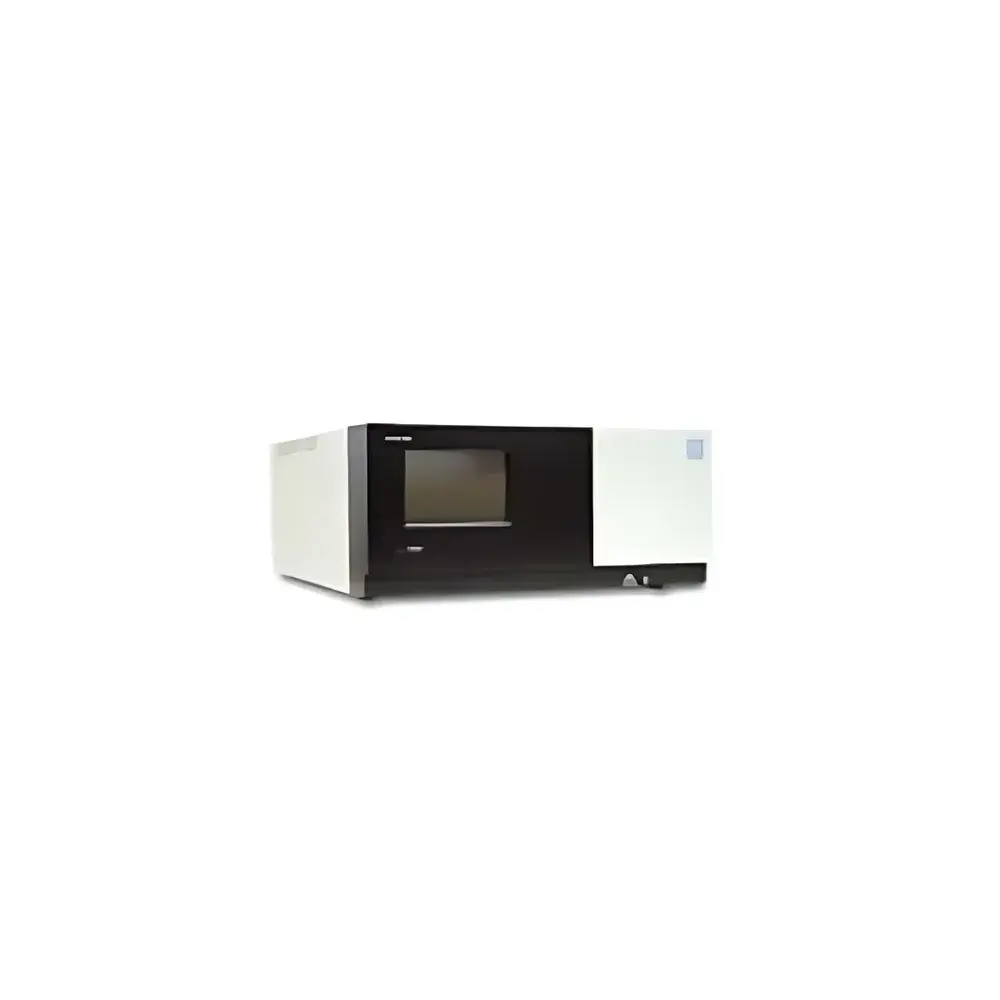
Thermo Fisher Scientific Corona CAD Charged Aerosol Detector
| Brand | Thermo Fisher Scientific |
|---|---|
| Origin | Shanghai, China |
| Manufacturer Type | Authorized Distributor |
| Product Origin | Domestic (China) |
| Model | Thermo Fisher Corona CAD |
| Pricing | Upon Request |
Overview
The Thermo Fisher Scientific Corona CAD Charged Aerosol Detector is a universal, mass-based detection system engineered for high-performance liquid chromatography (HPLC) and ultra-high-performance liquid chromatography (UHPLC) platforms. Unlike optical or ionization-based detectors, the Corona CAD operates on the principle of charged aerosol detection—converting eluting analytes into fine, uniform droplets via nebulization, followed by controlled solvent evaporation to generate non-volatile solute particles. These particles are then charged through collision with positively charged nitrogen gas ions in a corona discharge chamber. The resulting charge is collected and measured as a current proportional to the mass of analyte present. This physical detection mechanism eliminates dependence on chromophores, ionizability, or volatility—making the Corona CAD uniquely suited for compounds that are invisible to UV-Vis detectors and poorly ionized in electrospray ionization (ESI) sources, such as carbohydrates, lipids, polymers, steroids, peptides, and excipients.
Key Features
- True universal detection for non-volatile and semi-volatile compounds, independent of molecular structure or functional group
- Mass-proportional response: signal current correlates directly with analyte mass loading—not molar concentration or extinction coefficient
- Wide dynamic range (>10⁴), enabling quantification across trace to preparative-level concentrations without dilution or re-injection
- High reproducibility (<2% RSD for repeated injections) and robust inter-day precision under GLP-compliant operation
- Integrated anti-gradient flow path for stable baseline and quantitative accuracy during gradient elution
- Optimized for UHPLC compatibility: low dwell volume, rapid response time (<1 s), and pressure-rated up to 1000 bar
- Self-calibrating design with real-time drift compensation and automated purge cycles to minimize carryover
Sample Compatibility & Compliance
The Corona CAD detects all non-volatile and semi-volatile analytes—including small-molecule APIs, biologics intermediates, natural products, surfactants, and synthetic polymers—regardless of UV absorbance or ionization efficiency. It is widely deployed in pharmaceutical QC/QA labs for release testing per ICH Q2(R2) guidelines and supports full audit trail functionality compliant with FDA 21 CFR Part 11 and EU Annex 11 requirements. Instrument validation documentation aligns with ASTM E2656 (Standard Guide for Validation of Chromatographic Methods) and USP Analytical Instrument Qualification. All firmware and method files support electronic signature workflows and secure user access control tiers.
Software & Data Management
Controlled via Thermo Fisher’s Chromeleon CDS (Chromatography Data System) v7.3 or later, the Corona CAD integrates natively with instrument methods, calibration sequences, and report templates. Software features include automated calibration curve generation using internal standard normalization, peak purity assessment via multi-point response factor mapping, and batch processing with customizable pass/fail criteria. Raw data files (.cdf) retain full metadata—including gas flow rates, drying temperature, and corona voltage—for retrospective analysis and regulatory submission. Audit trails record all parameter changes, user logins, and result modifications with timestamped, immutable entries.
Applications
- Quantitative analysis of UV-transparent excipients (e.g., lactose, mannitol, PEGs) in formulation development
- Stability-indicating assays for degradation products lacking chromophores
- Carbohydrate profiling in biologics manufacturing (e.g., glycan mapping of monoclonal antibodies)
- Lipidomics workflows requiring consistent response across phospholipids, triglycerides, and sphingolipids
- Polymers and oligomers characterization where refractive index detection suffers from solvent mismatch artifacts
- Method transfer between labs using different HPLC platforms—enabled by detector response independence from column chemistry or mobile phase composition
FAQ
How does the Corona CAD differ fundamentally from ELSD?
Unlike ELSD—which relies on light scattering intensity dependent on particle size and refractive index—the Corona CAD measures total charge transferred, yielding mass-proportional signals with superior linearity and lower detection limits.
Can the Corona CAD be used with gradient mobile phases?
Yes—when configured with the optional anti-gradient module, it maintains constant solvent composition at the detector inlet, eliminating baseline drift and response variability during organic modifier ramping.
Is the Corona CAD compatible with aqueous normal-phase or HILIC separations?
Yes—its tolerance for high aqueous content and low volatility solvents makes it ideal for HILIC, ion-pairing, and SEC applications where UV detection fails due to strong solvent absorbance.
Does the detector require daily recalibration?
No—its self-referencing design uses internal reference standards and continuous background monitoring to maintain accuracy without manual recalibration between runs.
What maintenance intervals are recommended for routine operation?
Nebulizer capillary cleaning every 50–100 injections; corona needle inspection every 2 weeks; annual preventive maintenance including gas filter replacement and voltage calibration verification.





