
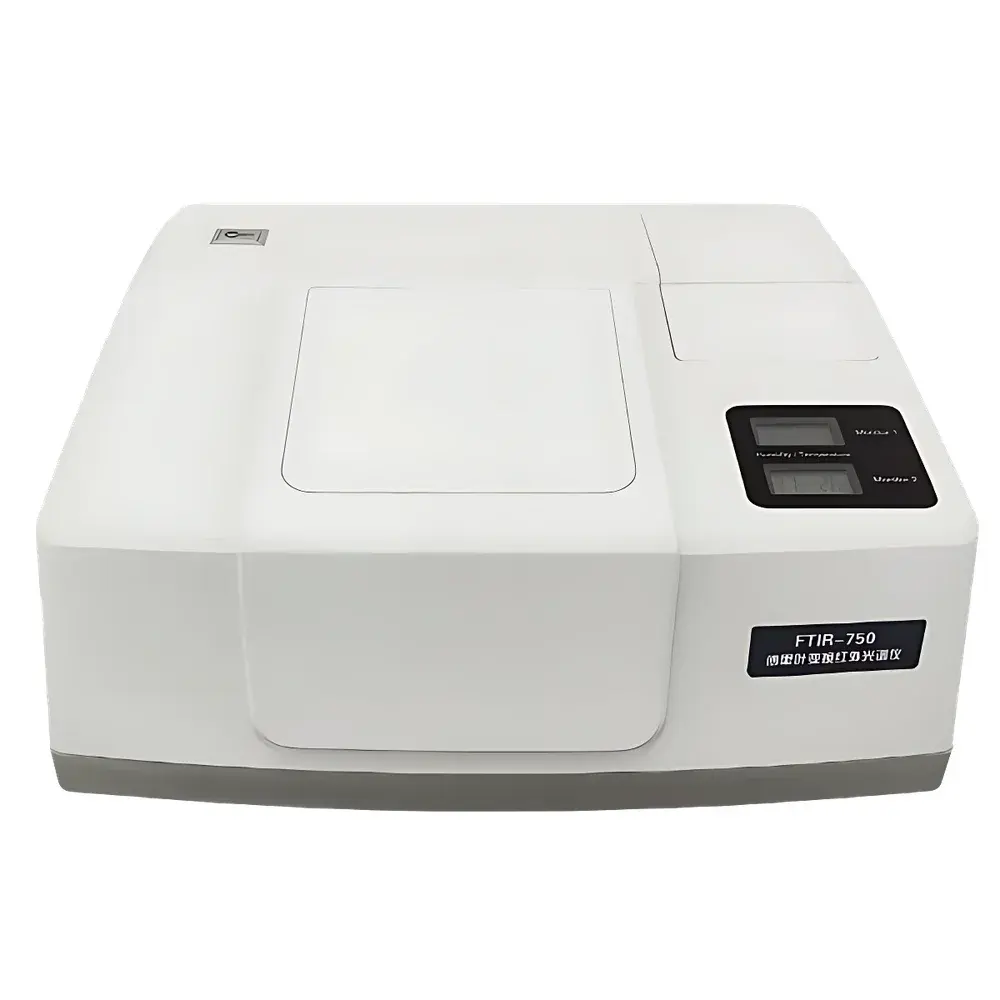
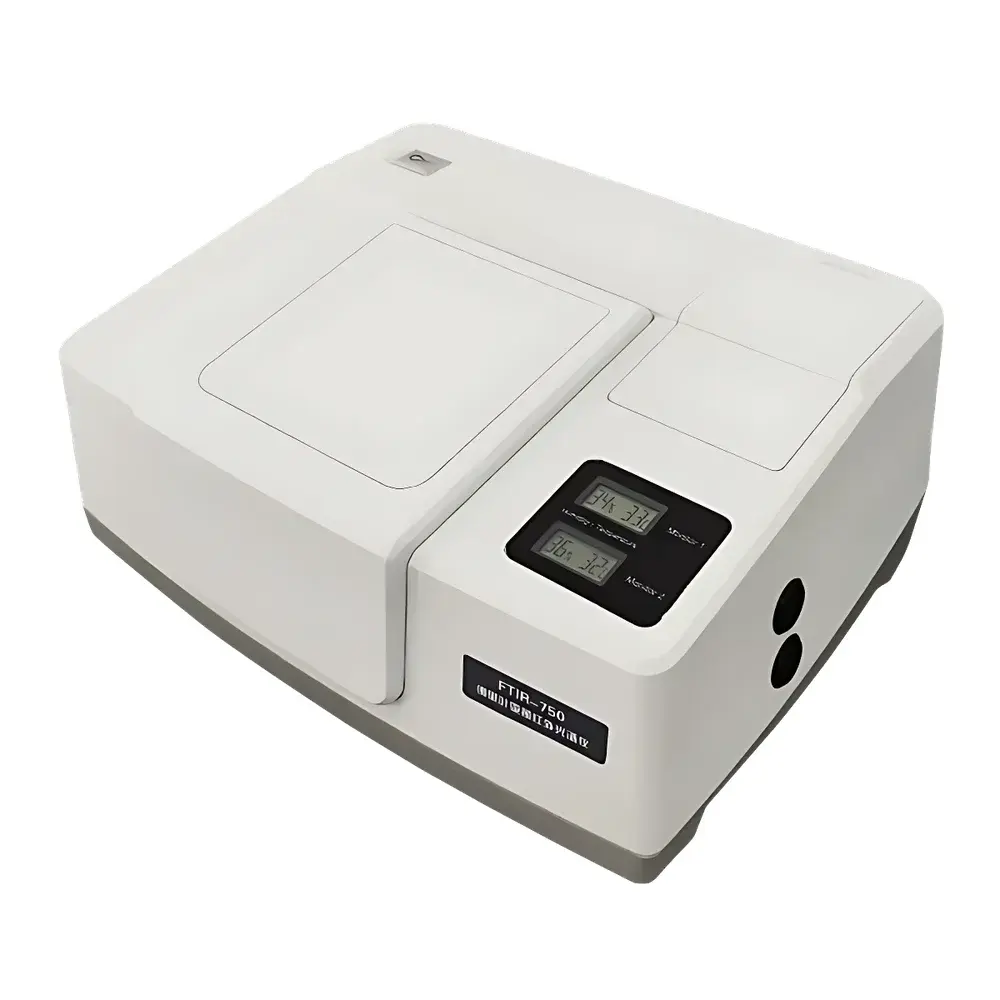
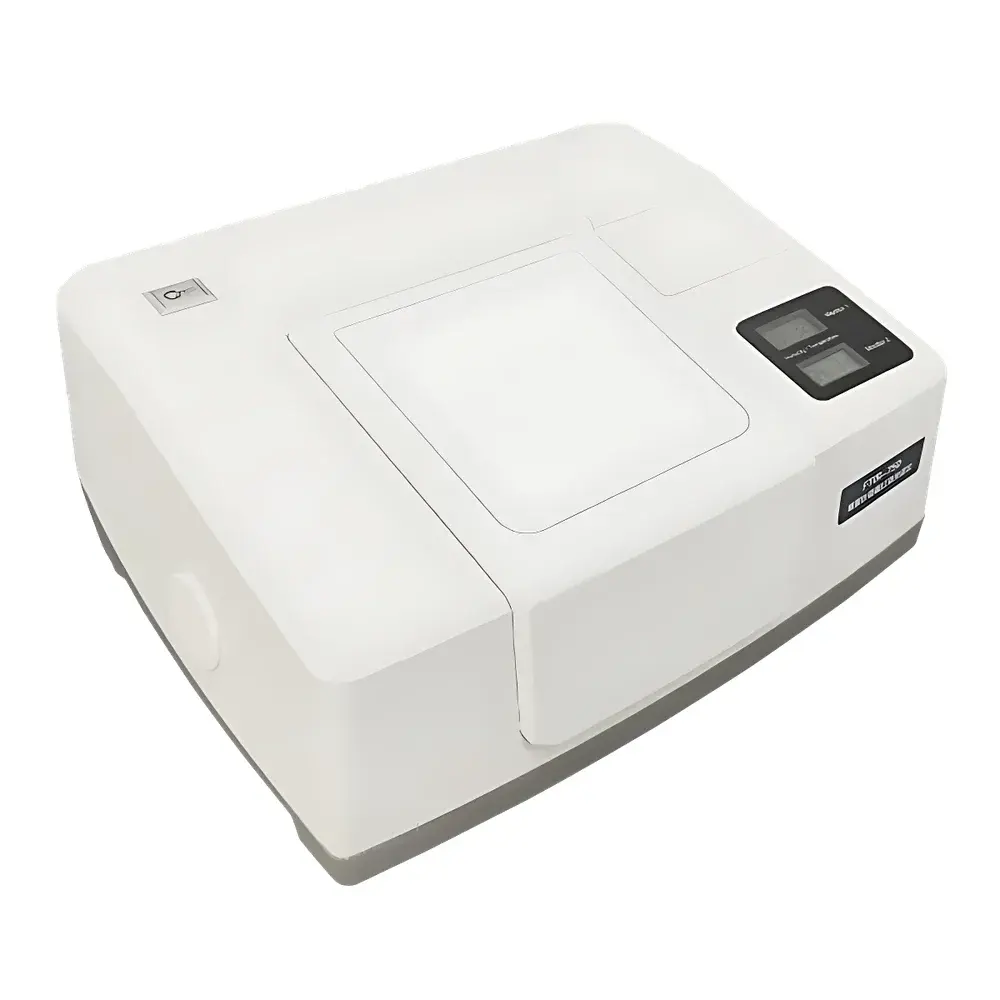
Gangdong FTIR-750 Fourier Transform Infrared Spectrometer
| Brand | Gangdong |
|---|---|
| Origin | Tianjin, China |
| Manufacturer Type | Original Equipment Manufacturer (OEM) |
| Instrument Type | Laboratory Benchtop FTIR Spectrometer |
| Instrument Architecture | Michelson Interferometer with Corner-Cube Retroreflectors |
| Optical Design | Double-Pass, Compensated Beam Path |
| Detector | High-Sensitivity DTGS with Optional MCT Upgrade |
| Spectral Range | 4000–400 cm⁻¹ (standard), extendable to 7800–350 cm⁻¹ |
| Resolution | ≤0.5 cm⁻¹ (user-selectable down to 0.25 cm⁻¹) |
| Signal-to-Noise Ratio | ≥30,000:1 (at 4 cm⁻¹, 1 min scan, peak-to-peak) |
| Scan Speed | Up to 10 kHz mirror velocity |
| Data Acquisition | 24-bit ADC, 125 kHz sampling rate |
| Compliance | ASTM E1421, ISO 17025 (when operated in accredited labs), USP <1119>, GLP-compliant data integrity architecture |
Overview
The Gangdong FTIR-750 Fourier Transform Infrared Spectrometer is a laboratory-grade, benchtop interferometric spectrometer engineered for high-fidelity molecular fingerprinting across research, quality control, and regulatory compliance environments. Based on the Michelson interferometer principle with corner-cube retroreflector optics, the FTIR-750 acquires full mid-infrared spectra (4000–400 cm⁻¹) by measuring the interference pattern of broadband infrared radiation after interaction with a sample—then applying Fast Fourier Transform (FFT) algorithms to reconstruct intensity-vs-wavenumber spectra. Its double-pass, optically compensated beam path minimizes alignment drift and thermal-induced phase errors, ensuring long-term spectral fidelity without routine realignment. Designed for continuous operation in ISO Class 7–8 laboratory spaces, the instrument integrates real-time environmental monitoring at the subsystem level—not merely ambient room conditions—to sustain optical stability and detector linearity under variable humidity and temperature loads.
Key Features
- Real-time dual-parameter environmental control: Independent digital monitoring of temperature (≤50 °C) and relative humidity (≤50% RH) within sealed optical and electronic compartments—ensuring stable source output, detector responsivity, and interferometer alignment.
- Optimized corner-cube interferometer module: Enhanced mechanical rigidity and low-thermal-expansion materials reduce mirror wobble and path-length drift; delivers >65% higher signal-to-noise ratio (SNR) vs. predecessor FTIR-650 under identical acquisition conditions (4 cm⁻¹, 1-min scan).
- High-resolution dynamic scanning: DSP-driven PID-controlled linear motor actuates the moving mirror via low-damping precision rail—enabling user-selectable resolution down to 0.25 cm⁻¹ with sub-millisecond positional repeatability.
- Multi-layer moisture mitigation architecture: Integrated large-capacity desiccant cartridge (≥12 months service interval under typical lab conditions); hermetically sealed interferometer chamber with dual-stage humidity barrier; gold-coated optical surfaces and passivated detector housing resist hydrolytic degradation and acidic gas corrosion.
- Ruggedized modular design: Optomechanical components isolated from power supply and control electronics via dedicated thermal zones; front-panel accessible purge port compatible with dry air or nitrogen (flow rate: 5–10 L/min).
Sample Compatibility & Compliance
The FTIR-750 supports standard transmission (KBr pellets, thin films), ATR (diamond, ZnSe, Ge crystals), and reflectance (specular, diffuse) sampling modalities. It is routinely deployed in laboratories operating under ISO/IEC 17025:2017 accreditation requirements, supporting method validation per USP for pharmaceutical excipient identification and impurity profiling. When configured with audit-trail-enabled software and electronic signature modules, the system meets FDA 21 CFR Part 11 data integrity criteria for regulated QC environments. All firmware and calibration routines are traceable to NIST-traceable reference standards (e.g., polystyrene film for wavenumber accuracy, water vapor lines for resolution verification).
Software & Data Management
Operates with Gangdong’s proprietary IRSoft v5.x platform—validated for Windows 10/11 (64-bit), supporting automated baseline correction, spectral subtraction, peak integration, library search (Sadtler, Hummel, and custom libraries), and multivariate analysis (PCA, PLS). Raw interferogram and spectrum files are stored in standardized JCAMP-DX format (.0, .dx) with embedded metadata (instrument ID, operator, date/time, acquisition parameters, calibration status). Software enforces role-based access control, electronic logbook entries, and immutable audit trails—including all processing steps, parameter changes, and report generation events—aligned with ALCOA+ principles (Attributable, Legible, Contemporaneous, Original, Accurate, Complete, Consistent, Enduring, Available).
Applications
- Pharmaceutical: Polymorph screening, counterfeit drug detection, raw material identity testing (per ICH Q5, Q6A), and cleaning validation residue analysis.
- Materials Science: Polymer degradation kinetics, filler dispersion homogeneity, coating thickness estimation via interference fringe analysis.
- Environmental & Forensics: Microplastic identification in water/sediment samples, paint chip layer analysis, explosive residue characterization.
- Electronics: Contamination mapping on PCB surfaces, outgassing product identification in vacuum chambers, solder flux residue composition.
- Academic Research: Reaction monitoring (time-resolved FTIR), hydrogen-bonding dynamics in biomolecules, catalyst surface adsorption studies.
FAQ
What spectral resolution options are available on the FTIR-750?
Standard resolution is 0.5 cm⁻¹; users may select 0.25 cm⁻¹, 1.0 cm⁻¹, or 4.0 cm⁻¹ depending on signal-to-noise and acquisition time requirements.
Is the instrument compatible with external gas purging systems?
Yes—equipped with a threaded 6-mm BSP purge port and integrated flow sensor; supports dry air or nitrogen purge at 5–10 L/min to minimize atmospheric CO₂ and H₂O absorption bands.
Does the FTIR-750 support GLP-compliant data handling?
When operated with IRSoft v5.x in validated configuration (including electronic signatures, audit trail, and secure user authentication), it fulfills core GLP data integrity requirements per OECD Principles of GLP.
Can the detector be upgraded in-field?
Yes—the DTGS detector module is mechanically and electrically interchangeable with optional liquid-nitrogen-cooled MCT detectors for enhanced sensitivity in low-light applications.
What maintenance intervals are recommended for routine operation?
Desiccant replacement every 12 months (or sooner in high-humidity environments); optical alignment verification annually; source lamp replacement every 10,000 hours (typical lifespan).






